


JEDDAH: More than 1,000 prehistoric stone structures have been revealed as part of an archaeological discovery in northwestern Saudi Arabia.
The structures are believed to be among the earliest stone monuments constructed by humans in the world.
Based on findings published by Cambridge University Press on April 30, experts revealed that the neolithic rectilinear structures could date back more than 7,000 years.
A team of archaeologists from the University of Western Australia led by Dr. Hugh Thomas has conducted aerial archaeology surveys and targeted excavations across the northwestern region of Saudi Arabia, predominantly focusing on the AlUla and Khaybar provinces.
Research was completed as part of a program by the Royal Commission of AlUla’s (RCU) Aerial Archeology in the Kingdom of Saudi Arabia AlUla project (AAKSAU).
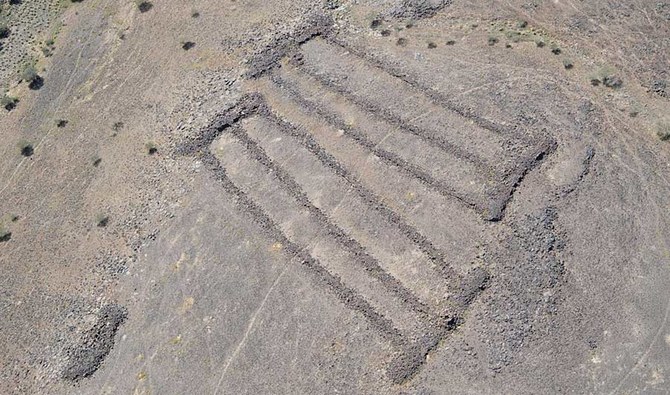
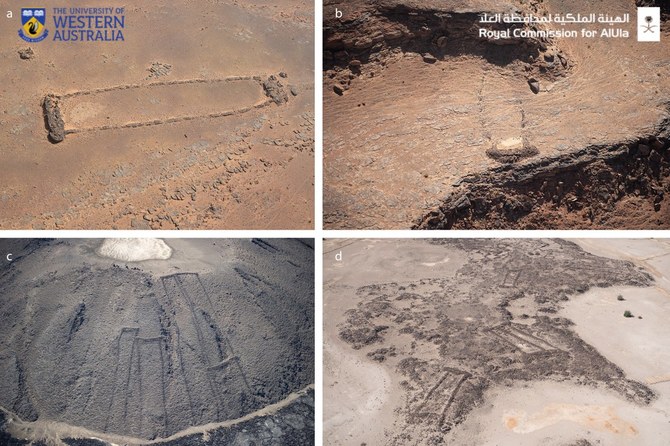
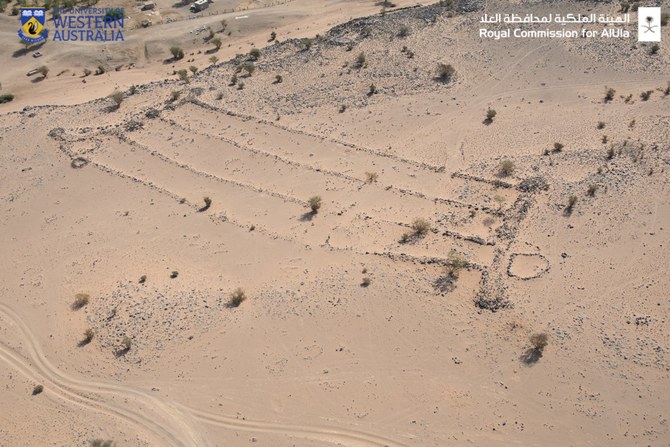
The structures, named mustatils — the plural form of the Arabic term for rectangles — consist of two thick-walled ends, connected by two or more long walls to create a series of giant rectangle courtyards, ranging in length from 20 meters to more than half a kilometer.
The base of the mustatils feature circular or semi-circular cells constructed outside the main entrances.
Findings revealed that about 1,000 of these mustatils cover an area of 200,000 square kilometers and appear to share similarities, suggesting that they all originate from the same time period. The largest of the structures is located near the Khaybar lava field and measures 525 meters in length.
A number of aerial surveys have also been conducted, while structures first discovered in the 1970s have been studied.
FASTFACT
The structures, named mustatils — the plural form of the Arabic term for rectangles — consist of two thick-walled ends, connected by two or more long walls to create a series of giant rectangle courtyards, ranging in length from 20 meters to more than half a kilometer. The base of the mustatils feature circular or semi-circular cells constructed outside the main entrances.
Several mysterious “gates” that were analyzed are believed to have functioned as elements of procession for ritual sacrifices, as remains of animals including cattle, sheep and gazelle were recovered. No human remains or domestic occupation were discovered in the excavation process, but further digging will take place.
The new findings differ from similar rock structures in the area known as “kites,” which are constructions resembling polygons, funnels and triangles that date back to about the same time as the mustatils. Researchers believe they were used as traps for herding animals, while other theorists say they could have been used as burial grounds or tombs.
In 2018, the RCU commissioned the AAKSAU, a broad ranging archaeological study of AlUla province, as part of the Indentation and Documentation of the Immovable Heritage Assets of AlUla program. Another program focused on Harrat Khaybar was also established in 2019 by the RCU.
3/ Mustatil are complex monumental structures consisting of two thick ends (base and head) connected by 2 or more long walls to create a series of courtyards, that look like big rectangles (mustatil, in Arabic) from the air. Mustatils range in length from 20m to over 600m. pic.twitter.com/wKL1S11AB4
— AAKSA (@aaksa_project) April 30, 2021


