

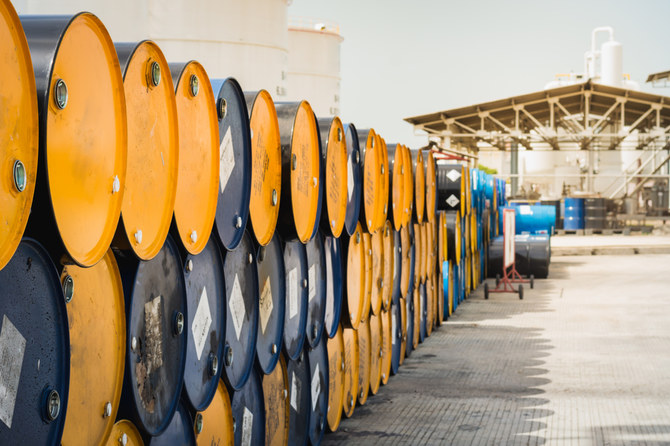

LONDON: Oil prices hovered above $90 a barrel on Friday, on track to end the week higher as investors chose to focus on tighter supply, despite broader macroeconomic uncertainty.
Both oil benchmarks hit 10-month highs earlier this week after Saudi Arabia and Russia extended their voluntary supply cuts of a combined 1.3 million barrels per day to the end of the year.
However, both benchmarks ended Thursday slightly lower amid volatile trade on multiple signals warning of weaker demand in the coming months.
Traders who took some profit on Thursday were back as they believe that the path of least resistance is certainly skewed to the upside, and oil prices are well on track to close another week in positive territory, said Naeem Aslam of Zaye Capital Markets.
BACKGROUND
Brent crude futures were up 53 cents to $90.45 a barrel by 16:08 Saudi time, while US West Texas Intermediate crude futures were up 39 cents at $87.26 a barrel.
Brent crude futures were up 53 cents to $90.45 a barrel by 16:08 Saudi time, while US West Texas Intermediate crude futures were up 39 cents at $87.26 a barrel.
Both benchmarks closed up about 2 percent last week — at $88.49 a barrel for Brent and $85.02 a barrel for WTI — in anticipation of the cut announcements.
On the demand side, a key concern is China, the world’s largest oil importer. The country has frustrated markets due to its sluggish post-pandemic recovery, while stimulus pledges have fallen short of expectations.
Data on Thursday showed overall Chinese exports and imports fell in August, as sagging overseas demand and weak consumer spending squeezed businesses.
However, even in times of lacklustre economic activity, China tends to bolster its storage capacity, particularly with the availability of cheap Russian crude. Last month, Chinese crude imports rose nearly 31 percent.
Demand for crude could also benefit from workers going on strike at projects in Australia which produce about 5 percent of the world’s supply of liquefied natural gas.
Meanwhile, questions remain about whether central banks in the US and Europe will continue their aggressive interest rate hike campaigns to tame persistent inflation.
On the global stocks markets, prices were subdued on Friday after prolonged pressure, with investors watching the contrasting fortunes of the dollar and yuan, and mulling central bank meetings and US data on the horizon.
US stock index futures were little changed.
The tech sector was in focus after about $200 billion was wiped from Apple’s market capitalization in two days on reports of China curbing iPhone use by state employees and on Friday protectionism fears were weighing on shares of suppliers.
Apple shares were flat in pre-market trading on Friday.
The dollar was set to clock up its best winning streak since 2014, bolstered by a resilient run of US economic data.
In contrast, the yuan fell to its weakest level since 2007 on worries about China’s slowing economy.
Investors were focused in upcoming central bank meetings this month and next batch of US data.
“Everything is geared toward the next couple of weeks, with European Central Bank, Federal Reserve and Bank of England meeting. I think they will all sit on their hands,” said Mike Hewson, chief market strategist at CMC Markets.
Robust economic data in the US this week have left some investors worried that even if the Fed leaves rates unchanged this month, they could remain high for longer than anticipated.
The US Consumer Price Index reading for August is due on Sept. 13 ahead of the Fed’s next meeting in the following week.
Stocks sought to stabilize after a week of easing, with the MSCI All Country stock index slightly weaker at 676.83 points, and down about 1.5 percent for the week so far, though still up nearly 12 percent for the year.
In Europe, the STOXX index of 600 companies eased 0.3 percent and heading for a loss of about 1 percent for the week, and on course for its longest run of losses since November 2016.
Patrick Spencer, vice chair of equities at Baird, said investors were trying to guess at what pace the Fed could begin cutting interest rates next year.
“Maybe you are going to see slightly higher for longer rates and they may not come down as quickly next year, and that in itself will slow consumption and consumer confidence,” Spencer said, adding that a US government shutdown is also a worry.


