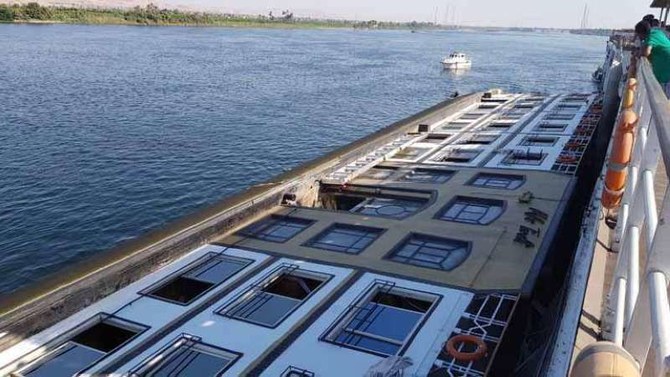
Egypt authorities reveal details on floating hotel in Luxor that sank

river rescue personnel succeeded in retrieving the bodies of the two workers who were killed (Social Media)
Short Url
Updated 30 August 2023
Follow

Egypt authorities reveal details on floating hotel in Luxor that sank

  • Tivoli Nile cruise ship had been out of operation since 2010
  • Floating hotel was moored between two other tourist boats, it tilted on one side without completely sinking

Cairo: Egyptian authorities revealed the details surrounding an accident on Tuesday in which a floating tourist hotel in the Nile in Luxor Governorate, south of the country, sank, resulting in the deaths of two people.

Egypt’s Ministry of Tourism and Antiquities said that the Tivoli Nile cruise ship had been out of operation since 2010 and that its tourism license had not been renewed since.

The floating hotel had undergone development and renovation work so that it could operate during the next winter season, provided that it passed inspections from the Ministry of Tourism and Antiquities and renewed its license.

No inspections had been conducted to restart operations, however, and no tourism operating license had been obtained from the ministry.

Egypt’s Ministry of Transport said that the owner of the floating hotel had submitted a request to the River Transport Authority to repair the ship. He was allowed to raise the unit on dry land in one of the specialized workshops approved of by the River Transport Authority.

The authority said that, after inspecting the Tivoli Nile ship, it granted the hotel a temporary permit to leave the repair shop to its own berth on Aug. 23 until it obtained the rest of the necessary licenses from the other relevant authorities.

The River Transport Authority stated that when the floating hotel was moored between two other tourist boats, it tilted on one side, which led to it settling on the bottom of the mooring without completely sinking.

The authority added that it is awaiting the public prosecution’s decision to determine the cause of the accident, which resulted in the deaths of two people, one of whom was 21 years old.

Luxor Governorate confirmed that the floating hotel had only workers and navigation crew on board.

It added that the river rescue personnel succeeded in retrieving the bodies of the two workers who were killed.


Iraq executes a former senior officer under Saddam for the 1980 killing of a Shiite cleric

Updated 56 min 33 sec ago
Follow

Iraq executes a former senior officer under Saddam for the 1980 killing of a Shiite cleric

  • Al-Sadr was a leading critic of Saddam’s secular Baathist government whose dissent intensified after the 1979 Islamic Revolution in Iran
  • The cleric’s execution in 1980 became a symbol of oppression under Saddam

BAGHDAD: Iraq announced on Monday that a high-level security officer during the rule of Saddam Hussein has been hanged for his involvement in the 1980 killing of a prominent Shiite cleric.
The National Security Service said that Saadoun Sabri Al-Qaisi, who held the rank of major general under Saddam and was arrested last year, was convicted of “grave crimes against humanity,” including the killing of prominent Iraqi Shiite cleric Mohammed Baqir Al-Sadr, members of the Al-Hakim family, and other civilians.
The agency did not say when Al-Qaisi was executed.
Al-Sadr was a leading critic of Iraq’s secular Baathist government and Saddam, his opposition intensifying following the 1979 Islamic Revolution in Iran, which heightened Saddam’s fears of a Shiite-led uprising in Iraq.
In 1980, as the government moved against Shiite activists, Al-Sadr and his sister Bint Al-Huda — a religious scholar and activist who spoke out against government oppression — were arrested. Reports indicate they were tortured before being executed by hanging on April 8, 1980.
The execution sparked widespread outrage at the time and remains a symbol of repression under Saddam’s rule. Saddam was from Iraq’s Sunni minority.
Since the 2003 US-led invasion of Iraq, authorities have pursued former officials accused of crimes against humanity and abuses against political and religious opponents. Iraq has faced criticism from human rights groups over its application of the death penalty.