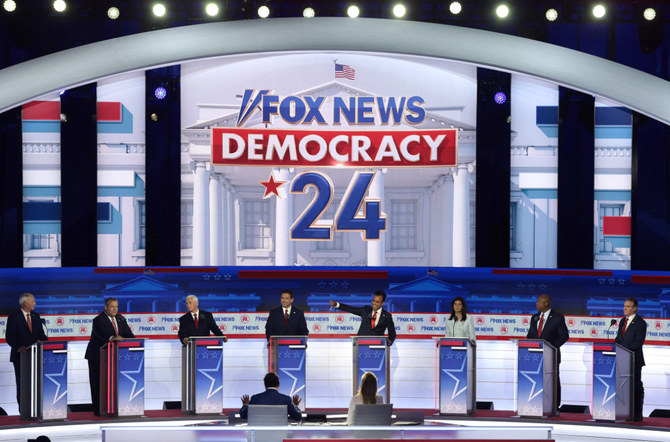
NEW YORK: Even without lead contender Donald Trump, an estimated 12.8 million people watched the first Republican presidential primary debate on two Fox News television channels and its streaming service.
There seemed little evidence that Trump’s attempt to counterprogram the debate, by appearing in an online interview with Tucker Carlson at about the same time on Wednesday, appreciably affected the number of people who were interested in checking out the eight alternatives.
The viewership was a little more than half the 24 million people who watched Trump appear in his first presidential debate in August 2015, the Nielsen company said. But it outpaced a January 2016 GOP candidates debate on Fox that Trump also skipped and was seen by 12.5 million people
Television is a vastly different world than it was eight years ago, with streaming more established and thousands of cable customers cutting the cord. The most-watched program seen live last week on either broadcast or cable TV was a “60 Minutes” rerun on CBS that reached 5.3 million viewers.
While ex-Fox host Carlson boasted Wednesday that his streamed interview would get a “far larger” audience than the televised debate — and Trump claiming that the interview exceeded the Super Bowl in audience — there’s no reliable way of checking that.
X, the social media company formerly known as Twitter, said late Thursday afternoon that the tweet of Carlson’s interview show had 236.7 million views. But that’s a count of how many times someone scrolled by Carlson’s interview with Trump in their feeds — even if they didn’t open up the post to see what was said.
If you happened to scroll by the post a dozen different times, that counts as a dozen views.
Public interaction numbers were smaller: There were some 55,000 comments attached to the interview, with about 200,000 people saying they liked it.
The television viewership figure is an estimate of how many people were watching the debate at any given minute. The debate was simulcast on Fox News Channel and the Fox Business Network.
Moderated by Bret Baier and Martha MacCallum, the two-hour debate barely mentioned Trump until it was halfway through. Then Baier said he wanted to take a brief moment to talk about “the elephant not in the room” — Trump and his four criminal indictments.
The reluctance to talk about the topic was evident, but the 10 minutes when it was discussed included some of the debate’s more electric moments.


![]()

Fox News reaches 12.8 million viewers for GOP primary debate, despite Donald Trump’s absence
Short Url
https://arab.news/bxhqu
Fox News reaches 12.8 million viewers for GOP primary debate, despite Donald Trump’s absence
- The number outpaced a January 2016 GOP candidates debate on Fox that Trump also skipped and was seen by 12.5 million people
- The television viewership figure is an estimate of how many people were watching the debate at any given minute


Latest updates






© 2026 SAUDI RESEARCH & PUBLISHING COMPANY, All Rights Reserved And subject to Terms of Use Agreement.