DUBAI: “I’ve made history being on top of my game for the past decade, but I still thrive for more.” That was what Mutaz Essa Barshim told World Athletics before the Doha Diamond League opener in May, and there is no doubt that the Qatari athlete has already sealed his place among the pantheon of high jumpers.
A chase for an unprecedented fourth successive world title ended in disappointment on Tuesday in Budapest however, as he had to settle for a bronze medal in what was an uncharacteristically poor performance.
Although perhaps the warning signs were there when he failed with his first effort at 2.25 meters, a height he normally clears with ease, immediately giving the momentum to his competitors. He did clear 2.29m on his first attempt alongside Gianmarco Tamberi and JuVaughn Harrison and it looked as though it would be a three-way battle for the gold.
All three sailed over 2.33m, and with a thrilling finale looking certain, all he had to do was hope for mistakes by his rivals to claim another gold.
Unfortunately for Barshim, it was not to be. He failed at his first two attempts when the bar was raised to 2.36m while Tamberi cleared with his first, and Harrison with his second. His third attempt was lacklustre and his glory laden six-year reign at major outdoor championships came to an end as Tamberi, his great friend and rival, secured his first world title.
A record-extending fourth world crown proved to be one step too far, yet there is no doubting that the 32-year-old has been a beacon of hope for not only Qatari athletes, but also the entire Gulf region, for what he has achieved in the sport. It has not come easily however, with Barshim facing plenty of challenges along an arduous road to success.
Two Olympic silvers in 2012 and 2016 (the former being upgraded from an initial bronze) were sandwiched between a runner-up finish at the 2013 worlds, and this suggested he was making inroads toward becoming one of the best there had ever been in the event.
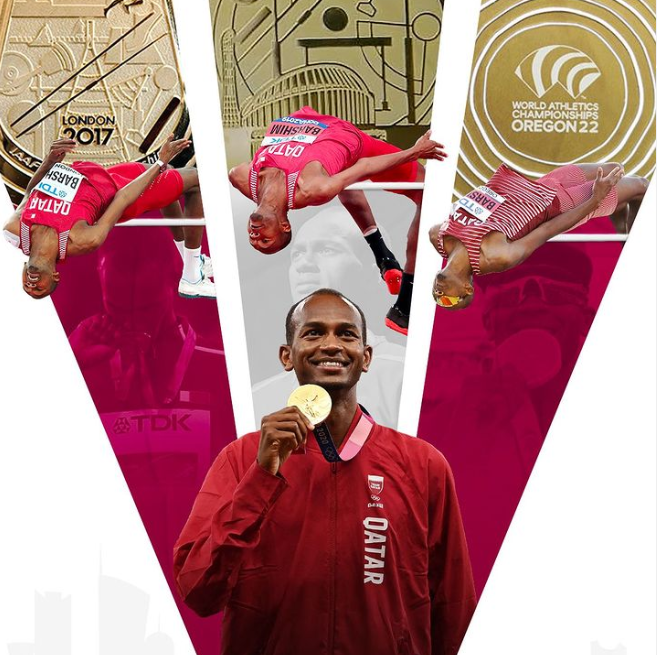
Indeed, when the 2017 World Athletics Championships rolled around, Barshim was ready to conquer all in front of him. In the same stadium in which he secured his first Olympic medal five years prior, he cleared every height perfectly and won his maiden world title, although he ended his competition by missing three attempts at 2.40m. It did not matter though as Barshim had already secured the win.
With a world title under his belt, and after five consecutive years of clearing 2.40m, his next goal was to break Javier Sotomayor’s world record of 2.45m.
A potentially history-making moment soon turned into a nightmare as he suffered a serious ankle injury which ruled him out of the remainder of the 2018 season and with Doha playing host to the subsequent World Championships, Barshim faced a race to be fit.
On the injury, he told the “Mind Set Win” podcast: “I found one doctor. He had been operating on sports injuries for 30 or 40 years, and he told me, ‘this is the worst I have ever seen.’ He said any chance of coming back was maybe 1 percent, it’s impossible.”
The Doha-born star looked down the barrel at the prospect of missing not only the worlds in his home country, but also having to end his career prematurely when it looked as though he was about to explode into the stratosphere.
Such adversity may have destroyed a weaker man, but Barshim is no mere mortal. With records to chase and an elusive Olympic gold medal to win, the high jumper stormed to the top of the podium in front of a packed crowd at the Khalifa International Stadium in Doha. He cleared a height of 2.37m to become the first jumper to win successive world titles, with his ascent to a local deity nearly complete.
It would be a two-year wait for the Olympics due to the coronavirus pandemic disrupting various sporting events but, when it finally arrived, Barshim created more history and, for once, it was not down to his jumping ability.
The Olympic Games and Qatar have not exactly had a winning relationship. Indeed, the country has only secured eight medals since it began competing at the Games in 1984.
Under the lights in Tokyo on Aug. 1, 2021, with a pulsating crowd behind him, Barshim had the chance to make his own history but also history for his nation. Deep into the competition, Barshim and Tamberi were neck and neck. The duo had cleared each height on the first attempt and when the bar was raised to 2.39m, both could smell glory.
What happened next though was a mark of true sportsmanship rarely seen at the highest level.
The pair both failed with their three attempts at the height and, if going by the rules, a jump off would be needed to declare a winner. “Can we have two golds?” Barshim nonchalantly asked the official, and when he said it was possible, all hell broke loose.
The Italian burst into 1,000 emotions all at once, seeing a dream come true due to the remarkable act of sportsmanship from the Qatari athlete.
It was a mark of the man after all the examples of his quality as a sportsman.
Medals and records are what world-class athletes train for every day in life, sacrificing everything for that one opportunity to make themselves a hero. Barshim has enjoyed such moments more than most, yet sharing gold in Tokyo will perhaps be what he is best remembered for.
As for this? Perhaps not so much. Finishing third in Budapest and missing out on a fourth consecutive world crown ended his dominance of the sport, but he has certainly made his mark and his achievements will surely inspire thousands of young athletes in his home country and throughout the region and remind them they can conquer the world.
But is this the end? We know better when it comes to Barshim. Sotomayer’s world record of 2.45m potentially remains in his sights.


Could medal-winning Qatari high jumper raise bar again to take 4th world title?
https://arab.news/2n258
Could medal-winning Qatari high jumper raise bar again to take 4th world title?

- There is no doubt that the Qatari athlete has already sealed his place among the pantheon of high jumpers


History-chasing Djokovic and Alcaraz to meet in Australian Open final after epic semifinal wins
- Carlos Alcaraz striving to become the youngest man ever to complete a career Grand Slam
- Novak Djokovic is aiming to be the oldest man in the Open era to win a Grand Slam title
MELBOURNE: Novak Djokovic finally beat one of the two men who have been blocking his path to an unprecedented 25th Grand Slam singles title when he edged Jannik Sinner in five sets Friday to reach the Australian Open final.
To get that coveted No. 25, he’ll next have to beat the other: top-ranked Carlos Alcaraz.
They’re both chasing history in Sunday’s championship decider, with the 22-year-old Alcaraz striving to become the youngest man ever to complete a career Grand Slam.
The top-ranked Alcaraz also had to come through a grueling five-setter. He fended off No. 3 Alexander Zverev 6-4, 7-6 (5), 6-7 (3), 6-7 (4), 7-5 in a match that started in the warmth of the afternoon Friday and, 5 hours and 27 minutes later, became the longest semifinal ever at the Australian Open.
That pushed the start of Djokovic’s match against Sinner back a couple of hours, and the 38-year-old Djokovic finally finished off a 3-6, 6-3, 4-6, 6-4, 6-4 win just after 1:30 a.m.
“It feels surreal,” Djokovic said of his 4-hour, 9-minute triumph. “Honestly, it feels like winning already tonight. I know I have to come back … and fight the No. 1 of the world. I just hope that I’ll have enough gas to stay toe-to-toe with him.
“That’s my desire. Let the God decide the winner.”
Djokovic was at the peak of his defensive powers, fending off 16 of the 18 breakpoints he faced against the two-time defending Australian Open champion. It ended a run of five losses to Sinner, and a run of four semifinal exits for Djokovic at the majors.
“Had many chances, couldn’t use them, and that’s the outcome,” Sinner said. “Yeah, it hurts, for sure.”
Alcaraz and Sinner have split the last eight major titles between them since Djokovic won his last title at the 2023 US Open.
Nobody knows how to win more at Melbourne Park than Djokovic. He has won all 10 times he’s contested the Australian Open final.
He said he saw Alcaraz after the first of the semifinals was over and he congratulated him on reaching his first final at Melbourne Park.
“He said sorry to delay,” Djokovic later explained. “I told him ‘I’m an old man, I need to go earlier to sleep!”
Djokovic, aiming to be the oldest man in the Open era to win a Grand Slam title, was kept up late.
“I’m looking forward to meeting him on Sunday,” he said.
Final 4
With the top four seeds reaching the Australian Open men’s semifinals for just the fifth time, Day 13 was destined to produce some drama. The season-opening major had been a relatively slow burn, until the back-to-back five-setters lasting a combined 9 hours and 36 minutes.
Alcaraz and Zverev, the 2025 runner-up, surpassed the 2009 classic between Rafael Nadal and Fernando Verdasco as the longest ever Australian Open semifinal.
Medical timeout
Alcaraz was as close as two points from victory in the third set but was hampered by pain in his upper right leg and his medical timeout became contentious.
He said initially it didn’t feel like cramping because the pain seemed to be just in one muscle, the right adductor, and he needed an assessment.
He navigated the third and fourth sets and was behind in the fifth after dropping serve in the first game. He kept up the pressure but didn’t break back until Zverev was serving for the match. He then won the last four games.
“I think physically we just pushed each other to the limit today. We pushed our bodies to the limit,” Alcaraz said. “Just really, really happy to get the win, that I came back. I just rank this one in the top position of one of the best matches that I have ever won.”
Believe
Asked how he was able to recover despite being so close to defeat, Alcaraz admitted he was struggling but said kept “believing, believing, all the time.”
“I’ve been in these situations, I’ve been in these kinds of matches before, so I knew what I had to do,” he said. “I had to put my heart into the match. I think I did it. I fought until the last ball.”
Zverev was demonstrably upset about the time out out in the third set, taking it up with a tournament supervisor, when his rival was given the three-minute break for treatment and a massage on the leg.
After the match, he maintained that he didn’t think it was right, but he didn’t think it should overshadow the match.
“I don’t want to talk about this right now, because I think this is one of the best battles there ever was in Australia,” he said “It doesn’t deserve to be the topic now.”


