

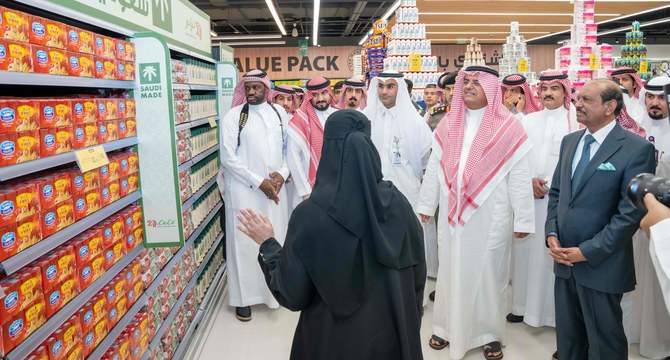
New LuLu store underscores group’s continued investment in KSA

1 / 3
2 / 3
3 / 3
Short Url
Updated 23 August 2023
Follow

New LuLu store underscores group’s continued investment in KSA

  • The Saudi leadership is building a strong economic environment in the Kingdom for investors and citizens to thrive and prosper. — Yusuff Ali M.A., Chairman and Managing Director of Lulu Group International

LuLu Hypermarket opened on Monday its 33rd Saudi outlet in the historic city of Hafar Al-Batin in the Eastern Province. The store is spread across one level of more than 120,000 square feet in Al-Othaim Mall and promises to be a shoppers’ delight, complete with all the popular LuLu shopping touch-points such as grocery, fresh fruit and vegetables, and fashion.

Prince Mansour bin Mohammed bin Saad Al-Saud, governor of Hafar Al-Batin region, inaugurated the store in the presence of Khalaf Hamdan Al-Otaibi, mayor of Hafar Al-Batin. The chief guests were welcomed by Yusuff Ali M.A., chairman and managing director of Lulu Group International, and senior management. 

Ali thanked the Saudi leadership — King Salman, Crown Prince Mohammed bin Salman and Eastern Province Gov. Prince Saud bin Naif.

“The Saudi leadership is building a strong economic environment in the Kingdom for investors and citizens to thrive and prosper,” Ali said.

“LuLu Group’s new hypermarket in the Eastern Province underscores our efforts to keep pace with the rapid urban expansion of Saudi Arabia, where more and more cities and districts are increasing facilities and see the community as the heart of the Kingdom’s progress.” 

The chairman said that LuLu Group was working toward consolidating Saudization in its company and pledged to employ 10,000 Saudi nationals by the end of 2025. The 33 LuLu stores in the Kingdom presently employ 4,000 Saudi nationals, of which 1,500 are women. 

The new hypermarket will stock an abundant range of fresh fruit, vegetables, meat and seafood from around the world, have an in-house bakery serving freshly baked breads and cakes, as well as shopping options that tap into new dietary trends. These include a wide selection of plant-based meat substitutes and foods, organic and superfood selections and an extensive “free-from” range varieties.

The store also includes popular LuLu shopping stations such as LuLu Fashion, the electronics section LuLu Connect, the beauty and cosmetics division BLSH and optical and eyewear section, EyeExpress

A special feature of the new store will be the focus on food products grown and produced in Saudi Arabia — farmed fish, the best cuts of locally slaughtered lamb and beef in the meat section, Saudi coffee, Saudi-grown fruit and vegetables as well as foods made in the Kingdom.

Savvy shoppers can also track and save on shopping by opting for financial payment tools such as Tabby and Qaura, which offer easy installment payment schemes. They can also pay through banks that offer installments at zero percent.

The Hafar Al-Batin store will also offer shoppers the environmentally-sound and technologically advanced service of an e-receipt for every purchase, which will be sent as an SMS to the shopper’s phone upon payment at the checkout counter. The store offers quick and convenient shopping with 26 checkout counters and 2,500 car parking spaces.

An eye-catching element of the opening ceremony was the use of Saudi Arabia’s traditional Sadu weaving patterns as in-store decor and the live demonstration of the classical art by skilled Saudi women. 

Also present at the inauguration were Director of LuLu Hypermarket Saudi Arabia Shehim Muhammed, Regional Director of LuLu Eastern Province Moiz Nuruddin and other senior officials.


More crop per drop: NADEC and EF Polymer deploy breakthrough technology to cut agricultural water use by 40%

Updated 14 January 2026
Follow

More crop per drop: NADEC and EF Polymer deploy breakthrough technology to cut agricultural water use by 40%

Following a strategic technology-scouting framework led by Universal Materials Incubator, the National Agricultural Development Company has entered into a partnership to launch large-scale field trials of EF Polymer, marking a significant step in deploying deep-technology solutions to strengthen the Kingdom’s food and water security.

The collaboration initiates field trials of EF Polymer’s proprietary solution — a 100 percent organic, biodegradable powder that performs like a “soil battery” upcycled from food waste. Engineered to address water scarcity in arid and semi-arid regions, the material can absorb up to 50 times its own weight in water and gradually release moisture directly to plant roots. This mechanism has the potential to reduce irrigation water use by up to 40 percent, while enhancing crop yield and long-term agricultural productivity.

Beyond water efficiency, EF Polymer improves nutrient retention by minimizing fertilizer leaching, thereby reducing overall fertilizer requirements. After approximately one year in the soil, the material fully biodegrades into organic carbon, organic matter, and trace nutrients such as magnesium, calcium, and nitrogen — contributing directly to improved soil health and long-term fertility.

The solution is affordable, easy to apply, and suitable for a wide range of crops, making it viable both for individual farmers and for industrial-scale agricultural operations such as NADEC’s. 

EF Polymer has already achieved significant commercial adoption across multiple global markets, including Japan, the US, India and Turkiye, where it is actively used by farmers and agribusiness operators to improve water efficiency, soil health, and crop resilience under varying climatic conditions.

Its organic credentials are certified by OMRI and Ecocert, reinforcing its alignment with sustainable and regenerative agricultural practices.

The stakes for this alliance are high. By 2030, global freshwater demand is projected to exceed supply by 40 percent. In Saudi Arabia, the challenge is localized but intense: the agricultural sector alone consumes approximately 11.4 billion cubic meters of water annually. This partnership underscores NADEC’s commitment to adopting innovative, scalable technologies that conserve natural resources while supporting resilient food systems across the Kingdom.

Mohamed Al-Rajhi, VP of supply chain sector at NADEC, said: “Strategic agriculture today requires a long-term commitment to soil health and resource circularity. NADEC is leading the shift toward regenerative practices that restore our natural capital rather than merely consuming it. By diversifying our crop portfolio and investing in closed-loop nutrient management, we are insulating our operations against global price volatility and environmental shifts.”

“We are aggressively deploying AI-driven irrigation systems and satellite-based crop monitoring to optimize every drop of water and every hectare of land. This strategic pivot toward agri-digitization allows us to mitigate climate risks in real-time while significantly reducing our carbon footprint. Our commitment to sustainability is our greatest competitive advantage, ensuring that NADEC remains the cornerstone of the Middle East’s agri-food sector for decades to come. These trials focus on strategic scalable crops like wheat and olive trees to ensure the future of the Kingdom’s food security is both sustainable and locally rooted,” he added.

Strategic trial milestones:

  • Wheat: Trials have commenced to demonstrate water retention in this water-intensive crop.
  • Olive and blueberry: Specialized testing is scheduled for March to evaluate yield improvements and nutrient efficiency.

This collaboration supports Saudi Vision 2030 goals of reducing non-renewable groundwater use by 90 percent.