

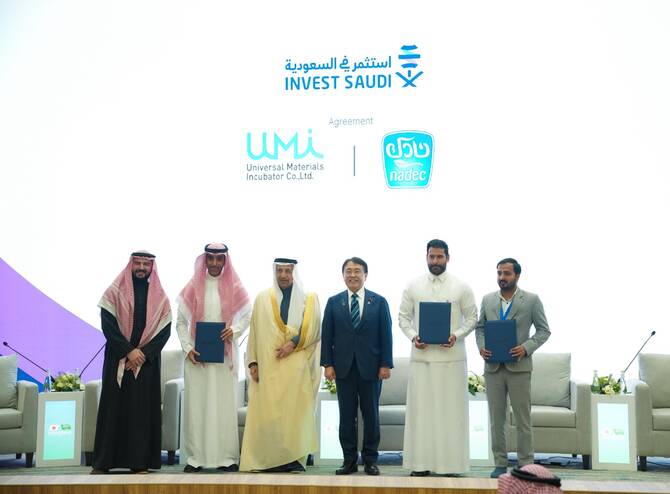
More crop per drop: NADEC and EF Polymer deploy breakthrough technology to cut agricultural water use by 40%

Short Url
Updated 14 January 2026
Follow

More crop per drop: NADEC and EF Polymer deploy breakthrough technology to cut agricultural water use by 40%

Following a strategic technology-scouting framework led by Universal Materials Incubator, the National Agricultural Development Company has entered into a partnership to launch large-scale field trials of EF Polymer, marking a significant step in deploying deep-technology solutions to strengthen the Kingdom’s food and water security.

The collaboration initiates field trials of EF Polymer’s proprietary solution — a 100 percent organic, biodegradable powder that performs like a “soil battery” upcycled from food waste. Engineered to address water scarcity in arid and semi-arid regions, the material can absorb up to 50 times its own weight in water and gradually release moisture directly to plant roots. This mechanism has the potential to reduce irrigation water use by up to 40 percent, while enhancing crop yield and long-term agricultural productivity.

Beyond water efficiency, EF Polymer improves nutrient retention by minimizing fertilizer leaching, thereby reducing overall fertilizer requirements. After approximately one year in the soil, the material fully biodegrades into organic carbon, organic matter, and trace nutrients such as magnesium, calcium, and nitrogen — contributing directly to improved soil health and long-term fertility.

The solution is affordable, easy to apply, and suitable for a wide range of crops, making it viable both for individual farmers and for industrial-scale agricultural operations such as NADEC’s. 

EF Polymer has already achieved significant commercial adoption across multiple global markets, including Japan, the US, India and Turkiye, where it is actively used by farmers and agribusiness operators to improve water efficiency, soil health, and crop resilience under varying climatic conditions.

Its organic credentials are certified by OMRI and Ecocert, reinforcing its alignment with sustainable and regenerative agricultural practices.

The stakes for this alliance are high. By 2030, global freshwater demand is projected to exceed supply by 40 percent. In Saudi Arabia, the challenge is localized but intense: the agricultural sector alone consumes approximately 11.4 billion cubic meters of water annually. This partnership underscores NADEC’s commitment to adopting innovative, scalable technologies that conserve natural resources while supporting resilient food systems across the Kingdom.

Mohamed Al-Rajhi, VP of supply chain sector at NADEC, said: “Strategic agriculture today requires a long-term commitment to soil health and resource circularity. NADEC is leading the shift toward regenerative practices that restore our natural capital rather than merely consuming it. By diversifying our crop portfolio and investing in closed-loop nutrient management, we are insulating our operations against global price volatility and environmental shifts.”

“We are aggressively deploying AI-driven irrigation systems and satellite-based crop monitoring to optimize every drop of water and every hectare of land. This strategic pivot toward agri-digitization allows us to mitigate climate risks in real-time while significantly reducing our carbon footprint. Our commitment to sustainability is our greatest competitive advantage, ensuring that NADEC remains the cornerstone of the Middle East’s agri-food sector for decades to come. These trials focus on strategic scalable crops like wheat and olive trees to ensure the future of the Kingdom’s food security is both sustainable and locally rooted,” he added.

Strategic trial milestones:

  • Wheat: Trials have commenced to demonstrate water retention in this water-intensive crop.
  • Olive and blueberry: Specialized testing is scheduled for March to evaluate yield improvements and nutrient efficiency.

This collaboration supports Saudi Vision 2030 goals of reducing non-renewable groundwater use by 90 percent.



Jameel Observatory-CREWSnet advances climate resilience in Bangladesh

Updated 20 January 2026
Follow

Jameel Observatory-CREWSnet advances climate resilience in Bangladesh

The Jameel Observatory Climate Resilience Early Warning System Network, an initiative co-founded by the Massachusetts Institute of Technology and Community Jameel to reinvent climate change adaptation in vulnerable communities into a proactive, integrated and evidence-based process, announced the launch of its Adaptation Fortress initiative, transforming existing cyclone shelters and providing protection from heat waves in Bangladesh for the first time.
The first Adaptation Fortress is under construction in Satkhira district, southwest Bangladesh. If this pilot is successful, the initiative will open a pathway, with additional funding, to scaling up to 1,250 Adaptation Fortresses providing heatwave relief to half a million of the region’s most vulnerable residents.
More than 30 million people live in southwestern Bangladesh. Between 2019 and 2021, including in the midst of the COVID-19 pandemic, multiple cyclones hit the region, devastating land, homes and entire communities. The threats posed by climate change — rising sea levels and more extreme weather — mean that people living in this region are likely to face similar crises in the years ahead. In addition to cyclones, extreme heat is a growing threat, putting people at risk of dehydration and heatstroke. In 2024, the UN found that heat waves caused nationwide school closures for two weeks, with some schools closing for six to eight weeks due to the combined impact of heat waves and flooding.
In Bangladesh, the Jameel Observatory-CREWSnet has used its mid-century climate projections and analysis of local human systems to design a pilot for a multi-purpose, multi-objective structure called an Adaptation Fortress.
By engaging extensively with local communities, the Jameel Observatory-CREWSnet, which includes among its partners BRAC, a global nongovernmental organization established in Bangladesh, is demonstrating a new model of climate adaptation that repurposes schools that are also cyclone shelters to serve as sanctuaries during extreme heat events.
The climate resilient shelter model is the first of its kind in Bangladesh and serves as a blueprint for infrastructure development across South Asia. Designed to protect the most vulnerable community members during government-declared heat emergencies, Adaptation Fortresses feature solar power generation and battery backup systems to ensure the shelter is resilient to outages during extreme heat conditions. The site also includes rainwater harvesting capacity and is designed so that excess energy generated when air conditioning is not in use is made available for community use.
Mohammed Abdul Latif Jameel KBE, founder and chairman of Community Jameel, said: “The Jameel Observatory-CREWSnet’s construction of this first pilot Adaptation Fortress marks a milestone for Bangladesh and the region. It lays the foundation for a proactive response to cyclones and heat stress — emergencies that the team has projected will become frequent events, threatening the lives of millions in Bangladesh. By adapting infrastructure today, we are building the resilience needed for tomorrow.”
Professor Elfatih Eltahir, lead principal investigator of the Jameel Observatory-CREWSnet, said: “Bangladesh built a vast network of cyclone shelters that have been effective in protecting vulnerable populations. For the first time the Jameel Observatory-CREWSnet is introducing the concept of shelter from heat waves as well as cyclones in southwest Bangladesh. This integrated and proactive initiative will significantly improve climate resilience in a region with some of the highest risks from climate change.”
Dr. Deborah Campbell, executive director of the Jameel Observatory-CREWSnet, said: “Bangladesh is getting hotter and will experience more frequent and severe heat waves, leaving many people very vulnerable to heat stress and lacking the resources to adapt. The Adaptation Fortress initiative will provide shelter for the most vulnerable community members in southwest Bangladesh and has the potential to serve as a model for similar proactive climate resilience infrastructure development across Bangladesh and South Asia.”
Dr. Md Liakath Ali, principal investigator of the Jameel Observatory-CREWSnet at BRAC, said: “BRAC is proud to partner with the Jameel Observatory-CREWSnet in pioneering the Adaptation Fortress initiative, an important step toward protecting vulnerable communities from the growing risks of extreme heat in coastal Bangladesh. By transforming existing cyclone shelters into multi-purpose, climate-resilient infrastructure, we are demonstrating how locally grounded solutions can address emerging climate hazards while strengthening community well-being. Alongside the pilot, we are committed to engaging policy makers so that future heat and climate risks are integrated into national planning processes. The lessons from this initiative will not only support communities in the southwest, but also inform long-term, scalable strategies for resilience across the country.”