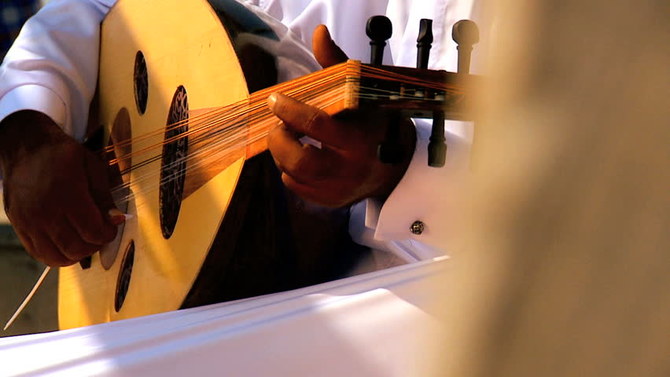
Saudi Music Commission launches Oud House in Riyadh

1 / 2
Oud House has been set up as a training center for musicians under the guidance and supervision of maestro Naseer Shamma and will offer lectures and workshops. (Supplied)
2 / 2
Oud House has been set up as a training center for musicians under the guidance and supervision of maestro Naseer Shamma and will offer lectures and workshops. (Supplied)
Short Url
Updated 23 August 2023
Follow

Saudi Music Commission launches Oud House in Riyadh

  • Project aims to empower local talent, promote Arab culture
  • Oud House curriculum will include lessons led by musical experts on playing instruments such as the flute, bezek, cello, and violin

RIYADH: The Saudi Music Commission recently inaugurated its Oud House project in Riyadh and has invited applications from people interested in learning how to play Arabic musical instruments.

Traditional instruments such as the oud, duf, rebab, and mizmar, commonly played at celebrations in the Kingdom, are a key part of the country’s musical culture.

Oud House has been set up as a training center for musicians under the guidance and supervision of maestro Naseer Shamma and will offer lectures and workshops.

The oud, which dates back more than 3,000 years, is one of the oldest and most important stringed instruments in the Arab world’s musical heritage and has played a significant role through history.

The Oud House curriculum will include lessons led by musical experts on playing instruments such as the flute, bezek, cello, and violin.

The project aims to promote Arabic culture, raise awareness about the significance of the oud, and foster a global community of professional oud players.

After undergoing a period of training and rehearsals, students will have the opportunity to participate in concerts.

The establishment of Oud House forms part of the Music Commission’s work to enhance the music industry in Saudi Arabia, encourage its growth, and provide training and empowerment opportunities for local talent.

The commission aims to develop the institute to be a globally recognized center, spread awareness about Arabic musical instruments, specifically the oud, and preserve the heritage of Arabic music.

Registration is open until Sept. 21 via https://engage.moc.gov.sa/reg_form/tracks/2853/new.


The difference between European and Gulf weddings — from a photographer’s point of view

Updated 21 January 2026
Follow

The difference between European and Gulf weddings — from a photographer’s point of view

DUBAI: From her early career in northeast France to working across the Gulf and Europe, wedding photographer Maddy Christina has observed many contrasts between such events in different parts of the world.

Her early years as a photographer were defined by variety; she worked across fashion, family portraits and weddings simultaneously before recognizing how wedding photography brings multiple genres together in a single day. 

Christina said weddings in the region required a shift in both perspective and technique. (Supplied)

“I actually fell into weddings by accident,” Christina told Arab News. “It blends every discipline at once — fashion for the couple session, sports for the reception, documentary work throughout the day, still life with details and jewelry.”

Christina’s connection to the Middle East began through Parisian clients who invited her to Dubai for a post-wedding session: “I instantly connected with the energy of the city,” she said.

Christina’s connection to the Middle East began through Parisian clients who invited her to Dubai for a post-wedding session. (Supplied)

A few years later, a wedding in Kuwait marked the start of her long-term relationship with the region.

Now working extensively across the Gulf Cooperation Council, Christina said weddings in the region required a shift in both perspective and technique.

For Christina, the most meaningful aspect extends beyond the wedding day itself. (Supplied)

“Working across the GCC has opened my mind in ways I didn’t expect,” she said, adding it felt like “resetting everything I thought I knew about weddings” — particularly compared to her experience in Europe.

She said there were clear distinctions between the two regions. “European weddings tend to be more demonstrative and expressive, while brides in the Gulf often place a deeper emphasis on tradition, family bonds and a sense of ceremony,” she said. “The emotional language is different, yet equally beautiful.”

From a technical standpoint, the contrast is just as pronounced: “In the south of France, I was used to shooting outdoors at sunset with couples already comfortable in front of the camera. Here, I often find myself in much smaller spaces, with no windows, artificial light and couples who may be more reserved.”

Christina is drawn to candid moments. (Supplied)

She added that adapting to these conditions pushed her to explore new ways of shaping light and expanded her creative approach.

While Christina is drawn to candid moments, like “guests laughing together, old friends reconnecting, a fleeting emotion passing across someone’s face,” posed pictures remain central to her work.

For Christina, the most meaningful aspect extends beyond the wedding day itself.

“It’s not the decor that makes a wedding unforgettable for me,” she said. “It’s the connection I build with the bride. That long-term bond is what feels truly magical.”