

Former central bank chief Shamshad Akhtar assumes charge as Pakistan’s caretaker finmin

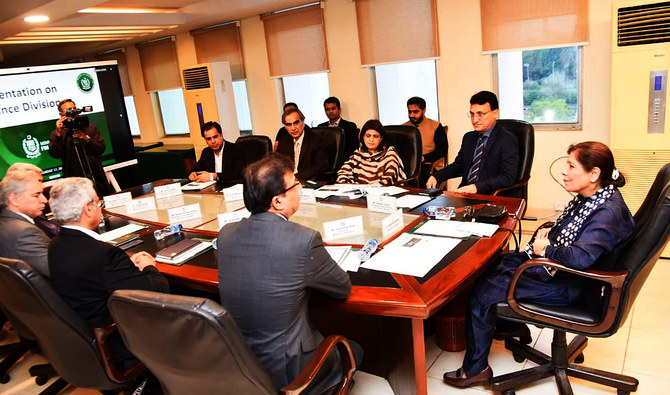
Former Pakistan central bank chief Dr. Shamshad Akhtar (right) gestures at a briefing session in the Ministry of Finance as she assumes charge of caretaker finance minister in Islamabad on August 17, 2023. (Photo courtesy: Ministry of Finance)
Short Url
Updated 18 August 2023
Follow

Former central bank chief Shamshad Akhtar assumes charge as Pakistan’s caretaker finmin

  • Akhtar’s appointment comes as Islamabad aims to continue reforms agreed with the IMF
  • The caretaker finance minister vows to ensure fiscal discipline, address income inequality

ISLAMABAD: Dr. Shamshad Akhtar, former Pakistan central bank chief, on Thursday assumed charge as the caretaker finance minister of the South Asian country, the Finance Division said, following an oath-taking of the 16-member interim cabinet that would run the country until the general elections due later this year.

Akhtar, who holds a Ph.D. in Economics, served as the first woman governor of the State Bank of Pakistan from 2006 till 2009. Prior to her appointment as the SBP chief, the veteran economist served at multiple positions at the Asian Development Bank (ADB) and the World Bank. She has presented numerous papers on economics and finance at international conferences and symposia.

Her appointment comes at a time when Pakistan is facing daunting challenges on the economic front and barely averted a sovereign default in June by securing a $3 billion bailout deal with the International Monetary Fund (IMF). The IMF requires the South Asian country to continue with the reforms agreed with the lender to keep receiving the loan tranches in order to keep the economy afloat.

“Dr. Shamshad Akhtar arrived at the Finance Ministry and officially took over the responsibility of Caretaker Finance Minister of Pakistan after taking oath at the Presidency,” the Finance Division said in a statement.

“On her arrival at the Finance Ministry, she was warmly welcomed by Secretary Finance and senior officials of the Ministry. Later, Secretary Finance and his team gave a detailed briefing on the economic situation and trends of major financial economic indicators of the country.”

Upon assuming her new role, the statement said, Akhtar expressed her dedication to ensuring fiscal discipline, promoting investment and bolstering efforts to address income inequality in the country.

Meanwhile, Caretaker Prime Minister Anwaar-ul-Haq Kakar allocated portfolios to the newly-appointed federal ministers, advisers and special assistants.

Senator Sarfaraz Ahmed Bugti was given the portfolio of interior, narcotics control, overseas Pakistanis and human resource development; Jalil Abbas Jilani foreign affairs; Lt. Gen (retired) Anwar Ali Hyder defense production; Murtaza Solangi information and broadcasting; Sami Saeed planning and development; Shahid Ashraf Tarar communications, maritime affairs and railways; Ahmad Irfan Aslam law and justice, climate change, water resources; Muhammad Ali power and petroleum; Gohar Ejaz commerce, industries and production; Umar Saif information technology, telecommunication and science and technology; Nadeem Jan national health services; Khalil George human rights; Aneeq Ahmed religious affairs; Jamal Shah national heritage and culture; and Madad Ali Sindhi education and professional training, according to the PM’s office.

The prime minister also appointed Air Marshal (retired) Farhat Hussain as adviser for aviation, Ahad Khan Cheema adviser for establishment and Dr. Waqar Masood Khan as adviser for finance. Syeda Arifa Zehra, Vice Admiral (retired) Iftikhar Ahmad Rao, Wasih Shah, Mishal Hussain Malik and Muhammad Jawad Sohrab Malik were appointed special assistants.


Islamabad dismisses claims about paying up to 8 percent interest on foreign loans as ‘misleading’

Updated 22 February 2026
Follow

Islamabad dismisses claims about paying up to 8 percent interest on foreign loans as ‘misleading’

  • Pakistan has long relied on external loans to help bridge persistent gaps in public finances and foreign exchange reserves
  • Pakistan’s total external debt, liabilities stand at $138 billion at an overall average cost of around 4 percent, ministry says

KARACHI: Pakistan’s finance ministry on Sunday dismissed as “misleading” claims that the country is paying up to 8 percent interest on external loans, saying the overall average cost of external public debt is approximately 4 percent.

Pakistan has long relied on external loans to help bridge persistent gaps in public finances and foreign exchange reserves, driven largely by a narrow tax base, chronic trade deficits, rising debt-servicing costs and repeated balance-of-payments pressures.

Over the decades, successive governments have turned to multilateral and bilateral lenders, including the International Monetary Fund, the World Bank and the Asian Development Bank, to support budgetary needs and shore up foreign exchange reserves.

The finance ministry on Sunday issued a clarification in response to a “recent press commentary” regarding the country’s external debt position and associated interest payments, and said the figures required contextual explanation to ensure accurate understanding of Pakistan’s external debt profile.

“Pakistan’s total external debt and liabilities currently stand at $138 billion. This figure, however, encompasses a broad range of obligations, including public and publicly guaranteed debt, debt of Public Sector Enterprises (both guaranteed and non-guaranteed), bank borrowings, private-sector external debt, and intercompany liabilities to direct investors. It is therefore important to distinguish this aggregate figure from External Public (Government) Debt, which amounts to approximately $92 billion,” it said.

“Of the total External Public Debt, nearly 75 percent comprises concessional and long-term financing obtained from multilateral institutions (excluding the IMF) and bilateral development partners. Only about 7 percent of this debt consists of commercial loans, while another 7 percent relates to long-term Eurobonds. In light of this composition, the claim that Pakistan is paying interest on external loans ‘up to 8 percent’ is misleading.

The overall average cost of External Public Debt is approximately 4 percent, reflecting the predominantly concessional nature of the borrowing portfolio.”

With respect to interest payments, public external debt interest outflows increased from $1.99 billion in Fiscal Year (FY) 2022 to $3.59 billion in FY2025, representing an increase of 80.4 percent, not 84 percent as reported. In absolute terms, interest payments rose by $1.60 billion over this period, not $1.67 billion, it said.

According to the State Bank of Pakistan’s records, Pakistan’s total debt servicing payments to specific creditors during the period under reference were as follows: the IMF received $1.50 billion, of which $580 million constituted interest; Naya Pakistan Certificates payments totaled $1.56 billion, including $94 million in interest; the Asian Development Bank received $1.54 billion, including $615 million in interest; the World Bank received $1.25 billion, including $419 million in interest; and external commercial loans amounted to nearly $3 billion, of which $327 million represented interest payments.

“While interest payments have increased in absolute terms, this rise cannot be attributed solely to an expansion in the debt stock,” the ministry said. “Although the overall debt stock has increased slightly since FY2022, the additional inflows have primarily originated from concessional multilateral sources and the IMF’s Extended Fund Facility (EFF) under the ongoing IMF-supported program.”

Pakistan secured a $7 billion IMF bailout in Sept. 2024 as part of Prime Minister Shehbaz Sharif’s efforts to stabilize the South Asian economy that narrowly averted a default in 2023. The government has since been making efforts to boost trade and bring in foreign investment to consolidate recovery.

“It is also important to note that the increase in interest payments reflects prevailing global interest rate dynamics. In response to the inflation surge of 2021–22, the US Federal Reserve raised the federal funds rate from 0.75-1.00 percent in May 2022 to 5.25–5.50 percent by July 2023. Although rates have since moderated to around 3.75 percent, they remain significantly higher than 2022 levels,” the finance ministry said.

“The government remains committed to prudent debt management, transparency, and the continued strengthening of Pakistan’s macroeconomic stability,” it added.