Pakistan’s caretaker PM says government to ensure ‘full use’ of special investment council

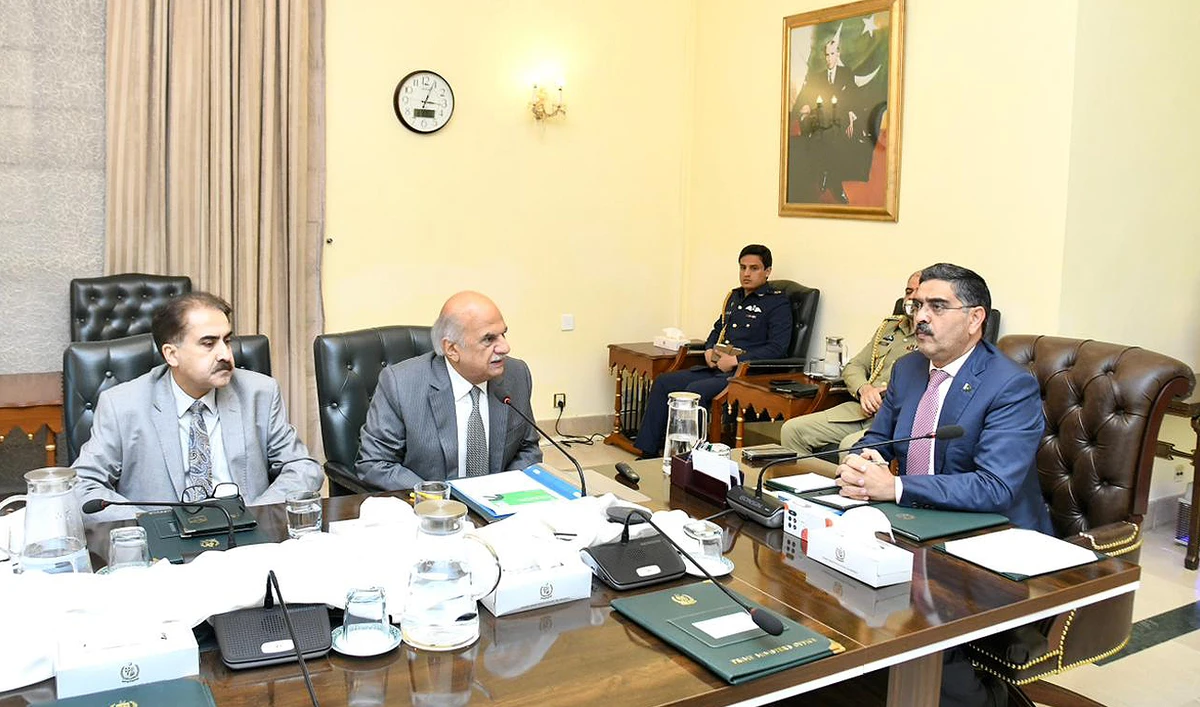
Pakistan's caretaker prime minister Anwaar-ul-Haq Kakar (right) gestures during a briefing on economic affairs at the Prime Minister's Office in Islamabad on August 17, 2023. (Photo courtesy: Prime Minister's Office)
Short Url
Updated 17 August 2023
Follow

Pakistan’s caretaker PM says government to ensure ‘full use’ of special investment council

  • Pakistan formed Special Investment Facilitation Council in June this year to attract foreign investment from GCC countries
  • Caretaker PM says government, despite short tenure, will devote ‘all energies’ to Pakistan’s economic development, stability

ISLAMABAD: Pakistan’s Caretaker Prime Minister Anwaar-ul-Haq Kakar vowed on Thursday to ensure “full use” of the country’s Special Investment Facilitation Council, saying that his government would devote its energies towards economic development and stability, a statement from the Prime Minister's Office (PMO) said.

Pakistan set up the Special Investment Facilitation Council (SIFC) in June to attract foreign investment, particularly from Gulf countries. A notification dated June 17 from then Prime Minister Shehbaz Sharif’s Office said SIFC would attract investments in energy, IT, minerals, defense, and agriculture from Gulf Cooperation Council (GCC) countries.

The body, which has the army chief and other military leaders in key roles, aims to take a “unified approach” to steer the country out of an economic crisis.

“The caretaker government would ensure the full use of the Special Investment Facilitation Council (SIFC),” PM Kakar said on Thursday while attending a briefing on the progress of the council.

“[The forum] is a ray of hope for Pakistan's economic development.”

Kakar acknowledged the “immense potential” that the SIFC offered in terms of foreign investment in tourism and infrastructure projects, adding that his government would pay special attention to those sectors.

“International quality infrastructure is of key importance for the promotion of foreign investment in the country,” Kakar noted. “As for the improvement of Pakistan's energy sector, the regulatory structure should be aligned with contemporary international requirements.”

Earlier this month, a delegation from Saudi Arabia arrived in Pakistan to explore investment opportunities in the mining sector, aiming to tap into Pakistan’s $6 trillion estimated worth of mineral deposits.

The Saudi delegation attended Pakistan’s first dedicated summit on minerals in Islamabad, where then PM Sharif and Pakistan’s army chief General Syed Asim Munir spoke in front of a gathering of foreign investors, diplomats, and international dignitaries. The summit was organized under the umbrella of the SIFC.

Pakistan, seven Muslim nations back Palestinian technocratic body, stress Gaza-West Bank unity

Updated 15 January 2026
Follow

Pakistan, seven Muslim nations back Palestinian technocratic body, stress Gaza-West Bank unity

  • The National Committee for the Administration of the Gaza Strip was announced on January 14
  • Muslim nations call for consolidation of the ceasefire and unimpeded humanitarian aid into Gaza

ISLAMABAD: Pakistan and seven other Muslim-majority countries on Thursday welcomed the formation of a temporary Palestinian technocratic body to administer Gaza, stressing that it must manage daily civilian affairs while preserving the institutional and territorial link between the Gaza Strip and the West Bank amid the ongoing peace efforts.

In a joint statement, the foreign ministers of Pakistan, Egypt, Jordan, Saudi Arabia, Qatar, Türkiye, Indonesia and the United Arab Emirates said the newly announced National Committee for the Administration of the Gaza Strip would play a central role during the second phase of a broader peace plan aimed at ending the war and paving the way for Palestinian self-governance.

“The Ministers emphasize the importance of the National Committee commencing its duties in managing the day-to-day affairs of the people of Gaza, while preserving the institutional and territorial link between the West Bank and the Gaza Strip, ensuring the unity of Gaza, and rejecting any attempts to divide it,” the statement said.

The committee, announced on Jan. 14, is a temporary transitional body established under United Nations Security Council Resolution 2803 and is to operate in coordination with the Palestinian Authority, the ministers said.

The statement said the move forms part of the second phase of US President Donald Trump’s Comprehensive Peace Plan for Gaza, which the ministers said they supported, praising Trump’s efforts to end the war, ensure the withdrawal of Israeli forces and prevent the annexation of the occupied West Bank.

The top leaders of all eight Muslim countries attended a meeting with Trump in New York last September, shortly before he unveiled the Gaza peace plan.

The ministers also called for the consolidation of the ceasefire, unimpeded humanitarian aid into Gaza, early recovery and reconstruction and the eventual return of the Palestinian Authority to administer the territory, leading to a just and sustainable peace based on UN resolutions and a two-state solution on pre-1967 lines with East Jerusalem as the Palestinian capital.