

Pakistan’s caretaker PM says government to ensure ‘full use’ of special investment council

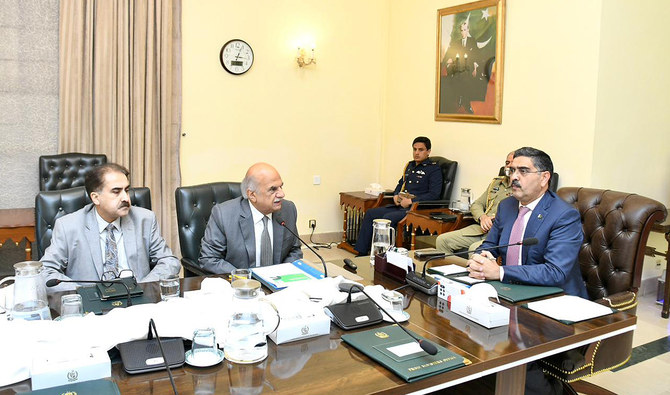
Pakistan's caretaker prime minister Anwaar-ul-Haq Kakar (right) gestures during a briefing on economic affairs at the Prime Minister's Office in Islamabad on August 17, 2023. (Photo courtesy: Prime Minister's Office)
Short Url
Updated 17 August 2023
Follow

Pakistan’s caretaker PM says government to ensure ‘full use’ of special investment council

  • Pakistan formed Special Investment Facilitation Council in June this year to attract foreign investment from GCC countries
  • Caretaker PM says government, despite short tenure, will devote ‘all energies’ to Pakistan’s economic development, stability

ISLAMABAD: Pakistan’s Caretaker Prime Minister Anwaar-ul-Haq Kakar vowed on Thursday to ensure “full use” of the country’s Special Investment Facilitation Council, saying that his government would devote its energies towards economic development and stability, a statement from the Prime Minister's Office (PMO) said.

Pakistan set up the Special Investment Facilitation Council (SIFC) in June to attract foreign investment, particularly from Gulf countries. A notification dated June 17 from then Prime Minister Shehbaz Sharif’s Office said SIFC would attract investments in energy, IT, minerals, defense, and agriculture from Gulf Cooperation Council (GCC) countries.

The body, which has the army chief and other military leaders in key roles, aims to take a “unified approach” to steer the country out of an economic crisis.

“The caretaker government would ensure the full use of the Special Investment Facilitation Council (SIFC),” PM Kakar said on Thursday while attending a briefing on the progress of the council.

“[The forum] is a ray of hope for Pakistan's economic development.”

Kakar acknowledged the “immense potential” that the SIFC offered in terms of foreign investment in tourism and infrastructure projects, adding that his government would pay special attention to those sectors.

“International quality infrastructure is of key importance for the promotion of foreign investment in the country,” Kakar noted. “As for the improvement of Pakistan's energy sector, the regulatory structure should be aligned with contemporary international requirements.”

Earlier this month, a delegation from Saudi Arabia arrived in Pakistan to explore investment opportunities in the mining sector, aiming to tap into Pakistan’s $6 trillion estimated worth of mineral deposits.

The Saudi delegation attended Pakistan’s first dedicated summit on minerals in Islamabad, where then PM Sharif and Pakistan’s army chief General Syed Asim Munir spoke in front of a gathering of foreign investors, diplomats, and international dignitaries. The summit was organized under the umbrella of the SIFC.


Pakistan rice exports slump 40% as India’s return hits pricing power

Updated 24 February 2026
Follow

Pakistan rice exports slump 40% as India’s return hits pricing power

  • Statistics show non-Basmati shipments have fallen over 50 percent in July-January period
  • Government offers 9 percent tax drawback on premium Basmati exports to support sector

ISLAMABAD: Pakistan’s rice exports fell 40.5 percent to $1.31 billion in the first seven months of the fiscal year, official data showed on Tuesday, as India’s return to the global market squeezed Islamabad’s market share and pricing power.

According to the Pakistan Bureau of Statistics (PBS), non-Basmati exports dropped 50.8 percent to $827.8 million, with volumes falling to 2.0 million tons from 3.15 million tons a year ago. Basmati exports declined 6.62 percent to $477.7 million, with volumes easing to 436,484 tons from 487,278 tons.

The Ministry of National Food Security told a parliamentary committee in two separate meetings in December and January that India’s re-entry into the global rice market was a key factor behind the decline, saying increased Indian supplies had made Pakistani rice less competitive.

Officials told lawmakers that India benefits from free trade agreements and provides substantial support to its rice sector, putting additional pressure on Pakistani exporters.

In response, the Ministry of Commerce last month issued a notification under the “Drawback of Local Taxes and Levies for Rice Order, 2026,” allowing a rebate of 9 percent of the free-on-board (FOB) value for Basmati exports priced above $750 per metric ton.

The government said the measure, announced on January 23, aims to ease liquidity pressures on exporters and improve competitiveness.

While PBS data for July-January shows a 40.5 percent decline, figures from the Federal Board of Revenue (FBR) for July-December show an even steeper 47 percent drop to $973 million from $1.82 billion in the same period last year, reflecting a deficit of over $800 million.

Industry representatives say they are now focusing on market diversification to counter the slowdown.

“Currently Basmati is mainly exported to Middle East and EU. Non-Basmati is exported to Philippines, Indonesia, Malaysia and African countries,” Malik Faisal Jahangir, chairman of the Pakistan Rice Exporters Association, told Arab News last week.

“For the new markets for our non-basmati rice exports, we are looking to increase our volumes to China, Philippines, Indonesia and Bangladesh,” he added.