

Pakistan’s 16-member caretaker cabinet takes oath

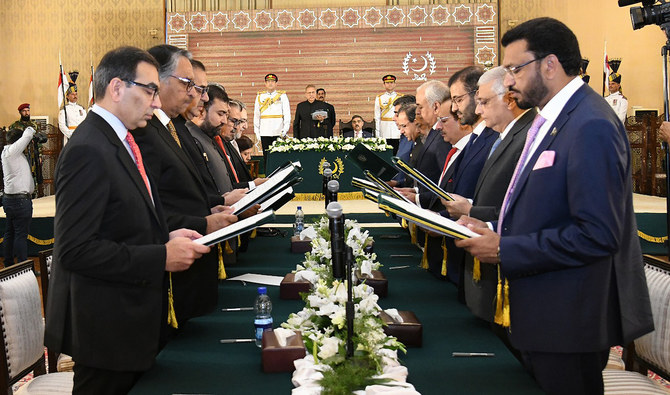
In this handout photo taken and released by the President's House, Pakistan President Dr. Arif Alvi administers oath from caretaker PM Anwaar-ul-Haq Kakar's cabinet at the President's House in Islamabad on August 17, 2023. (Photo courtesy: President House)
Short Url
Updated 17 August 2023
Follow

Pakistan’s 16-member caretaker cabinet takes oath

  • 16-member cabinet includes senior economist Dr. Shamshad Akhtar, who is believed to have been appointed finance minister
  • Pakistan’s caretaker government will have its hands full in leading country to elections through political instability, economic crisis

ISLAMABAD: Pakistani President Dr. Arif Alvi on Thursday administered oath to a caretaker cabinet, days after Anwaar-ul-Haq Kakar was sworn in as interim prime minister to oversee general elections.

The caretaker administration will have its hands full in attempting to oversee general elections in Pakistan at a time when the country is grappling with an economic crisis and heightened political instability.

Those who took oath as cabinet members include ex-Pakistan ambassador to the US, Jalil Abbas Jilani, senior journalist Murtaza Solangi, Dr Umar Saif, Sarfraz Bugti, Shahid Ashraf Tarar, industrialist Gohar Ejaz, Jalil Abbas Jilani, Jamal Shah, Dr Nadeem Jan, Aneeq Ahmed, Muhammad Sami, Ahmed Irfan, and Lt General (retired) Anwar Ali Haider.

Senior economist Dr. Shamshad Akhtar, who is also a former governor of the State Bank of Pakistan, is believed to have been given the finance portfolio while Jilani will be appointed as Pakistan’s caretaker foreign minister.

According to Pakistan’s constitution, members of the caretaker cabinet and their immediate family (spouses and children) would not be eligible to contest the upcoming elections.

The Cabinet Division or Prime Minister’s Office would issue a formal notification announcing the portfolios assigned to various members of the cabinet. The majority of the members are technocrats.

The role and functions of the caretaker government have been clearly defined in Section 230 of the Elections Act, 2017, which restricts its functions to “day-to-day matters which are necessary to run the affairs of the government.”

As per the Act, the caretaker government is supposed to be “impartial to every person and political party” and is not mandated to “take major policy decisions except on urgent matters.” It is also not authorized to undertake transfers and postings of public officials without approval from Pakistan’s election regulator.

“The caretaker government shall not attempt to influence elections or do or cause to be done anything which may, in any manner, influence or adversely affect the free and fair elections,” the Elections Act states.

The amendments passed by parliament to the Elections Act earlier this month empowered the caretaker government to take important decisions about “existing bilateral, multilateral and ongoing projects” already signed with international institutions like the World Bank and the International Monetary Fund (IMF). Experts, however, said the amendment would not change the “basic character” of the interim government.

Pakistan pitches digital finance reforms to foreign fintech investors

Updated 4 sec ago
Follow

Pakistan pitches digital finance reforms to foreign fintech investors

  • Khurram Schehzad highlights progress on digital banking and plans for regulating blockchain and virtual assets
  • Visiting delegation welcomes policy clarity, sees scope for long-term investment and partnerships in Pakistan

KARACHI: Pakistan on Saturday pitched its digital finance and fintech reforms to foreign investors as part of a broader effort to attract capital after macroeconomic stabilization, with a senior official highlighting progress on digital banking, payments infrastructure and regulatory overhaul.

The outreach came as Islamabad seeks to sustain reform momentum following a period of economic stress, positioning technology-led financial inclusion as a pillar of its recovery and growth strategy while courting international investors.

Khurram Schehzad, adviser to the finance minister, briefed a delegation of international fintech investors on Pakistan’s reform agenda and digital growth plans at a meeting in federal capital, according to a statement from the finance ministry.

“Consistent policy implementation and structural reforms have strengthened macroeconomic fundamentals and improved Pakistan’s investment outlook,” he said, highlighting the “renewed global confidence” in the economy.

Officials said the discussions focused on the government’s Digital Pakistan Vision, including efforts to expand digital payments, build public digital infrastructure and digitize government transactions to widen financial inclusion and formalize the economy.

Schehzad cited the role of Raast, Pakistan’s instant payment system, which enables real-time, low-cost and interoperable digital payments nationwide, as well as regulatory reforms introduced by the State Bank of Pakistan to modernize retail digital banking.

Under the new framework, easypaisa Digital Bank has been operational for nearly a year, while Mashreq Digital Bank has also begun operations, with several other digital banks moving toward launch, the statement said.

The adviser also outlined Pakistan’s plans to develop a regulatory framework for blockchain, Web3.0 and virtual assets, saying authorities were engaging with global platforms to support innovation while ensuring compliance and investor protection.

The investor delegation was led by John Sfakianakis, chairman of Fintech Solutions Holding, alongside the company’s chief executive Kirill Smolin, and was facilitated by local technology firm Tech Avenue.

The investors welcomed the “clarity of reforms and policy direction,” saying Pakistan’s combination of macroeconomic stabilization, digital infrastructure and emerging technologies offered opportunities for long-term investment and strategic partnerships, the finance ministry said.