

Niger junta says open to talks as Putin, US stress peace

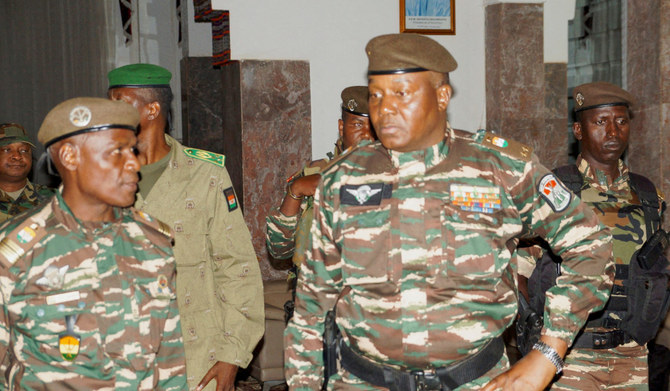
General Abdourahmane Tiani, who was declared as the new head of state of Niger by leaders of a coup, arrives to meet with ministers in Niamey, Niger July 28, 2023. (REUTERS)
Short Url
Updated 16 August 2023
Follow

Niger junta says open to talks as Putin, US stress peace

  • Russian President Vladimir Putin spoke to Mali’s military leader about the recent coup in neighboring Niger on Tuesday, a call likely to cause concern among Western governments that fear growing Russian influence in West Africa’s Sahel region

NIAMEY: Niger’s junta on Tuesday said that it was open to talks to resolve a regional crisis caused by last month’s military coup, while Russia and the United States called for a peaceful resolution.
Western powers and democratic African governments have called for the coup leaders to reinstate ousted President Mohamed Bazoum, who they have detained since July 26, but the military leaders have refused and rejected attempts at negotiation.
West African army chiefs will meet on Thursday and Friday in Ghana to prepare for a possible military intervention, which the main regional bloc, the Economic Community of West African States (ECOWAS), has threatened to launch if diplomacy fails.
Any military intervention could further destabilize the impoverished Sahel, where an insurgency by groups linked to Al-Qaeda and Islamic State has displaced millions over the past decade and fueled a hunger crisis.
“We are in a process of transition. We have explained the ins and outs, reiterated our willingness to remain open and to talk to all parties, but we have insisted on the need for the country to be independent,” said Ali Mahamane Lamine Zeine, who was appointed prime minister by the military last week.
He spoke after a trip to meet Chad’s President Mahamat Deby, who staged his own coup in 2021. Niger’s takeover is the seventh in West and Central Africa in three years.
The coup and its aftermath have sucked in international powers with strategic interests in the region.
Russian President Vladimir Putin spoke to Mali’s military leader about the recent coup in neighboring Niger on Tuesday, a call likely to cause concern among Western governments that fear growing Russian influence in West Africa’s Sahel region.
Putin “stressed the importance of a peaceful resolution of the situation for a more stable Sahel,” Mali’s interim President Assimi Goita said on social media platform X, formerly known as Twitter.
Pentagon spokesperson Sabrina Singh said US President Joe Biden’s administration was committed to a diplomatic resolution, and said Niger was a partner it did not want to lose.
Singh declined to call the takeover a coup but said it “certainly looks like an attempted coup.”
Meanwhile, ECOWAS has the support of Central Africa’s regional bloc ECCAS in efforts to overturn Niger’s coup and restore constitutional order, Nigerian President and ECOWAS Chairman Bola Tinubu said on Tuesday.
“I understand the fear of our people on any form of military action. We are working to keep the sanctions in place and we are following them to the letter,” he said in a statement.
Russian influence in West Africa has grown while the West’s has waned since a string of coups began. Military leaders in Mali and Burkina Faso have kicked out troops from former colonial power France and strengthened ties with Moscow.
In Mali, the army government also brought in mercenaries from Russia’s Wagner group, who have been accused of executing civilians and committing other grave human rights abuses.
Under Bazoum, Niger remained a Western ally. The US, France, Germany and Italy have troops stationed there under agreements with the now-deposed civilian government.
Putin has called for a return to constitutional order in Niger, while Wagner chief Yevgeny Prigozhin welcomed the army takeover and offered his services.
Support for Russia has appeared to surge in Niger since the coup, with junta supporters waving Russian flags at rallies and calling for France to disengage.
Niger’s coup leaders have revoked a raft of military agreements with France, although Paris shrugged this off by saying that it did not recognize them as legitimate authorities.


Gaza student evacuated to UK with her family after government climbdown

Updated 9 sec ago
Follow

Gaza student evacuated to UK with her family after government climbdown

  • Manar Al-Houbi was initially denied permission to bring her husband and children after changes to UK rules on foreign scholarship recipients
  • Several students still stranded in Gaza as relocation deadline looms, after refusing to abandon family members

LONDON: A student from Gaza granted permission to live and study in the UK has been evacuated from the Palestinian territory, with her family, by the British government.

Manar Al-Houbi won a full scholarship to study for a doctorate at the University of Glasgow. It also allowed her to bring her husband and children with her, and they applied for the required visas. But shortly before her studies were due to start, UK authorities told her the rules for international students and their dependents had changed and her family could no longer accompany her.

Shortly after her story was reported in October, however, the government backed down as said it would consider evacuation of international students’ dependents on a “case-by-case basis.”

Al-Houbi and her family are now in Jordan, on their way to the UK, The Guardian newspaper reported on Friday. The British scheme for the evacuation of students from Gaza is due to expire on Dec. 31. People who have attempted to use it have described it as being riddled with issues, as a result of which some students with scholarships have been left stranded in the Palestinian territory.

Several told the Guardian they had decided not to travel to the UK because they had felt pressured into leaving loved ones behind, including children.

Wahhaj Mohammed, 32, said he was told by the Foreign, Commonwealth and Development Office to travel to the UK alone, and his wife and children would be allowed to join him later. Two months after he arrived in Glasgow, his family are still in Gaza with no time frame for them to follow him.

“The uncertainty affects every aspect of my life here,” he told The Guardian. “It’s difficult to settle, to feel present or to engage academically when the people you love most remain living under constant threat.”

The Guardian said UK officials were “hopeful” his family would be evacuated in 2026 but could offer no guarantee about when this might happen.

Another student, Amany Shaher, said she refused to leave her family behind in Gaza and as a result was denied permission to travel to the UK this week. She does not know whether she will be permitted to defer her scholarship to study at the University of Bristol.

The 34-year-old, who has three children, said: “How can I even consider leaving my children behind in Gaza? Nowhere else in the world would a mother be expected to part so easily from her children. It’s dehumanizing. We have a right to stick together as a family and not be forced to separate — that should not be too much to ask.

“None of us know if the UK’s student evacuation scheme will be extended or not. We haven’t been given any clear guidance or timelines and have no idea what 2026 will bring.”

Mohammed Aldalou also refused to leave behind his family, including his 5-year-old autistic and non-verbal son, to take up a scholarship for postgraduate studies at the London School of Economics.

He said the Foreign Office had suggested to him he travel separately from them, as they did with Mohammed.

“They should ask themselves what they would do if they were in my shoes,” he said. “It’s heartbreaking that after everything we’ve been through, we’re being asked to make this impossible decision.”

Sources told The Guardian it was unlikely the Foreign Office would extend the scheme to allow students to travel from Gaza to the UK later, but that a meeting took place last week with the Department for Education to discuss whether students could begin their studies online.