


NIAMEY, Niger: The African Union (AU) on Monday held talks on the Niger crisis as the country’s post-coup rulers sounded defiance yet also pointed to diplomacy for a potential solution.
But talks at the AU’s headquarters in the Ethiopian capital Addis Ababa coincided with a flare-up over threats by the regime to prosecute Niger’s deposed president.
“AU’s Peace & Security Council meets to receive an update on the evolution of the situation in Niger and the efforts to address it,” the pan-African body said in a post on X, formerly known as Twitter.
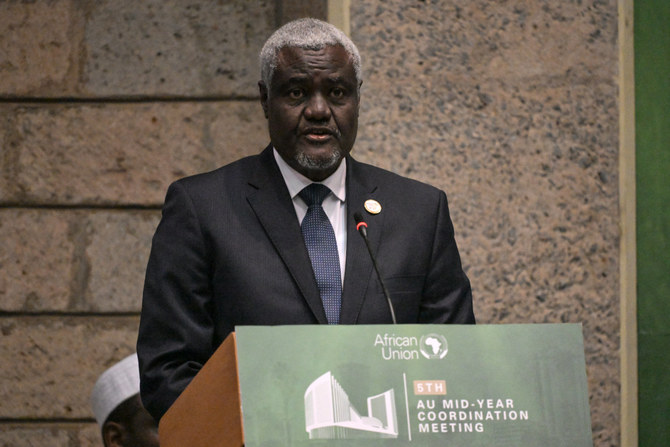
Those attending included AU Commission chief Moussa Faki Mahamat as well as representatives from Niger and the West African bloc ECOWAS, it said.
President Mohamed Bazoum, whose election in 2021 was a landmark in the country’s troubled history, was toppled on July 26 by members of his presidential guard.
His ousting unleashed a shockwave around West Africa, where Mali and Burkina Faso — likewise battered by a jihadist insurgency — have also suffered military takeovers.
Seeking to stop the cascade of coups, the Economic Community of West African States (ECOWAS) slapped sanctions on Niger and last week approved deployment of a “standby force to restore constitutional order.”
But uncertainties hang over any intervention — from operational feasibility to internal divisions within ECOWAS — and the bloc also says it wants a peaceful outcome.
On July 30, it issued a seven-day ultimatum to restore Bazoum or face the potential use of force, but the deadline expired without action.
Mixed signals have emerged from the regime as the crisis nears the end of its third week.
At the weekend, the coup leaders said they were open to a diplomatic push after their chief, General Abdourahamane Tiani, met with Nigerian religious mediators.
Those talks came after a scheduled meeting of ECOWAS military chiefs in Ghana was postponed for “technical reasons.”
But on Sunday night, Niger’s rulers declared they had gathered sufficient evidence to prosecute Bazoum for “high treason and undermining internal and external security.”
The legal threat was angrily condemned by ECOWAS.
In a statement, the bloc said it had learned of the threats “with stupefaction.”
“It represents yet another form of provocation and contradicts the (regime’s) reported willingness... to restore constitutional order through peaceful means.”
Washington said it was “incredibly dismayed” by the plan to try the detained president.
Bazoum’s foreign minister said on Monday that there were “pogroms” in the capital Niamey, but did not specify against whom they were directed.
“Currently in Niamey... there are pogroms with hordes of young people excited by racial and ethnic hatred,” Hassoumi Massaoudou, the foreign minister in the ousted civilian government, told RFI and France 24.
“That is why there is an urgent need to stop this and put Niger back on a path of peace, stability and economic progress.”
Bazoum, 63, and his family have been held at the president’s official residence since the coup, with international concern mounting over his conditions in detention.
On Monday, the military-appointed prime minister, Ali Mahaman Lamine Zeine, a civilian, declared Niger would thwart ECOWAS’s sanctions threat.
“We think that even though it is an unfair challenge that has been imposed on us, we should be able to overcome it. And we will overcome it,” he told German broadcaster Deutsche Welle.
The bloc has severed financial transactions and electricity supplies and closed borders with landlocked Niger, blocking much-needed imports to one of the world’s poorest countries.
The military leaders on Sunday said the sanctions make it hard for people to access medicines, food and electricity and described the punishment as “illegal, inhumane and humiliating.”
But Zeine also stressed the importance of Niger’s ties with neighboring Nigeria as well as the West African bloc.
“We have a great interest in preserving this important and historical relationship and also in having ECOWAS work on purely economic issues first,” he said.
A landlocked nation in the heart of the arid Sahel, Niger is one of the world’s poorest and most turbulent countries.
It frequently ranks at the bottom of the Human Development Index, a UN benchmark of prosperity.
Bazoum’s election in 2021 marked the first time that the country had experienced a peaceful transition of power since gaining independence from France in 1960.
He survived two attempted coups before being ousted, in the fifth putsch in the country’s history.
His ousting deals a huge blow to French and US strategy in the Sahel.
France refocused its anti-jihadist operations on Niger after withdrawing from Mali and Burkina Faso last year following a bust-up with their juntas.
It has around 1,500 troops in Niger, many of them at an air base near Niamey, while the Pentagon has around a thousand military personnel.


