

British and Dutch jets go after Russian bombers

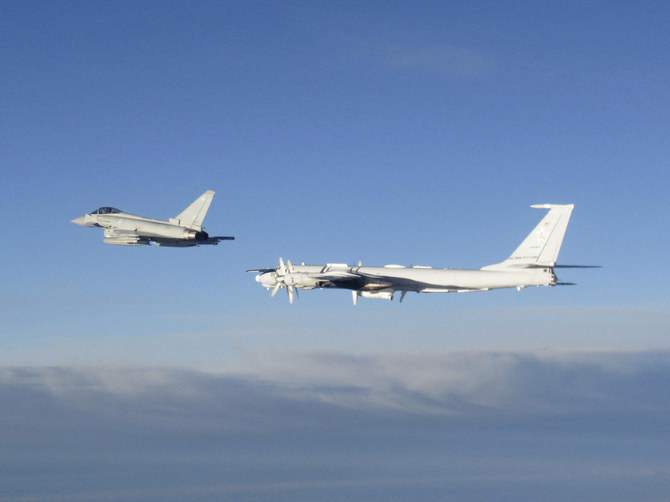
​ A British Royal Air Force Typhoon, left, monitors a Russian Tupolev Tu-142 long-range maritime patrol bomber as it transited north of the Shetland Islands within NATO's northern air policing area on Aug. 14, 2023. (UK Ministry of Defense photo via AP)
Short Url
Updated 15 August 2023
Follow

British and Dutch jets go after Russian bombers

  • The Dutch Defense Ministry scrambled two of its F-16 fighters the Russian bombers were spotted flying over the Baltic Sea toward the Netherlands
  • As the Russian bombers arrived part of NATO’s northern air policing area, British Typhoons intercepted them and escorted them of the UK’s area of interest

LONDON: The Dutch Defense Ministry and the British Royal Air Force said they scrambled fighter jets on Monday when Russian bombers were tracked flying toward the airspace of the Netherlands and off Scotland, respectively. The pair of Russian warplanes spotted in each location were flying in international airspace.

Britain’s Royal Air Force said two Typhoon fighters were launched from Lossiemouth to monitor the Russian bombers as they flew north of the Shetland Islands off Scotland. The Russian Tu-142 Bear-F and Tu-142 Bear-J, which are used for maritime reconnaissance and anti-submarine warfare, were in airspace that is part of NATO’s northern air policing area, the UK Defense Ministry said.
Russian aircraft entering the UK’s zone of international airspace can pose a hazard to other planes because they often don’t communicate with air traffic control or broadcast their coordinates, the military said.
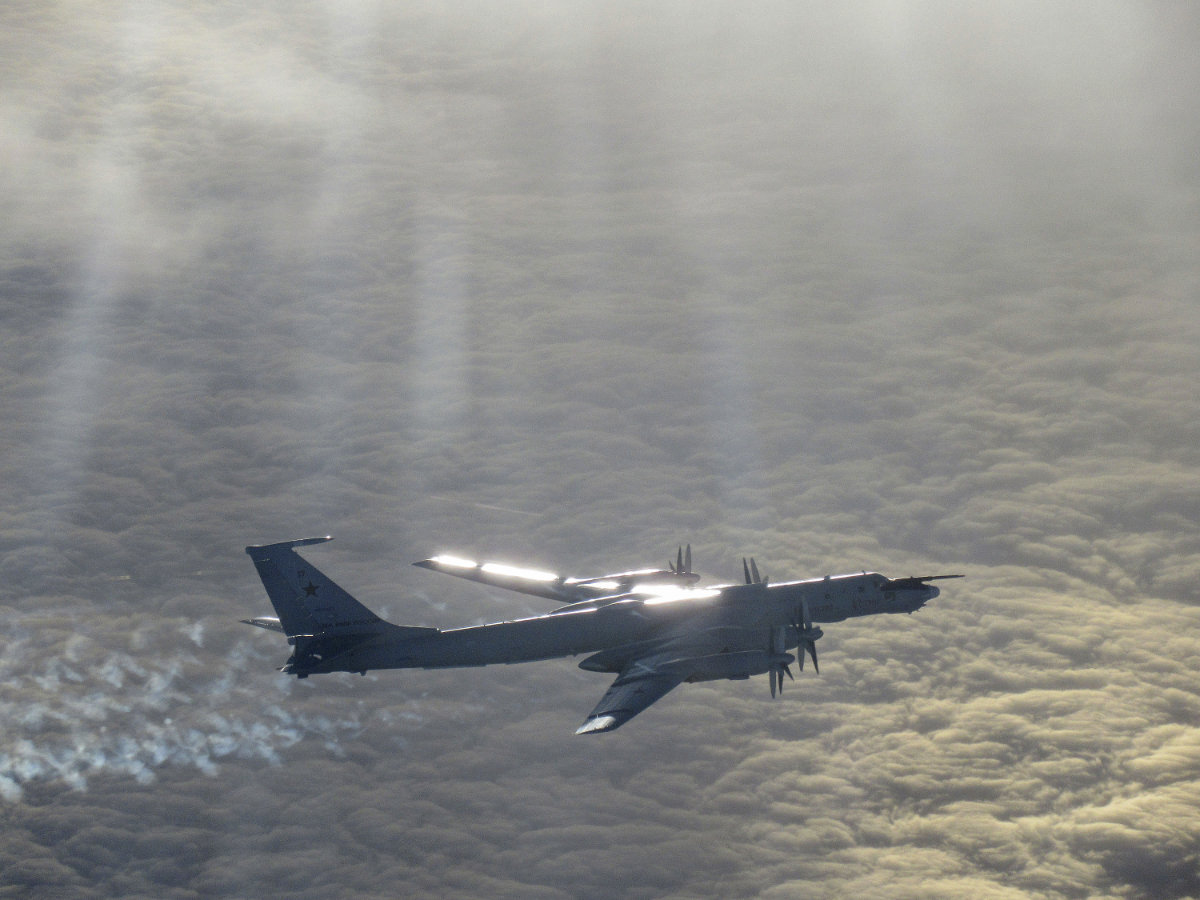


This photo released on Aug. 14, 2023 by the Ministry of Defense shows one of the two Russian Tupolev long-range maritime patrol bombers as they transited north of the Shetland Islands within NATO's northern air policing area. (AP)

The Typhoons stayed with the Russian planes until they were out of the UK’s area of interest, according to a statement from the lead pilot, who wasn’t named.
Denmark’s air force said its fighter jets identified the Russian bombers flying over the Baltic Sea toward the Netherlands. The Dutch Defense Ministry said it then scrambled two of its own F-16 fighters.
“This doesn’t happen often, but today’s incident demonstrates the importance of rapid deployment,” the ministry said. “The F-16s are on standby 24 hours a day and can take off within minutes and intercept an unidentified aircraft.”
British and German fighter jets were sent up in mid-March to intercept a Russian aircraft flying close to Estonian airspace, officials said at the time. The day before, the US had said a Russian fighter jet struck a US surveillance drone over the Black Sea.
Russia insisted its warplanes didn’t hit the MQ-9 Reaper drone, arguing the drone had maneuvered sharply and crashed into the water. The back-to-back incidents raised concerns about aerial standoffs near Russia and Ukraine
The Kremlin’s forces have pummeled Odesa since Russia last month broke off a wartime deal to protect Ukraine’s crucial grain exports. The Russian attacks appear aimed at facilities that transport grain and also at wrecking cherished Ukrainia historical sites.


Bangladesh halts controversial relocation of Rohingya refugees to remote island

Updated 29 December 2025
Follow

Bangladesh halts controversial relocation of Rohingya refugees to remote island

  • Administration of ousted PM Sheikh Hasina spent about $350m on the project
  • Rohingya refuse to move to island and 10,000 have fled, top refugee official says

DHAKA: When Bangladesh launched a multi-million-dollar project to relocate Rohingya refugees to a remote island, it promised a better life. Five years on, the controversial plan has stalled, as authorities find it is unsustainable and refugees flee back to overcrowded mainland camps.

The Bhasan Char island emerged naturally from river sediments some 20 years ago. It lies in the Bay of Bengal, over 60 km from Bangladesh’s mainland.

Never inhabited, the 40 sq. km area was developed to accommodate 100,000 Rohingya refugees from the cramped camps of the coastal Cox’s Bazar district.

Relocation to the island started in early December 2020, despite protests from the UN and humanitarian organizations, which warned that it was vulnerable to cyclones and flooding, and that its isolation restricted access to emergency services.

Over 1,600 people were then moved to Bhasan Char by the Bangladesh Navy, followed by another 1,800 the same month. During 25 such transfers, more than 38,000 refugees were resettled on the island by October 2024.

The relocation project was spearheaded by the government of former Prime Minister Sheikh Hasina, who was ousted last year. The new administration has since suspended it indefinitely.

“The Bangladesh government will not conduct any further relocation of the Rohingya to Bhasan Char island. The main reason is that the country’s present government considers the project not viable,” Mizanur Rahman, refugee relief and repatriation commissioner in Cox’s Bazar, told Arab News on Sunday.

The government’s decision was prompted by data from UN agencies, which showed that operations on Bhasan Char involved 30 percent higher costs compared with the mainland camps in Cox’s Bazar, Rahman said.

“On the other hand, the Rohingya are not voluntarily coming forward for relocation to the island. Many of those previously relocated have fled ... Around 29,000 are currently living on the island, while about 10,000 have returned to Cox’s Bazar on their own.”

A mostly Muslim ethnic minority, the Rohingya have lived for centuries in Myanmar’s western Rakhine state but were stripped of their citizenship in the 1980s and have faced systemic persecution ever since.

In 2017 alone, some 750,000 of them crossed to neighboring Bangladesh, fleeing a deadly crackdown by Myanmar’s military. Today, about 1.3 million of them shelter in 33 camps in the coastal Cox’s Bazar district, making it the world’s largest refugee settlement.

Bhasan Char, where the Bangladeshi government spent an estimated $350 million to construct concrete residential buildings, cyclone shelters, roads, freshwater systems, and other infrastructure, offered better living conditions than the squalid camps.

But there was no regular transport service to the island, its inhabitants were not allowed to travel freely, and livelihood opportunities were few and dependent on aid coming from the mainland.

Rahman said: “Considering all aspects, we can say that Rohingya relocation to Bhasan Char is currently halted. Following the fall of Sheikh Hasina’s regime, only one batch of Rohingya was relocated to the island.

“The relocation was conducted with government funding, but the government is no longer allowing any funds for this purpose.”

“The Bangladeshi government has spent around $350 million on it from its own funds ... It seems the project has not turned out to be successful.”