KYIV: Seven people – including a 23-day-old baby girl – were killed in Russian shelling in Ukraine’s southern Kherson region on Sunday, the country’s Internal Affairs Ministry said.
Artillery shelling in the village of Shiroka Balka, on the banks of the Dnieper River killed a family — a husband, wife, 12-year-old boy and 23-day-old girl — and another resident.
Two men were killed in the neighboring village of Stanislav, where a woman was also wounded.
The attack on Kherson province followed Ukrainian Deputy Defense Minister Hanna Maliar’s comments on Saturday attempting to quell rumors that Ukrainian forces had landed on the occupied left (east) bank of the Dnieper in the Kherson region.
“Again, the expert hype around the left bank in the Kherson region began. There are no reasons for excitement,” she said.
Kherson regional Gov. Oleksandr Prokudin said Sunday that three people had been wounded in Russian attacks on the province on Saturday.
Elsewhere, Ukrainian military officials said Saturday evening that Kyiv’s forces had made progress in the south, claiming some success near a key village in the southern Zaporizhzhia region and capturing other unspecified territories.
Ukraine’s General Staff said they had “partial success” around the tactically important Robotyne area in the Zaporizhzhia region, a key Russian stronghold that Ukraine needs to retake in order to continue pushing south toward Melitopol.
“There are liberated territories. The defense forces are working,” General Oleksandr Tarnavskyi, commander of Ukraine’s southern forces, said of the southern front.
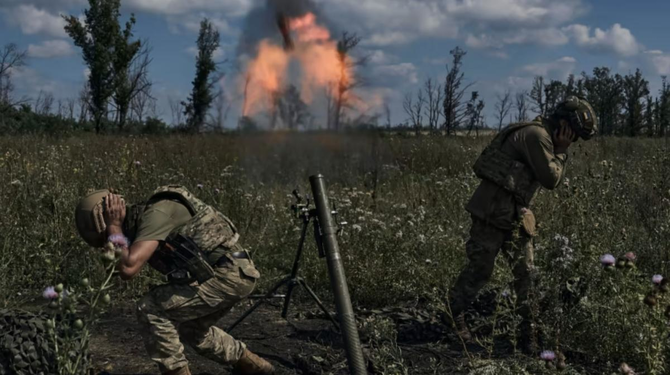
Battles in recent weeks have taken place on multiple points along the over 1,000-kilometer (600-mile) front line as Ukraine wages a counteroffensive with Western-supplied weapons and Western-trained troops against Russian forces who invaded nearly 18 months ago.
Ukrainian troops have made only incremental gains since launching a counteroffensive in early June.
Meanwhile, a Russian warship on Sunday fired warning shots at a Palau-flagged cargo ship in the south-western Black Sea, the first time Russia has fired on a merchant ship beyond Ukraine since exiting a landmark UN-brokered grain deal last month.
According to Russia’s Defense Ministry, the Sukru Okan was heading northwards to the Ukrainian Danube River port of Izmail.
“The captain of the dry-cargo ship did not respond to the request to stop for inspection for the carriage of prohibited goods. To force the ship to stop, warning fire was opened from automatic small arms from a Russian warship,” Russia’s Ministry of Defense wrote on Telegram, adding that the ship later stopped and allowed an inspection team to board.
Four weeks ago, Moscow withdrew from a key export agreement that allowed Ukraine to ship millions of tons of grain across the Black Sea for sale on world markets. In the wake of that withdrawal, Russia carried out repeated strikes on Ukrainian ports, including Odesa, and declared wide areas of the Black Sea unsafe for shipping.
In Russia, local officials reported on Sunday that air defense systems shot down three drones over the Belgorod region and one over the neighboring Kursk region, both of which border Ukraine.
Ukrainian drone strikes on Russian border regions are a fairly regular occurrence. Drone attacks deeper inside Russian territory have been on the rise since a drone was destroyed over the Kremlin in early May. In recent weeks, attacks have increased both on Moscow and on Crimea, which Russia annexed from Ukraine in 2014 — a move that most of the world considered illegal.
Firing drones at Russia, after more than 17 months of war, has little apparent military value for Ukraine but the strategy has served to unsettle Russians and bring home to them the conflict’s consequences.
Later Sunday afternoon, local officials in the Belgorod province reported an explosion in an apartment building in the regional capital, also called Belgorod.
Regional Gov. Vyacheslav Gladkov said that the facade of the apartment building had been damaged, with windows shattered and air conditioning units broken. Fifteen cars parked nearby also sustained damage, but there were no casualties. Gladkov said that the cause of the explosion was under investigation.
The Wagner mercenary group has played a key role in Russia’s military campaign, but there is a “realistic possibility” that the Kremlin is no longer providing funding, according to British defense officials.
In its latest intelligence briefing, the Ministry of Defense said it believed Wagner was “likely moving toward a down-sizing and reconfiguration process” in order to save money, and that the Kremlin had “acted against some other business interests” of Wagner chief Yevgeny Prigozhin. The officials assessed that Belarusian authorities were the “second most plausible paymasters.”
Thousands of Wagner fighters arrived in Russian-allied Belarus under a deal that ended their armed rebellion in late June and allowed them and Prigozhin to avoid criminal charges.


![]()

7 killed in Ukraine’s Kherson region, including a 23-day-old baby girl
Short Url
https://arab.news/gwjkx
7 killed in Ukraine’s Kherson region, including a 23-day-old baby girl
- Battles in recent weeks have taken place on multiple points along the over 1,000-kilometer (600-mile) front line
- Ukrainian military officials said Saturday evening that Kyiv’s forces had made progress in the south


Latest updates


© 2026 SAUDI RESEARCH & PUBLISHING COMPANY, All Rights Reserved And subject to Terms of Use Agreement.