

Niger’s junta gains upper hand over threatening regional military force

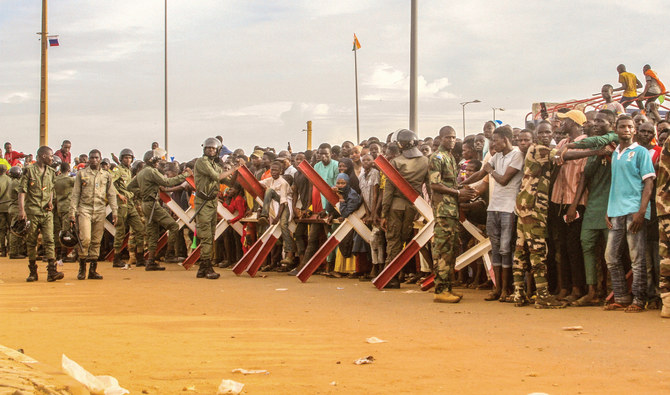
Supporters of Niger’s junta during a demonstration in the capital city Niamey. The July 26 coup in the African country is seen as a major blow to many Western nations. (Reuters)
Short Url
Updated 13 August 2023
Follow

Niger’s junta gains upper hand over threatening regional military force

  • Analysts believe putschists are holding all the cards and have cemented their rule

NIAMEY: One week after a deadline passed for mutinous soldiers in Niger to reinstate the country’s ousted president or face military intervention, the junta has not acquiesced. No military action has been taken and the coup leaders appear to have gained the upper hand over the regional group that issued the threat, analysts say.

The West African regional bloc ECOWAS had given the soldiers that overthrew Niger’s democratically elected President Mohamed Bazoum until last Sunday to release and reinstate him or they threatened military action. On Thursday, the bloc ordered the deployment of a “standby” force to restore constitutional rule in Niger, with Nigeria, Benin, Senegal and Ivory Coast saying they would contribute troops.

But it’s unclear when, how or if the troops will deploy. The move could take weeks or months to set into motion, and while the bloc decides what to do the junta is gaining power, some say.

“It looks the putschists have won and will stay ... The putschists are holding all the cards and have cemented their rule,” said Ulf Laessing, head of the Sahel program at the Konrad Adenauer Foundation.

ECOWAS is unlikely to intervene militarily and risk dragging Niger into civil war, he said, adding that ECOWAS and Western countries would instead likely press the junta to agree to a short transition period.

Europe and the US will have little choice but to recognize the junta in order to continue the security cooperation in the region, Laessing said.

The July 26 coup is seen as a major blow to many Western nations, which saw Niger as one of the last partners in the conflict-riddled Sahel region south of the Sahara Desert that they could work with to beat back a growing insurgency linked to Al-Qaeda and Daesh. The US and France have more than 2,500 military personnel in the region and together with other European countries have invested hundreds of millions of dollars in military assistance and training Niger’s forces.

There was still little clarity about what would happen days after ECOWAS announced the “standby” force deployment.

A meeting of the region’s defense chiefs was postponed indefinitely. The African Union is expected to hold a meeting on Monday to discuss Niger’s crisis. The group’s Peace and Security Council could overrule the decision if it felt that wider peace and security on the continent was threatened by an intervention.

The delay of the defense chiefs’ meeting to discuss the “standby” force shows that ECOWAS views the use of force as a last resort, said Nate Allen, an associate professor at the Africa Center for Strategic Studies.

“Given the likely challenges an intervention would face, (the use of force would) require a high degree of consensus and coordination not just within ECOWAS, but within the African Union and international community writ large,” he said.

But those with ties to the junta say they are preparing for a fight, especially since the soldiers are unwilling to negotiate unless ECOWAS acknowledges its leader, Gen. Abdourahmane Tchiani, who overthrew the president, as the new ruler.

“ECOWAS is demanding that (the junta) immediately release President Bazoum and restore him as head of state. Is this a joke?” said Insa Garba Saidou, a local activist who assists Niger’s new military rulers with their communications and says he is in direct contact with them. “Whether Bazoum resigns or not, he will never be Niger’s president again.”


India, EU agree on trade deal slashing tariffs on 99.5% of Indian exports

Updated 5 sec ago
Follow

India, EU agree on trade deal slashing tariffs on 99.5% of Indian exports

  • Agreement expected to be signed later this year and come into force in early 2027
  • Duty cuts on 99.5% Indian exports to EU unlikely to offset US tariff impact, expert says

NEW DELHI: India and the EU have concluded negotiations on a deal creating a free trade zone of 2 billion people, European Commission President Ursula von der Leyen and Indian Prime Minister Narendra Modi said on Tuesday.

Talks for the pact, referred to by both leaders as the “mother of all deals,” started in 2007 and stalled repeatedly over the years, with the negotiation process only speeding up last year, following new US tariff polices.

The agreement is expected to be signed later this year and may come into force in early 2027.

“People around the world are calling it the ‘mother of all deals.’ This agreement brings huge opportunities for India’s 1.4 billion people and for millions of people across European countries,” Modi said during a joint press conference with Von der Leyen and European Council President Antonio Costa in New Delhi.

“It represents 25 percent of the global GDP and one-third of global trade.”

The deal paves the way for India to open its vast market to free trade with the EU, its biggest trading partner, and gain preferential access for almost all of its exports to the 27-nation European bloc.

“We have created a free trade zone of 2 billion people, with both sides set to gain economically,” Von der Leyen said. “We have sent a signal to the world that rules-based cooperation still delivers great outcomes.”

The conclusion of negotiations comes as US President Donald Trump slapped India with 50 percent tariffs and has threatened to impose new duties on several EU countries unless they support his efforts to take over Greenland.

“This is a signal to the US that like-minded entities, EU and India, are willing to come together and work together,” Prof. Harsh V. Pant, vice president of the Observer Research Foundation, told Arab News.

“Here are two countries that are bringing in a greater predictability and less volatility in their relationship, and they will move ahead irrespective of what the US does.”

The deal is expected to double EU goods exports to India by 2032 as tariffs on 96.6 percent of EU goods exports — from automobiles and industrial goods to wine and chocolates — will be eliminated or reduced, saving up to $4.75 billion per year in duties on European products, according to a European Commission press release on Tuesday.

At the same time, the EU will eliminate or reduce tariffs on 99.5 percent of goods imported from India over seven years, India’s Ministry of Commerce and Industry said in a statement, projecting gains mainly in labor-intensive sectors like textiles, leather, marine products, gems and jewelry.

“Indian services will also benefit from the trade deal. But, more than just export growth, the deal is part of a broader EU-India alliance on green tech, critical raw materials, digital rules and other aspects, which should channelize higher FDI (foreign direct investment) into India,” said Dr. Anupam Manur, professor of economics at the Takshashila Institution.

“India can potentially have a welfare and income gain of 0.5 percent of its GDP in the long run. It would also boost Indian exports to the EU by about $5 billion from the current level of about $76 billion.”

The agreement is unlikely to fully compensate for a slowdown in trade with the US.

“In the near term, this will partially offset the loss of exports to the US due to tariffs but cannot be expected to entirely mitigate it. Shifting supply chains and exports take time,” Manur said.

“The implementation of the FTA would take about a year’s time. The deal is expected to come into force by early 2027.”