

Doctor allowed to see detained Niger president as Nigerian religious leaders meet with junta

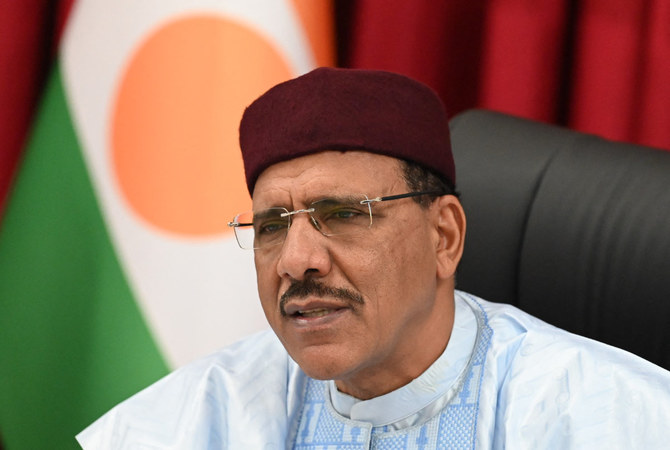
Niger's former President Mohamed Bazoum, shown in this picture taken on May 2, 2022, at the presidential palace in Niamey, was seen by a doctor for the first time on August 12, 2023, since he was toppled on July 26 by his presidential guard. (AFP)
Short Url
Updated 13 August 2023
Follow

Doctor allowed to see detained Niger president as Nigerian religious leaders meet with junta

  • The Muslim leaders visited Niamey with the blessing of Nigerian President Bola Tinubu, head of the West African regional bloc ECOWAS
  • The doctor, a member of the entourage, saw ousted president Mohamed Bazoum and also brought food for him, his wife and son: Source

NIAMEY, Niger: Niger’s detained president was seen by his doctor on Saturday, his entourage said amid mounting concern for his condition, while Nigerian religious leaders met the officers who seized power last month to try to defuse the crisis.
The Muslim leaders visited the capital Niamey with the blessing of Nigerian President Bola Tinubu, head of the West African regional bloc ECOWAS, a source close to the delegation told AFP.
ECOWAS has approved the deployment of a “standby force to restore constitutional order” in Niger as soon as possible, but scrapped a Saturday crisis meeting on the coup that deposed Mohamed Bazoum.
Bazoum, 63, was toppled on July 26 by his presidential guard, which has since held him and his family at his official Niamey residence.
The European Union, the African Union and the United Nations joined others in sounding the alarm for Bazoum on Friday after reports described worsening detention conditions.
Bazoum “had a visit by his doctor today,” a member of his entourage told AFP, adding the physician had also brought food for Bazoum, his wife and son.
“He’s fine, given the situation,” the source added.
Human Rights Watch said it had spoken with Bazoum earlier this week. The ousted leader had described the treatment of himself, his wife and their unwell 20-year-old son as “inhuman and cruel,” HRW said.
“My son is sick, has a serious heart condition, and needs to see a doctor,” the group quoted him as saying. “They’ve refused to let him get medical treatment.”
UN rights chief Volker Turk on Friday said Bazoum’s reported detention conditions “could amount to inhuman and degrading treatment, in violation of international human rights law.”
Top US diplomat Antony Blinken said he was “dismayed” by the military’s refusal to release Bazoum’s family as a “demonstration of goodwill.”

The delegation of Nigerian religious leaders was received by newly appointed Prime Minister Ali Mahaman Lamine Zeine in Niamey, and then strongman General Abdourahamane Tiani, according to Niger’s national television.
The group was headed by Sheikh Bala Lau, leader of the Izala Salafist movement in Nigeria, Niger’s ANP press agency reported.
A source close to the delegation told AFP they had left on the mandate of Tinubu “to douse tension created by the prospect of military intervention by ECOWAS.”
“The clerics are in Niamey to explain to the junta leaders that Nigeria is not fighting Niger and that the decisions taken on Niger are not Nigeria’s but those of ECOWAS as a regional bloc,” the source added.
Lau had earlier in the week led a delegation of clerics who met with Tinubu in Nigeria’s capital Abuja where the mission was discussed, the source said.
On Friday, West African leaders suspended the crisis meeting that had been set for Saturday in Ghana’s capital Accra. Chiefs of staff from the Economic Community of West African States (ECOWAS) cited “technical reasons.”

Sources said the meeting was originally set up to inform the organization’s leaders about “the best options” for activating and deploying the standby force.
“The military option seriously envisaged by ECOWAS is not a war against Niger and its people but a police operation against hostage takers and their accomplices,” Hassoumi Massaoudou, foreign minister in the ousted civilian government, said Saturday.
ECOWAS is determined to stop the sixth military takeover in the region in just three years.
It has severed financial transactions and electricity supplies and closed borders with landlocked Niger, blocking much-needed imports to one of the world’s poorest countries.
ECOWAS had previously issued a seven-day ultimatum to the coup leaders to reinstate Bazoum, but the generals defied the deadline, which expired on Sunday.

Thousands of coup supporters rallied in Niamey on Friday to protest against the ECOWAS plan to send troops.
Protesters gathered near a French military base on the outskirts of Niamey shouting “Down with France, down with ECOWAS.”
Niger’s new leaders have accused former colonial power France, a close Bazoum ally, of being behind the hard-line ECOWAS stance.
France has around 1,500 troops in Niger as part of a force battling an eight-year jihadist insurgency.
It is facing growing hostility across the Sahel, withdrawing its anti-jihadist forces from neighboring Mali and Burkina Faso last year after falling out with military governments that ousted elected leaders.


Trump signals interest in easing tensions, but Minneapolis sees little change on the streets

Updated 29 January 2026
Follow

Trump signals interest in easing tensions, but Minneapolis sees little change on the streets

  • Immigration enforcement operations and confrontations with activists continued Wednesday in Minneapolis and St. Paul

MINNEAPOLIS: President Donald Trump seemed to signal a willingness to ease tensions in Minneapolis after a second deadly shooting by federal immigration agents, but there was little evidence Wednesday of any significant changes following weeks of harsh rhetoric and clashes with protesters.
The strain was evident when Trump made a leadership change by sending his top border adviser to Minnesota to take charge of the immigration crackdown. That was followed by seemingly conciliatory remarks about the Democratic governor and mayor.
Trump said he and Gov. Tim Walz, whom he criticized for weeks, were on “a similar wavelength” following a phone call. After a conversation with Mayor Jacob Frey, the president praised the discussion and declared that “lots of progress is being made.”
But on city streets, there were few signs of a shift. Immigration enforcement operations and confrontations with activists continued Wednesday in Minneapolis and St. Paul.
A group of protesters blew whistles and pointed out federal officers in a vehicle on a north Minneapolis street. When the officers’ vehicle moved, a small convoy of activists followed in their cars for a few blocks until the officers stopped again.
When Associated Press journalists got out of their car to document the encounter, officers with the federal Bureau of Prisons pushed one of them, threatened them with arrest and told them to get back in their car despite the reporters’ identifying themselves as journalists. Officers from multiple federal agencies have been involved in the enforcement operations.
From their car, the AP journalists saw at least one person being pepper sprayed and one detained, though it was unclear if that person was the target of the operation or a protester. Agents also broke car windows.
Attorney General Pam Bondi, who is visiting Minnesota, said 16 people were arrested Wednesday on charges of assaulting, resisting or impeding law enforcement in the state. She said more arrests were expected.
“NOTHING will stop President Trump and this Department of Justice from enforcing the law,” Bondi said in a social media post.
Messages seeking comment were left with Immigration and Customs Enforcement and the Border Patrol.
Woman tells agents: ‘They’re good neighbors’
On Wednesday afternoon in the Minneapolis suburb of Brooklyn Center, half a dozen agents went to a house in a small residential neighborhood.
One agent knocked on the door of the home repeatedly. Another told the AP they were seeking a man who had been twice deported and was convicted of domestic abuse. The agent said the man had run into the home and the agents lacked a judicial warrant to get inside.
Some federal immigration officers have asserted sweeping power to arrest someone considered illegally present or otherwise deportable using an administrative warrant but without a judge’s warrant. The key difference in the two warrants is whether agents can forcibly enter a private property to make an arrest, as they were captured on video doing in Minneapolis earlier this month.
A handful of activists blew whistles at the agents in Brooklyn Center. One agent said: “They’d rather call the police on us than to help us. Go figure.”
As the agents were preparing to leave, a woman called out to them saying, “You need to know they’re good neighbors.”
Kari Rod told the AP that she didn’t know these neighbors well, but they had come to her garage sale, kept their yard clean and waved hello when she drove by. She didn’t believe enforcement agents to be speaking the truth about whom they arrest, including another neighbor whom she said was deported to Laos last summer.
“I don’t trust a single thing they said about who they are,” Rod said. “From my interactions, I know them way better than anyone else does, any one of those federal agents.”
Immigrants are ‘still very worried’
Many immigrant families are still fearful of leaving their homes, and Latino businesses are still closed, said Daniel Hernandez, who owns the Minneapolis grocery store Colonial Market. He also runs a popular Facebook page geared toward informing the Hispanic community in the Twin Cities.
While Colonial Market is open, all but one of the dozen immigrant-run businesses that rented space inside have closed since late December, and none has plans to reopen, Hernandez said.
“The reality is the community is still very worried and afraid,” Hernandez said.
Hernandez referenced Border Patrol commander Gregory Bovino, who helped lead the administration’s crackdown in the Twin Cities and who has reportedly been assigned elsewhere.
Bovino “was removed, but the tactics so far are still the same,” Hernandez said. “Nobody now is trusting the government with those changes.”
The federal enforcement extended to the city’s Ecuadorian consulate, where a federal law enforcement officer tried to enter before being blocked by employees.
Judge warns ICE about not complying with federal orders
In Minnesota federal court, the issue of ICE not complying with court orders came to the fore as Chief Judge Patrick Schiltz said the agency had violated 96 court orders in 74 cases since Jan. 1.
“This list should give pause to anyone — no matter his or her political beliefs — who cares about the rule of law,” he wrote. “ICE has likely violated more court orders in January 2026 than some federal agencies have violated in their entire existence.”
Schiltz earlier this week ordered ICE’s acting director to personally appear in his courtroom Friday after the agency failed to obey an order to release an Ecuadorian man from detention in Texas. The judge canceled the order after the agency freed the man.
The judge, who was appointed by President George W. Bush, warned ICE that future noncompliance may result in future orders requiring the personal appearances of Acting Director Todd Lyons or other government officials.
ICE didn’t immediately respond to an email seeking comment.
Veteran visits sidewalk memorial
Elsewhere on Wednesday, Donnie McMillan placed a cardboard sign reading “In remembrance of my angel” at the makeshift memorial where Alex Pretti was shot.
The Vietnam veteran knelt to pay his respects and saluted to honor the nurse whom he said he remembered seeing during his frequent visits to the Veterans Affairs hospital where Pretti worked.
“I feel like I’ve lost an angel right here,” McMillan, 71, said, pointing to the growing sidewalk memorial covered in flowers, candles and signs. “This is not the way we should operate.”
Also Wednesday, the Department of Homeland Security said two federal agents involved in Pretti’s death have been on leave since Saturday, when the shooting happened.
US Rep. Ilhan Omar, a Democrat, spoke to journalists one day after a man attacked her during a town hall meeting by squirting a strong-smelling substance on her as she denounced the Trump administration.
“What is unfolding in our state is not accidental. It is part of a coordinated effort to target Black and brown, immigrant and Muslim communities through fear, racial profiling and intimidation,” Omar said. “This administration’s immigration agenda is not about law enforcement — it is about making people feel they do not belong.”