

Over 40 Saudi designers set to exhibit at Milan Fashion Week

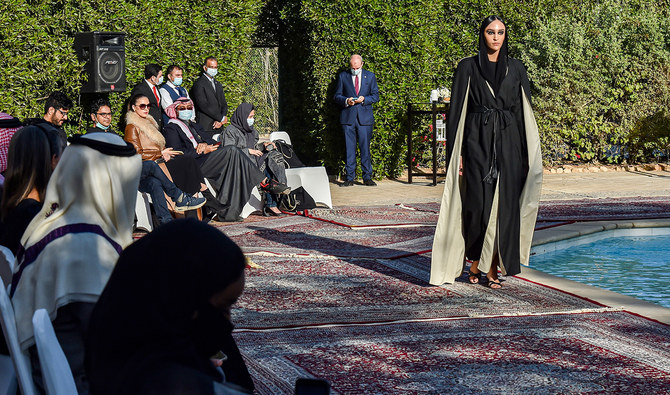
A model walks during the presentation of the "Khaleeki Chic" (Stay stylish) collection by Saudi and Belgian designers Safia Hussein and Christophe Beaufays, at the Belgian residence in Saudi Arabia's capital Riyadh's diplomatic quarter, on January 23, 2021. (AFP/File)
Short Url
Updated 13 August 2023
Follow

Over 40 Saudi designers set to exhibit at Milan Fashion Week

  • Clothes, jewelry, accessories designed in the Kingdom will be displayed from September 22 till September 25
  • The participation is organized in cooperation with Saudi Fashion Commission as part of Saudi 100 Brands project

ROME: More than 40 Saudi designers will exhibit their creations during Milan Fashion Week at White Milano, an international showcase of the global fashion scene dedicated to all-around, ready-to-wear collections.

Clothes, jewelry and accessories designed in the Kingdom will be displayed at the Visconti Pavilion between Sept. 22 and 25 at an event seen as a meeting point between emerging Arab designers and the most influential representatives in the fashion scene.

“The White Milano event is one of the most important on the fashion calendar for emerging brands wishing to establish themselves,” said Burak Cakmak, CEO of the Saudi Fashion Commission.

“With the growing interest of consumers and investors in Saudi fashion globally, our designers are excited to interact with buyers and see where the most interesting business opportunities are.”

Saudi participation at the event will be organized in cooperation with the commission as part of the Saudi 100 Brands project.

Launched in 2021, this scheme allows selected Saudi fashion designers to take part in a year-long series of masterclasses, one-on-one mentorships and workshops on design and innovation, sales strategies and exhibitions, providing them with the best tools to grow brands both locally and internationally.

Courses are held by an international team of experts from leading fashion houses including LVMH, Kering, Valentino, Chanel, Calvin Klein, Tom Ford, Bulgari, Camper and Swarovski.

Lectures are also held by representatives of the London Royal College of Art, Bocconi University in Milan, the London School of Economics and Yale University.

In its first year, Saudi 100 Brands provided more than 5,000 hours of specialized mentoring. The designers taking part in the project are aged 20-70, and 85 percent of them are women. Most attended the best design schools in the world, although some are self-taught.


French historical account connects Saudi highlands to modern cafe culture

Updated 5 sec ago
Follow

French historical account connects Saudi highlands to modern cafe culture

  • French merchant’s 1716 publication identifies Asir and neighboring areas as early centers of coffee cultivation, Saudi antiquarian Omar Murshid tells Arab News

MAKKAH: A 1716 publication titled “Voyage de l’Arabie Heureuse” (“Journey to Arabia Felix”) offers some of the earliest European documentation of coffee production and consumption in southern Arabia, according to Omar Murshid, an antiquarian specializing in local art, heritage and rare historical artifacts.

According to Murshid, the 1716 book, written by French merchant and traveler Jean de La Roque, provides early written evidence connecting products from southern Arabia’s highlands to Europe’s coffeehouse culture.

Speaking to Arab News, Murshid explained that La Roque traveled with missions of the French East India Company to the Red Sea region between 1708 and 1713.

‘Voyage de l’Arabie Heureuse’ by French merchant and traveler Jean de La Roque provides early written evidence connecting products from southern Arabia’s highlands to Europe’s coffeehouse culture. (Supplied)

His account is considered one of Europe’s earliest systematic examinations of coffee cultivation, trade, and societal influence.

The text identifies “mokha coffee” as originating in southern Arabian territories historically spanning from Yemen through the Sarawat range, areas that today include Asir, Abha, Jazan, and Najran.

La Roque described coffee trees as native to mountainous environments, noting that cultivation was concentrated in higher elevations rather than lowland areas.

HIGHLIGHTS

• Jean de La Roque’s account is considered one of Europe’s earliest systematic examinations of coffee cultivation, trade, and societal influence.

• He traveled with missions of the French East India Company to the Red Sea region between 1708 and 1713.

• The text identifies ‘mokha coffee’ as originating in southern Arabian territories historically spanning from Yemen through the Sarawat range, areas that today include Asir, Abha, Jazan, and Najran.

He linked bean quality to altitude and cooler nighttime temperatures and detailed the appearance of the coffee plant, its fruit and preparation process, including roasting, grinding, and brewing.

‘Voyage de l’Arabie Heureuse’ by French merchant and traveler Jean de La Roque provides early written evidence connecting products from southern Arabia’s highlands to Europe’s coffeehouse culture. (Supplied)

The book also records that coffee was widely consumed locally before becoming an export commodity, describing it as a part of daily social ritual.

La Roque identified the port of Mokha harbor as the main export center, where coffee harvested from the mountains was transported by camel caravans over journeys lasting 15 to 20 days before being shipped to Europe.

According to Murshid, La Roque documented early European encounters with coffee in Mokha, describing how it was served hot, without sugar or milk, in small dark vessels.

Omar Murshid said the account illustrates how coffee production and trade connected southern Arabia to global markets and influenced European habits. (Supplied)

While initially bitter, subsequent sips produced chest openness and mental sharpness, prompting one English trader to proclaim the beverage “stirs the soul and revitalizes the frame beyond French wine.”

Roasting fragrances — merging chocolate, cinnamon, and floral notes — captivated before consumption.

The text highlights the economic value of Arabian coffee at the time. Murshid said La Roque reported that Mokha coffee sold in Paris for significantly higher prices than beans from Java or other parts of the East Indies, reflecting its reputation for quality.

He also observed that coffee’s arrival in Europe contributed to the rise of dedicated gathering spaces in cities including Paris and London, which evolved into cafes associated with social and intellectual exchange.

Health considerations were also addressed. Murshid noted that La Roque cited contemporary European physicians who believed moderate coffee consumption aided digestion and improved mood, views that contributed to its acceptance among European consumers.

In his conclusion, La Roque described Arabia Felix as a region of agricultural and commercial importance despite its difficult terrain and relative remoteness.

Murshid said the account illustrates how coffee production and trade connected southern Arabia to global markets and influenced European habits.

He added that “Voyage de l'Arabie Heureuse” remains an important historical source for understanding the early movement of coffee from southern Arabia to Europe.

The text is frequently referenced in research and cultural initiatives focused on Arabian coffee heritage and continues to inform contemporary discussions about the origins of cafe culture.