

Blinken says no sanctions relief for Iran under prisoner deal

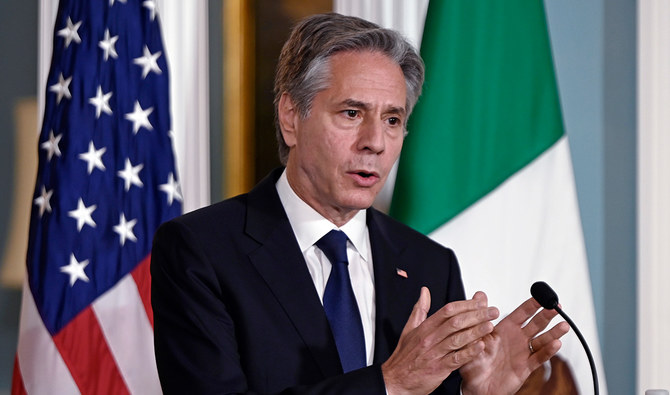
US Secretary of State Antony Blinken speaks to the press alongside Mexican Foreign Secretary Alicia Barcena (out of frame) in the Treaty Room at the US Department of State in Washington, DC, on August 10, 2023. (AFP)
Short Url
Updated 11 August 2023
Follow

Blinken says no sanctions relief for Iran under prisoner deal

  • US in contact with families of five Americans freed from prison, Blinken says
  • The US state secretary says he is not aware of other Americans held in Iran

WASHINGTON: Secretary of State Antony Blinken said Thursday that the United States would offer no sanctions relief to Iran under a draft deal that would free five Americans.

“In any event, in any respect, Iran will not be receiving any sanctions relief,” Blinken told reporters when asked about the expected release of $6 billion in frozen Iranian funds.

“Iran’s own funds would be used and transferred to restricted accounts such that the monies can only be used for humanitarian purposes,” he said.

Blinken said that the United States has been in contact with the families of five Americans freed from prison to house arrest in an expected first step to their release.

“My belief is that this is the beginning of the end of their nightmare, and the nightmare that their families have experienced,” he said.

Blinken said he was not aware of other Americans held in Iran.


Nigerian president vows security reset in budget speech

Updated 6 sec ago
Follow

Nigerian president vows security reset in budget speech

  • Government plans to buy 'cutting-edge' equipment to boost the fighting capability of military


ABUJA: Nigeria’s president vowed a national security overhaul as he presented the government budget, allocating the largest share of spending to defense after criticism over the handling of the country’s myriad conflicts.
Nigeria faces a long-running insurgency in the northeast, while armed “bandit” gangs commit mass kidnappings and loot villages in the northwest, and farmers and herders clash in the center over dwindling land and resources.
President Bola Tinubu last month declared a nationwide security emergency and ordered mass recruitment of police and military personnel to combat mass abductions, which have included the kidnapping of hundreds of children at their boarding school.
He told the Senate that his government plans to increase security spending to boost the “fighting capability” of the military and other security agencies by hiring more personnel and buying “cutting-edge” equipment.
Tinubu promised to “usher in a new era of criminal justice” that would treat all violence by armed groups or individuals as terrorism, as he allocated 5.41 trillion naira ($3.7 billion) for defense and security.
Security officials and analysts say there is an increasing alliance between bandits and extremists from Nigeria’s northeast, who have in recent years established a strong presence in the northwestern and central regions.
“Under this new architecture, any armed group or gun-wielding non-state actors operating outside state authority will be regarded as terrorists,” said Tinubu, singling out, among others, bandits, militias, armed gangs, armed robbers, violent cult groups, and foreign-linked mercenaries.
He said those involved in political or sectarian violence would also be classified as terrorists.
On the economic front, Tinubu hailed his “necessary” but not “painless” reforms that have plunged Nigeria into its worst economic crisis in a generation.
He said inflation has “moderated” for eight successive months, declining to 14.45 percent in the last month from 24.23 percent in March this year.
He projected that the budget deficit will drop next year to 4.28 percent of GDP from around 6.1 percent of GDP in 2023, the year he came into office.