



DUBAI: The film world is full of directors, but few have mastered the challenge of the true tentpole Hollywood blockbuster. Egyptian-American director Ali Selim just did so with aplomb — and made history in the process.
With a reported $212 million budget, Marvel’s “Secret Invasion” is the largest project led by an Arab filmmaker to date, a sprawling sci-fi spy thriller miniseries with an all-star cast. How did he pull it off? By focusing on the human element, even when things were at their biggest.
“For me, it always comes down to creating a space for actors to do that very small, mysterious, quiet thing that they do,” Selim tells Arab News. “Even in a scene where there’s literally 2,000 extras running by and propane bombs going off all around them.”
Those moments can be difficult for myriad reasons, Selim explains. In the first episode of the Disney+ miniseries, for example, Selim was tasked with capturing the shocking death of Maria Hill, the beloved character played for 12 years by actress Cobie Smulders, at the hands of what appears to be Samuel L. Jackson’s iconic character Nick Fury. Saying goodbye after so long is difficult for a performer. Pulling that off as a director took not only skill, but empathy.
“It was the biggest scene we filmed in the entirety of the eight-month shoot, and I just had to create a corner in that chaos where it’s all about her and her moment. And, credit to her, Cobie really pulled it off. My biggest worry was that I might get death threats for killing off Maria Hill, but luckily that didn’t happen,” Selim says.

Samuel L. Jackson as Nick Fury in Marvel Studios’ ‘Secret Invasion.’ (Marvel Studios)
Taking on the world of Marvel can be a daunting task, not only because of the size of each individual project, but also because of the baggage that comes with continuing a story that began when Jackson first stepped in front of the camera as Fury in 2008’s “Iron Man.” “Secret Invasion” picks up where 2019’s billion-dollar-grossing “Captain Marvel” left off, as a fringe group of shape-shifting alien refugees have broken from their peaceful brethren in an attempt to make Earth their own.
Selim was undoubtably the right man for the job, not just because of his extensive experience as a journeyman filmmaker working at every scale and in every genre — not to mention a staggering near 900 television commercials (“856, according to my last invoice,” Selim corrects us). Most importantly, Selim was able to find himself in the story on a personal level because of his heritage and upbringing.
“I pulled out of these scripts a theme that was very interesting to me, as it touches on the sociopolitical landscape we’re living in now. All of this pulses through my veins. My father is from Egypt, and my mother is an American of German descent. I spent extended periods of time in both Egypt and the US growing up, and I always felt both completely at home and completely alien in both places,” he explains.
Selim’s father came from an enormous family — 18 brothers and sisters, of whom 14 survived to adulthood. Each summer, he would spend time with hundreds of his relatives, and connected to Egyptian culture intimately, something that he held to tightly when he returned to school in Minnesota each fall.
“I don’t necessarily look Egyptian to Western eyes, so I was able to avoid prejudice growing up in the US, but I’ve still always felt ‘other’ deep down. Simultaneously, I wouldn’t say I’ve served as a bridge between two cultures, but rather my blood has allowed me to see the invisible bridge that already exists between them — the shared humanity. That has informed not just the way I tell stories, but the way I’ve lived my life,” Selim says.
His connection to the region continues to this day. Abu Bakr Shawky, the director behind the 2018 Cannes favorite “Yomeddine” and the upcoming Ithra-produced Saudi film “Hajjan,” counts Selim as a true mentor. Selim was integral to his own development as a filmmaker, he told us recently, and the Shawky family has also supported Selim on a personal level.
“My daughter is now connecting strongly with Egyptian culture, and Abu Bakr’s father actually helped us navigate the local government agencies so that we could get her Egyptian birth certificate and national ID,” Selim tells us.
His relationship with the region’s best talent has already made its way into his work. In 2016, he was able to work with one of the most-gifted Arab actors working today in his acclaimed miniseries “The Looming Tower,” which follows Algerian-French actor Tahar Rahim as the real-life Muslim Lebanese-American FBI agent Ali Soufan during his counter-terrorism efforts of the late 1990s.
As fulfilling as that experience was for him, Selim has many more stories to tell in the region. He has one upcoming project centered around the life of a major figure from the Arab world that he can’t yet reveal, as well as another that he has been trying to get off the ground for years.
“I won’t say too much, but it begins with that famous scene from ‘Lawrence of Arabia’ in reverse, told from the perspective of a Bedouin man trying to protect his family’s well,” teases Selim.
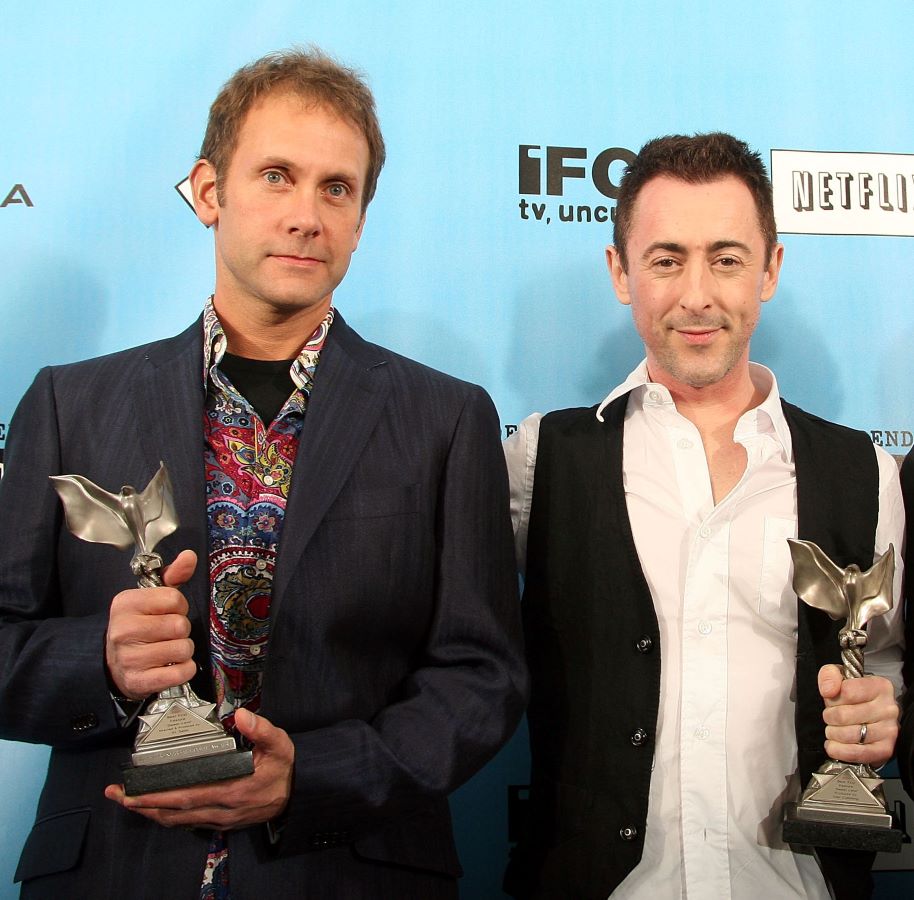
Ali Selim and actor Alan Cumming with the Best First Feature award for ‘Sweet Land’ at the 2007 Independent Spirit Awards. (AFP)
If it weren’t for his father, Selim would likely have never gotten into filmmaking at all. An economics professor at the University of Minnesota, his dad was recruited directly from Egypt by a man named Ed Coen. The two families grew very close and, as a child, Selim would have Sunday dinner at the Coen’s house, with Ed’s two sons, future Oscar winners Joel and Ethan Coen, sitting across from him.
“Ten years later, the two of them made ‘Blood Simple.’ I thought to myself, ‘There’s people that I know who can do this.’ I didn’t think I could be them, but I thought, ‘Why not try?’ Suddenly, the idea that stories are being told by real people made cinema feel attainable to me,” he says.
The filmmaker first stepped into the spotlight with his award-winning independent passion project “Sweet Land” in 2005, but it was his experience on HBO’s acclaimed series “In Treatment” five years later that would set the stage for the rest of his career, as he immediately thrived in the role of a collaborator who could be trusted to execute any vision.
“At the premiere of ‘Sweet Land,’ I remember my producer friend whispered in my ear, ‘I want you to enjoy the heck out of this, because it’s the last time you’ll make a film without adult supervision.’ And he was right. But I learned on ‘In Treatment’ that I loved working with brilliant people, arguing about how to get the right shot or the right performance,” says Selim.
“That’s exactly what I’ve done with ‘Secret Invasion’ too — executing this finely tuned vision led by (Marvel Studios head) Kevin Feige. Sure, it’s different from the maverick independent career I could have had, but I just never think of it that way. I love rolling up my sleeves and sticking my hands in the clay, figuring out how I can connect with something being told on the grandest scale.”


