

Pakistani parliament dissolved, setting the stage for general elections

1 / 2
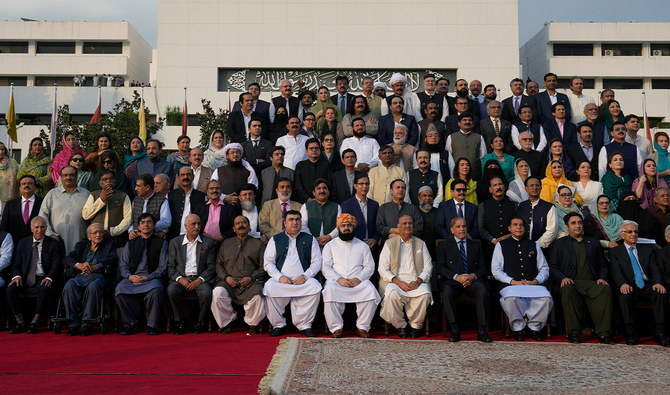
Pakistan's Prime Minister Shehbaz Sharif in a group photo with the members of the National Assembly in Islamabad, Pakistan August 9, 2023. (REUTERS)
2 / 2
The picture posted by the Pakistani president's office shows President Dr. Arif Alvi signing a summary sent by Prime Minister Shehbaz Sharif for the dissolution of the National Assembly in Islamabad, Pakistan on August 9, 2023. (President's Office)
Short Url
Updated 09 August 2023
Follow

Pakistani parliament dissolved, setting the stage for general elections

  • Sharif’s tenure technically expires on August 12, caretaker setup now has up to 90 days to hold general elections
  • Elections likely to be delayed beyond November as fresh constituency boundaries required after new census

ISLAMABAD: Pakistan’s National Assembly stood dissolved on Thursday after President Dr. Arif Alvi signed a summary sent by Prime Minister Shehbaz Sharif, sending the South Asian country into election mode.

The parliament’s five-year term was due to expire on August 12, but this move dissolved it three days earlier, meaning the caretaker government has 90 days to organize general elections, as against 60 days if the assembly had been dissolved when the government’s term expired, as per the constitution.

“The prime minister’s advice at para 6 of the summary is approved,” a notification released by the President House and signed by Alvi said.

Following the president’s decision, the National Assembly and the federal cabinet stand dissolved.

“The president dissolved the National Assembly on the advice of the prime minister under Article 58-1 of the Constitution,” said an official statement issued by the President’s Office.
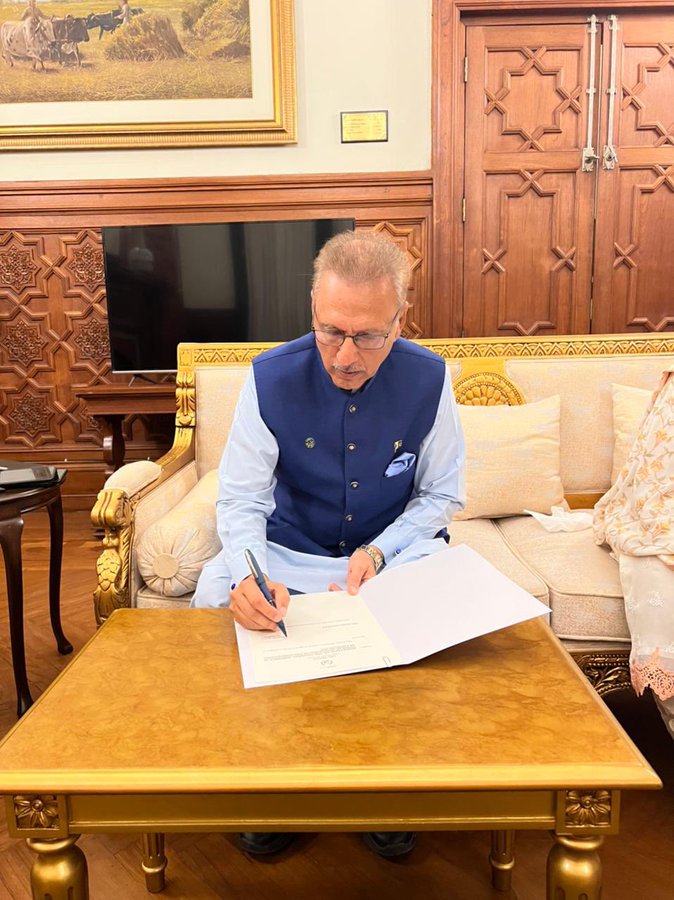


The picture posted by the Pakistani president's office shows President Dr. Arif Alvi signing a summary sent by Prime Minister Shehbaz Sharif for the dissolution of the National Assembly in Islamabad, Pakistan on August 9, 2023. (President's Office)

With parliament dissolved ahead of schedule, general elections would be due by November. But the government’s move last week to approve the results of a fresh digital census has thrown polls into uncertainty, as the Election Commission is now bound under the constitution to draw new constituency boundaries as per the results of the latest population count. That process could take up to six months and would mean polling day is pushed back by months.

The ECP has already said it cannot hold general elections on the basis of the new population count within the stipulated three-month deadline if it has to finalize fresh delimitations of constituencies.

Meanwhile, Pakistan’s myriad economic and political troubles continue.
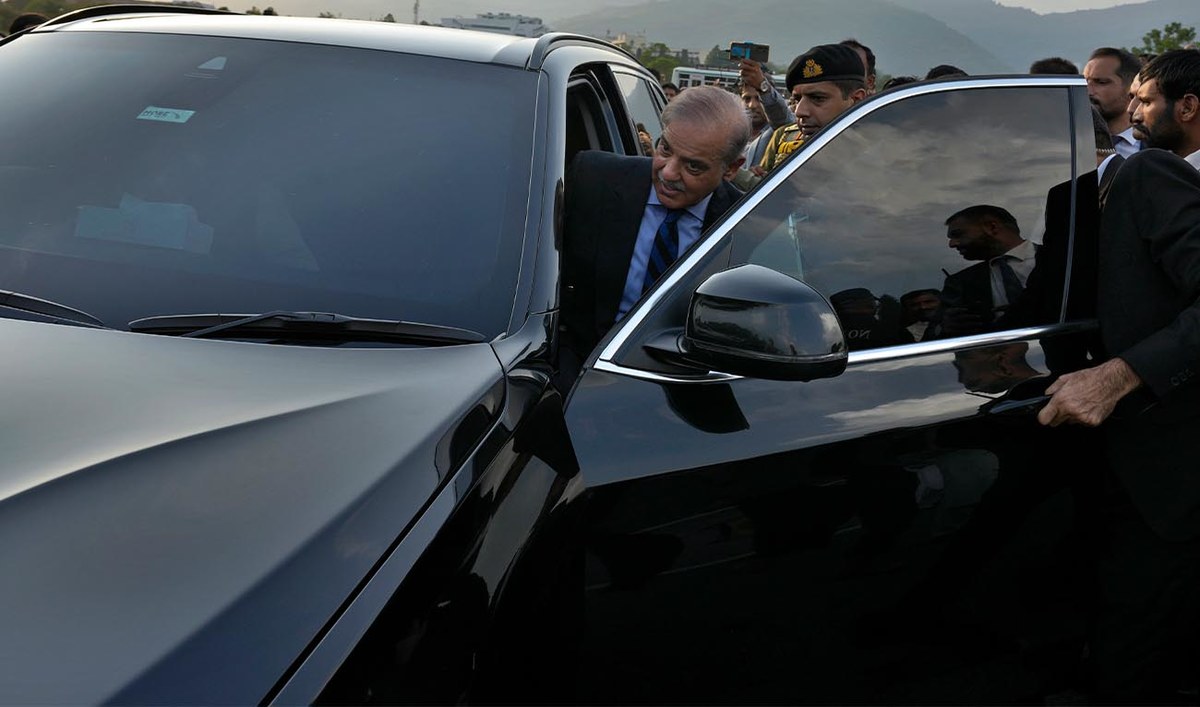


Pakistan's Prime Minister Shehbaz Sharif leaves after a group photo with lawmakers of the National Assembly at the end of the last session of the current parliament, in Islamabad, Pakistan, on August 9, 2023. (AP)

At the heart of the political crisis is former Prime Minister Imran Khan, whose ouster last year plunged the country into months of unrest and violent street protests. The ex-premier, the country’s most popular politician by far, was convicted and jailed on graft charges last week and on Tuesday the election regulator barred him from politics for five years, for all practical purposes ending his chances of running in upcoming elections.

His legal team has appealed the conviction and the disqualification though Khan also faces over 100 other cases, with charges ranging from terrorism to corruption and murder. Khan says the cases are part of the crackdown against him and his Pakistan Tehreek-e-Insaf party, orchestrated by the powerful military establishment and his political opponents. Both deny the charge.

Meanwhile, inflation remains at a record high and millions of ordinary Pakistanis are grappling with a cost-of-living crisis. The country’s Consumer Price Index rose to 28.3 percent in July, year-on-year, with prices up 3.5 percent in July from the previous month. In June, the CPI rise was 29.4 percent year-on-year, coming off a record 38 percent in May. On August 1, Pakistan announced an increase in petrol and diesel prices to meet fiscal objectives laid down in a deal with the International Monetary Fund (IMF), adding further fuel to its sky-high inflation.

Pakistan secured the last-gasp $3 billion deal with the IMF on June 30. Islamabad has committed to a petroleum levy of up to 50 rupees a liter, alongside a string of painful measures, including raising extra revenues, increasing energy prices and a market-based exchange rate, which has already fueled inflation.


Karachi hosts scaled-down Lux Style Awards as industry reflects on recognition, evolving formats, inclusion

Updated 18 min 11 sec ago
Follow

Karachi hosts scaled-down Lux Style Awards as industry reflects on recognition, evolving formats, inclusion

  • 24th edition of prestigious awards held at historic Mohatta Palace after the ceremony in May was canceled
  • Awards introduce new Digital Content Creators category amid changing entertainment and media landscape

KARACHI: Pakistan’s entertainment industry gathered in Karachi on Thursday for a smaller, more intimate ceremony marking the cc, as artists reflected on the importance of recognition, evolving formats and broader inclusion across creative fields.

The awards, considered Pakistan’s longest running and most prestigious entertainment honors, were held at the Mohatta Palace, a departure from previous large-scale events at the Karachi Expo Center. 

Actress Sanam Saeed, who co-hosted the evening, described the ceremony as “small and intimate,” a tone echoed by several attendees.

The scaled-down format followed an unusual year for the awards. The 23rd Lux Style Awards, scheduled to take place in Lahore in May, were canceled amid the brief war between Pakistan and India, with winners announced digitally and trophies delivered to recipients’ homes.

Among the prominent stars attending this year’s ceremony were Fahad Mustafa, Hania Aamir, Mawra Hocane and Yumna Zaidi. Aamir, who won Actor of the Year – Female (Viewers’ Choice), for the hit television drama Kabhi Main Kabhi Tum, said award platforms play a vital role in sustaining creative industries.

“It’s extremely important to appreciate the art that comes out of your country,” she told Arab News at the red carpet. The drama, she noted, resonated beyond Pakistan, trending in Bangladesh and India during its broadcast.

The picture shows entrance of the 24th Lux Style Awards in Karachi, Pakistan, on December 11, 2025. (AN photo)

Addressing fans abroad, Aamir, arguably Pakistan’s most popular celebrity internationally, said:

“Thank you so much for loving beyond borders. We love you as much even more. So thank you so much for appreciating all the hard work that we do.”

She also called for broader recognition across productions. 

“I’d like Lux [Style Awards] and every other award show to have a lot more diverse categories to appreciate every single person who is a part of the team. [And] who actually makes the project come to life.”

The Lux Style Awards have long attracted debate over transparency and credibility, a recurring discussion whenever nominations and winners are announced. 

Still, many artists said the platform remains essential for motivation and visibility.

“Whenever we discuss the awards, no award will be fair because some people will have certain reservations with it,” producer Abdullah Seja of iDream Entertainment told Arab News. “These might be the most authentic awards in Pakistan [but] obviously there is room for improvement in everything.”

Reflecting shifts in Pakistan’s creative economy, the awards introduced a separate category this year for Digital Content Creators. The inaugural trophy went to real-life couple Rabya Kulsoom and Rehan Nazim, known online as ‘Ron and Cocco’.

“The credit goes to Lux [Style Awards] for introducing the category because content creation is not easy,” Nazim said. “Whoever is doing it, it’s a difficult job. And now it has become a full-time job. You can’t take it lightly and do it on the side. So, we need to recognize the people who are doing it.”

Actress Yumna Zaidi, who won her first film award for Nayab, described the ceremony’s return to Karachi as significant. 

“I am so glad that it’s happening in Karachi because it’s been a while,” she said, adding, “Lux [Style Awards] are the strongest because it includes nominations from all the channels and it’s the strongest [competition].”

Mawra Hocane, whose drama Jafaa was nominated for TV Play of the Year (Critics’ Choice), said meaningful storytelling mattered more than trophies. 

“Platforms [like these] are very very important but more than that what’s important is that a project strikes a chord with the audience,” she said.

“I do my projects so that we can work on the position of women in society. [And] somehow elevate them, somehow create some space for them. And I think ‘Jafaa’ has done that.”

Music remained a central draw of the evening. 

Co-host Sanam Saeed said she was particularly looking forward to live performances. 

“Music is the kind of genre that bonds people together and puts Pakistan on the map,” she said. 
“We become one when it comes to music, forgetting all the distance, limitations and borders. [And] Our music does that.”

Singer and songwriter Hasan Raheem, popular among younger audiences, also performed during the ceremony and reflected on the value of such platforms. 

“These [platforms] are important, honestly,” he said. “I feel like things like these should happen because the real present and the gift that I personally get is the love from people that is the epitome of all the awards. I can never get a better award than that.”