

Taliban reject Pakistan’s ‘repeated allegations’ blaming Afghans for rise in militant attacks 

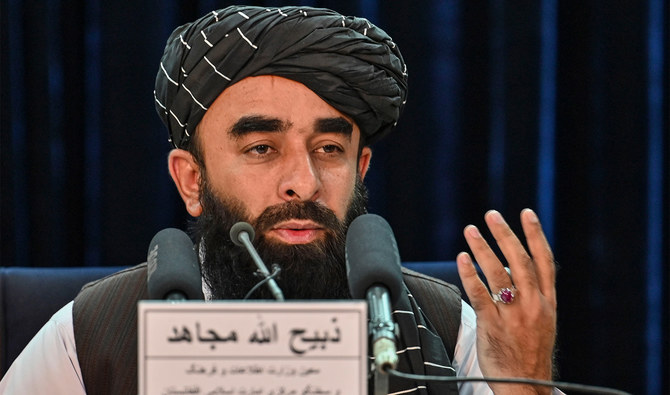
In this file photo, Taliban spokesman Zabihullah Mujahid addresses a press conference at government media and information center in Kabul, Afghanistan on Oct. 30, 2021. (AFP)
Short Url
Updated 09 August 2023
Follow

Taliban reject Pakistan’s ‘repeated allegations’ blaming Afghans for rise in militant attacks 

  • Statement comes following uptick in deadly violence in Pakistan
  • Pakistani PM recently said militants were being helped by ‘Afghan citizens’

KABUL: Afghanistan’s Taliban administration has rejected allegations made by Pakistani officials on the string of attacks in the neighboring country, and said Islamabad is responsible for finding a solution on its own.

Pakistan’s Prime Minister Shehbaz Sharif said last week that militants behind the spate of suicide attacks in the country – including a blast that killed at least 63 people in northwestern Pakistan in July – were being helped by “Afghan citizens” across the border.

“After the recent security incident in Pakistan, officials have once again blamed Afghans instead of strengthening the security of their country,” Zabihullah Mujahid, chief spokesman for Afghanistan’s Taliban administration, said in a statement issued on Tuesday night.

“The Islamic Emirate of Afghanistan strongly rejects these allegations and insists that Afghanistan is a country that has come out of a long-lasting war and it does not want to threaten the security of any country, specially neighboring countries.”

Pakistani officials have blamed the uptick in militant attacks on the outlawed Tehreek-e-Taliban Pakistan or TTP, which Islamabad says was emboldened by the Afghan Taliban takeover in 2021.

Though the TTP openly pledged allegiance to the Afghan Taliban after the fall of Kabul in 2021, they were not accepted by the latter and remained a separate militant group.

“The Islamic Emirate of Afghanistan once again emphasize that it is not in favor of any attack on Pakistan and we will not allow anyone to use the soil of Afghanistan against Pakistan,” Mujahid said.

“However, it is not our responsibility to prevent and control attacks inside the territory of Pakistan.”

Afghan officials have responded to similar allegations in the past in the same way, including when Foreign Minister Mawlawi Amir Khan Muttaqi met with Pakistan’s special envoy for Afghanistan Asif Durrani in Kabul last month.

Afghanistan and Pakistan should find a “common solution” when attacks occur, Mujahid said, as he highlighted that “blaming is not the solution.”

“In the past two years, since the establishment of Islamic Emirate in Afghanistan, the security situation of the country and the region has improved significantly,” Mujahid said. “The security incidents have increased only in Pakistan; it is the responsibility of the country to find a solution on its own.”

Mohammad Sadiq Shinwari, a security analyst based in Kabul, told Arab News on Wednesday that Pakistan’s allegations could “damage the strategic and diplomatic relations of both countries.”

“If Pakistan wants to solve the existing problems, it should share its intelligence issues … with the intelligence officials of the Afghan government so that the existing problems can be solved,” Shinwari said.


Pakistan, global crypto exchange discuss modernizing digital payments, creating job prospects 

Updated 05 December 2025
Follow

Pakistan, global crypto exchange discuss modernizing digital payments, creating job prospects 

  • Pakistani officials, Binance team discuss coordination between Islamabad, local banks and global exchanges
  • Pakistan has attempted to tap into growing crypto market to curb illicit transactions, improve oversight

ISLAMABAD: Pakistan’s finance officials and the team of a global cryptocurrency exchange on Friday held discussions aimed at modernizing the country’s digital payments system and building local talent pipelines to meet rising demand for blockchain and Web3 skills, the finance ministry said.

The development took place during a high-level meeting between Finance Minister Muhammad Aurangzeb, Pakistan Virtual Assets Regulatory Authority (PVARA) Chairman Bilal bin Saqib, domestic bank presidents and a Binance team led by Global CEO Richard Teng. The meeting was held to advance work on Pakistan’s National Digital Asset Framework, a regulatory setup to govern Pakistan’s digital assets.

Pakistan has been moving to regulate its fast-growing crypto and digital assets market by bringing virtual asset service providers (VASPs) under a formal licensing regime. Officials say the push is aimed at curbing illicit transactions, improving oversight, and encouraging innovation in blockchain-based financial services.

“Participants reviewed opportunities to modernize Pakistan’s digital payments landscape, noting that blockchain-based systems could significantly reduce costs from the country’s $38 billion annual remittance flows,” the finance ministry said in a statement. 

“Discussions also emphasized building local talent pipelines to meet rising global demand for blockchain and Web3 skills, creating high-value employment prospects for Pakistani youth.”

Blockchain is a type of digital database that is shared, transparent and tamper-resistant. Instead of being stored on one computer, the data is kept on a distributed network of computers, making it very hard to alter or hack.

Web3 refers to the next generation of the Internet built using blockchain, focusing on giving users more control over their data, identity and digital assets rather than big tech companies controlling it.

Participants of the meeting also discussed sovereign debt tokenization, which is the process of converting a country’s debt such as government bonds, into digital tokens on a blockchain, the ministry said. 

Aurangzeb called for close coordination between the government, domestic banks and global exchanges to modernize Pakistan’s payment landscape.

Participants of the meeting also discussed considering a “time-bound amnesty” to encourage users to move assets onto regulated platforms, stressing the need for stronger verifications and a risk-mitigation system.

Pakistan has attempted in recent months to tap into the country’s growing crypto market, crack down on money laundering and terror financing, and promote responsible innovation — a move analysts say could bring an estimated $25 billion in virtual assets into the tax net.

In September, Islamabad invited international crypto exchanges and other VASPs to apply for licenses to operate in the country, a step aimed at formalizing and regulating its fast-growing digital market.