Poland to double troops number at border with Belarus, accuses it of organizing illegal migration

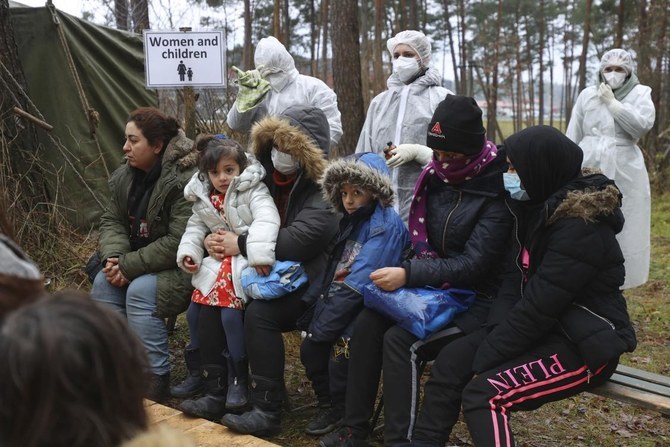
The Polish government announced Wednesday that it is planning to deploy an additional 2,000 troops to its border with Belarus, twice the number the Border Guard agency had requested, as fears of illegal migration rise. (AP/File)
Short Url
Updated 09 August 2023
Follow

Poland to double troops number at border with Belarus, accuses it of organizing illegal migration

  • Deputy interior minister Maciej Wasik announced the decision and accused the Belarusian authorities of organizing illegal migration
  • Polish authorities retaliated by building a tall steel wall, which has reduced the numbers of migrants and refugees crossing the border

WARSAW: The Polish government announced Wednesday that it is planning to deploy an additional 2,000 troops to its border with Belarus, twice the number the Border Guard agency had requested, as fears of illegal migration rise.
In an interview with state news agency PAP, a deputy interior minister, Maciej Wasik announced the decision and accused the Belarusian authorities of organizing illegal migration.
He said migration pressure on the Polish-Belarusian border area is growing, although it cannot compare to the situation two years ago.
At the time, large numbers of migrants from the Middle East and Africa arrived at the border, their travel there facilitated by flights and visas provided by the Minsk government — something Warsaw considered to be a form of “hybrid warfare.”
“If we had real border guards on the other side and not a smuggling service, these crossings would not exist at all,” Wasik said.
Polish authorities retaliated by building a tall steel wall, which has reduced the numbers of migrants and refugees crossing the border, but did not stop them entirely.
The fallout from Russia’s war against Ukraine has brought other concerns, including the presence of Russia-linked Wagner group mercenaries in Belarus this summer after their short-lived mutiny in Russia.
Earlier this week Belarus also began military exercises near its border with Poland and Lithuania. And last week two Belarusian helicopters flew briefly into Polish air space in what was viewed by Warsaw as a deliberate provocation.
The new troops will be an addition to the 2,000 already at the border. They support the work of hundreds of police and Border Guard officers, according to PAP.
Wasik said the new troops would reach their destination within the coming two weeks.
Poland’s President Andrzej Duda announced Tuesday that Poland will hold its parliamentary election on Oct. 15. The ruling authorities that he is allied with have been trying to show voters that they are serious about security and defense as they seek a third term.


In rare overlap, Chinese Muslims observe Ramadan with Lunar New Year

Updated 19 February 2026
Follow

In rare overlap, Chinese Muslims observe Ramadan with Lunar New Year

  • Lunar New Year started on Feb. 17 and is celebrated for another two weeks
  • Chinese Indonesians make up about 3 percent of the Indonesian population

JAKARTA: Every year, on the first day of Lunar New Year, Febriani visits relatives and gathers for a feast with her Chinese Muslim family, part of a long-standing tradition honoring their ethnic heritage.

But this year, as Thursday marks the beginning of Ramadan, she is celebrating two important occasions within the same week, in a rare overlap that last took place in 1995.

“I’m very happy and grateful that Lunar New Year and Ramadan are celebrated so closely. I observe both every year, so it’s truly special,” she told Arab News.

Widely observed across Asia, the Lunar New Year or Chinese New Year festival is believed to date back to the 14th century B.C., to the times of the Shang Dynasty, China’s earliest ruling dynasty, when people celebrated good harvests.

In 2026, it started on Feb. 17 and is celebrated for another two weeks. For many, celebrations typically involve elaborate feasts, giving children pocket money in red envelopes, and watching dragon dance parades.

In Indonesia, Chinese-descent citizens make up an estimated 3 percent of the country’s Muslim-majority population of more than 280 million. While most are either Buddhists or Christians, a small minority professes Islam.

For 25-year-old Febriani, both Lunar New Year and Ramadan are equally meaningful.

“The two celebrations teach us to strengthen bonds, to share with one another, and to become closer to family,” she said.

“They are both important to me because they happen only once every year and they’re always an occasion to gather with the extended family. It is also a chance to self-reflect and strengthen relationships with your loved ones.”

For Naga Kunadi, whose family lives in Central Java’s Cepu district, Chinese New Year is all about embracing his ethnic identity.

Earlier in the week, his family was busy preparing for the new year’s feast, which was a fusion of Chinese and Indonesian dishes, such as claypot tofu, meatball soup and shumai, or steamed dumplings.

“To celebrate Chinese New Year, we prepared halal Chinese food at home. It’s also a way to introduce to my children the traditions from our Chinese side, but there’s a bit of a fusion because my wife is Javanese,” Kunadi told Arab News.

Kunadi, an Islamic teacher at the Lautze Mosque in Jakarta, sees both Chinese New Year and Ramadan as opportunities to teach important life values for his two children. 

Upholding Chinese New Year traditions with his family is for him a way of preserving his ethnic heritage.

“We want to preserve cultural values as long as it does not clash with our religion,” he said.

“If we leave our culture behind, we might lose our identity, so this is something I want to teach my children.”

The fasting month of Ramadan, on the other hand, gives him a chance to teach and practice honesty.

“I want to focus on the religious and moral aspects during the holy month of Ramadan, when we practice honesty on a personal level,” Kunadi said.

“There’s always an opportunity to eat or snack in secret without anybody knowing, but we train ourselves not to do that. For me, Ramadan is a time for everyone to put honesty into practice, including myself and my children.”