

Berlin ready to extend Patriot air defence deployment to Poland until end of 2023

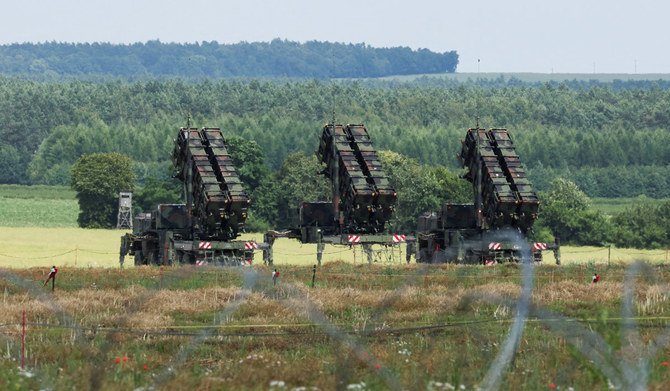
German Patriot air defence system units are seen at the military base, during German Defence Minister Boris Pistorius' visit, near Zamosc, Poland July 3, 2023. (REUTERS)
Short Url
Updated 09 August 2023
Follow

Berlin ready to extend Patriot air defence deployment to Poland until end of 2023

  • Relations between Berlin and the ruling nationalist Law and Justice (PiS) party in Warsaw have been strained, with both sides at odds over a range of topics - from arms deliveries to Kyiv to an EU migration deal rejected by Poland

BERLIN: Germany has offered to extend the deployment of three Patriot air defence units in Poland until the end of 2023, the defence ministry in Berlin said on Tuesday.
"An extension beyond the end of 2023 is not foreseen," the ministry said in a statement, adding that some of Germany's Patriot units were needed for use by NATO's quick reaction response force in 2024, while others had to undergo maintenance.
Together with three Patriot air defence units, some 300 German soldiers have been based in the Polish town of Zamosc, about 50 km (31 miles) from the Ukrainian border, since the start of the year to protect the southern town and its crucial railway link to Ukraine.
The deployment was triggered by a stray Ukrainian missile that struck the Polish village of Przewodow in the region last November, in an incident that raised fears of the war in Ukraine spilling over the border.
During a visit to Zamosc in July, German Defence Minister Boris Pistorius had not immediately responded to a request by his Polish counterpart to extend the Patriot mission.
Relations between Berlin and the ruling nationalist Law and Justice (PiS) party in Warsaw have been strained, with both sides at odds over a range of topics - from arms deliveries to Kyiv to an EU migration deal rejected by Poland.
Ground-based air defence systems such as Raytheon's Patriot are built to intercept incoming missiles.
They are, however, in short supply across NATO since many allies scaled down the number of air defence units after the Cold War.
Russia's invasion of Ukraine sent NATO allies scrambling to plug the gaps in their own inventories, while also supplying Kyiv with air defence systems to ward off Russian attacks.


Nigeria signals more strikes likely in ‘joint’ US operations

Updated 53 min 50 sec ago
Follow

Nigeria signals more strikes likely in ‘joint’ US operations

  • Nigeria on Friday signalled more strikes against jihadist groups were expected after a Christmas Day bombardment by US forces against militants in the north of the country

LAGOS: Nigeria on Friday signalled more strikes against jihadist groups were expected after a Christmas Day bombardment by US forces against militants in the north of the country.
The west African country faces multiple interlinked security crises in its north, where jihadists have been waging an insurgency in the northeast since 2009 and armed “bandit” gangs raid villages and stage kidnappings in the northwest.
The US strikes come after Abuja and Washington were locked in a diplomatic dispute over what Trump characterised as the mass killing of Christians amid Nigeria’s myriad armed conflicts.
Washington’s framing of the violence as amounting to Christian “persecution” is rejected by the Nigerian government and independent analysts, but has nonetheless resulted in increased security coordination.
“It’s Nigeria that provided the intelligence,” the country’s foreign minister, Yusuf Tuggar, told broadcaster Channels TV, saying he was on the phone with US State Secretary Marco Rubio ahead of the bombardment.
Asked if there would be more strikes, Tuggar said: “It is an ongoing thing, and we are working with the US. We are working with other countries as well.”
Targets unclear
The Department of Defense’s US Africa Command, using an acronym for the Daesh group, said “multiple Daesh terrorists” were killed in an attack in the northwestern state of Sokoto.
US defense officials later posted video of what appeared to be the nighttime launch of a missile from the deck of a battleship flying the US flag.
Which of Nigeria’s myriad armed groups were targeted remains unclear.
Nigeria’s jihadist groups are mostly concentrated in the northeast of the country, but have made inroads into the northwest.
Researchers have recently linked some members from an armed group known as Lakurawa — the main jihadist group located in Sokoto State — to Islamic State Sahel Province (ISSP), which is mostly active in neighboring Niger and Mali.
Other analysts have disputed those links, though research on Lakurawa is complicated as the term has been used to describe various armed fighters in the northwest.
Those described as Lakurawa also reportedly have links to Al-Qaeda affiliated group for the Support of Islam and Muslims (JNIM), a rival group to ISSP.
While Abuja has welcomed the strikes, “I think Trump would not have accepted a ‘No’ from Nigeria,” said Malik Samuel, an Abuja-based researcher for Good Governance Africa, an NGO.
Amid the diplomatic pressure, Nigerian authorities are keen to be seen as cooperating with the US, Samuel told AFP, even though “both the perpetrators and the victims in the northwest are overwhelmingly Muslim.”
Tuggar said that Nigerian President Bola Tinubu “gave the go-ahead” for the strikes.
The foreign minister added: “It must be made clear that it is a joint operation, and it is not targeting any religion nor simply in the name of one religion or the other.”