

Government arranges 'solidarity walk' as Pakistan marks 4th anniversary of India's revocation of Kashmir autonomy

1 / 2
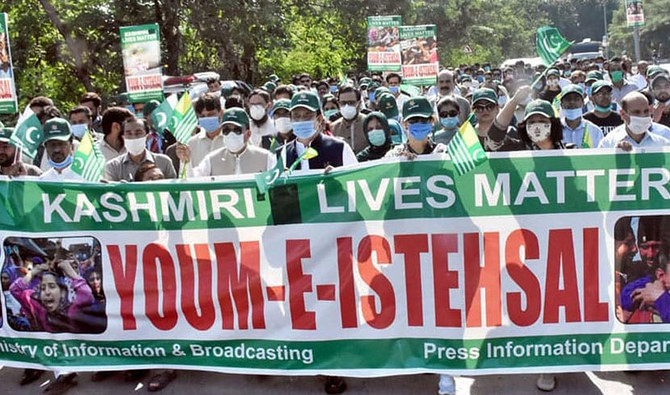
Pakistan government organizes solidarity walk to observe a day of protest over India's revocation of the special autonomous status of Kashmir, in Islamabad, Pakistan on August 5, 2023. (Photo courtesy: @SharpMediaNetx/Twitter)
2 / 2
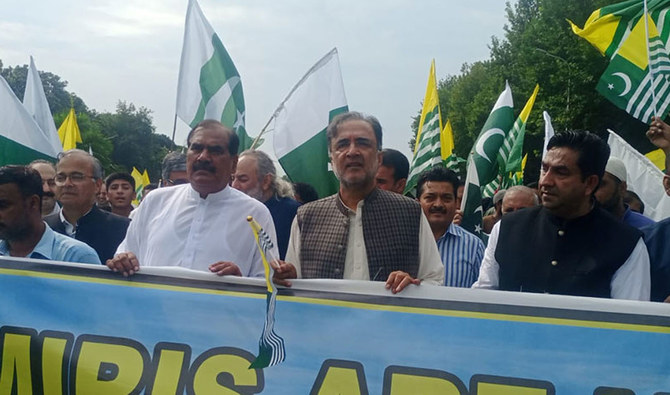
Pakistani politicians join solidarity walk to observe a day of protest over India's revocation of the special autonomous status of Kashmir, in Islamabad, Pakistan on August 5, 2023. (Photo courtesy: @RadioPakistan/Twitter)
Short Url
Updated 05 August 2023
Follow

Government arranges 'solidarity walk' as Pakistan marks 4th anniversary of India's revocation of Kashmir autonomy

  • On August 5, 2019, New Delhi revoked autonomy of the part of Kashmir it controls, dividing it into two federal territories 
  • The move’s immediate implications were that India’s only Muslim-majority region lost its flag, criminal code and constitution 

ISLAMABAD: Pakistanis are observing a day of protest today, on Saturday, over India’s revocation of the special autonomous status of the part of Kashmir it controls, which divided the region into two federal territories four years ago. 

India’s sudden move divided the region into Ladakh and Jammu-Kashmir federal territories, both ruled directly by New Delhi without a legislature of their own and run by bureaucrats. 

The move’s immediate implications were that India’s only Muslim-majority region lost its flag and constitution. Since then, New Delhi has enacted a slew of administrative changes, including a residency law that made it possible for Indian nationals to become permanent residents of the region. 

Pakistanis are observing a day of protest, or ‘Youm-e-Istehsal,’ to express solidarity with the Kashmiri people over the annexation of the disputed territory. In this regard, a “solidarity walk” was also held in the Pakistani capital of Islamabad early Saturday, along with rallies elsewhere in the country. 

“Pakistan will continue to lend its unstinted moral, political and diplomatic support to the rightful and just cause of the freedom struggle of the Kashmiri people,” Prime Minister Shehbaz Sharif said in a statement, shared by his office. 

“It is Pakistan’s abiding commitment and promise to our Kashmiri brothers and sisters that we will echo their voices at every forum until the world takes action and urges India to end its human rights violations and forcible occupation.” 

Kashmir has been divided between Pakistan and India since their independence from the British rule in 1947. Both countries claim the Himalayan territory in its entirety and have fought two of their four wars over it. 

In a separate statement, President Arif Alvi said Pakistan would continue to be the voice of the Kashmiri people and extend all possible support for the “fullest realization of their legitimate rights.” 

“We have no doubt that durable peace and stability in South Asia can only be achieved through a peaceful resolution of the Jammu and Kashmir dispute, in accordance with the relevant UN Security Council resolutions and the wishes of the Kashmiri people.” 


Pakistan minister calls for integrating ocean awareness into education to preserve ecosystems

Updated 5 sec ago
Follow

Pakistan minister calls for integrating ocean awareness into education to preserve ecosystems

  • Pakistan’s maritime sector posted a record $360 million profit in 2025 following a year of sweeping reforms
  • Junaid Anwar Chaudhry says education equips youth to make informed decisions, contribute to blue economy

KARACHI: Pakistan’s Maritime Affairs Junaid Anwar Chaudhry has urged integrating ocean awareness into formal education systems and empowering youth as active partners in order to preserve marine ecosystems, his ministry said on Saturday.

Chaudhry said this at a meeting with Minister of State for Education and Professional Training, Wajiha Qamar, who called on him and discussed strategies for enhancing marine education, literacy, and youth engagement in sustainable ocean management.

Pakistan’s maritime sector posted a record Rs100 billion ($360 million) profit in 2025 following a year of sweeping reforms aimed at improving port efficiency, cost-cutting, and safeguarding marine ecosystems to boost the blue economy.

“Understanding our oceans is no longer optional, it is essential for climate resilience, sustainable development, and the long-term health of our maritime resources,” Chaudhry said, highlighting the critical role of marine literacy.

The minister said education equips youth to make informed decisions and actively contribute to marine conservation and the blue economy, urging inclusion of marine ecosystems, conservation and human-ocean interactions into curricula, teacher training and global citizenship programs.

“Initiatives like ‘Ocean Literacy for All’ can mainstream these elements in national policies, school programs, and community workshops to build proactive citizenship on marine challenges,” he added.

Ocean Literacy for All is a UNESCO Intergovernmental Oceanographic Commission–coordinated global initiative under the UN Ocean Decade (2021–2030) that promotes ocean awareness, education, and conservation.

Chaudhry announced reforms in maritime education, including granting degree-awarding status to the Pakistan Marine Academy, and the establishment of the Maritime Educational Endowment Fund (MEEF) to provide scholarships for deserving children from coastal communities.

“The scholarship program promotes inclusive development by enabling access to quality education for youth from over 70 coastal and fishing communities, particularly in Sindh and Balochistan,” he said.

The discussions underscored raising awareness about oceans, coastal ecosystems and marine resources, according to the Pakistani maritime affairs ministry. Both ministers stressed the need to integrate climate and marine education from classrooms

to community programs, addressing risks like rising sea temperatures, coastal erosion, biodiversity loss and pollution.

“Incorporating marine science and ocean literacy into curricula can help students connect local challenges with global trends,” Qamar said, underscoring education’s transformative power in building social resilience.

The meeting explored translating complex marine science into accessible public knowledge through sustained, solution-oriented awareness campaigns, according to the maritime affairs ministry.

With coastline facing pressures from climate change, pollution, and overexploitation, the ministers called for a coordinated approach blending formal education, informal learning and youth-led advocacy.

“A joint effort by the Ministries of Maritime Affairs and Education can cultivate an ocean-literate generation, transforming vulnerability into resilience and ensuring the long-term sustainability of coastal and marine ecosystems,” Chaudhry said.