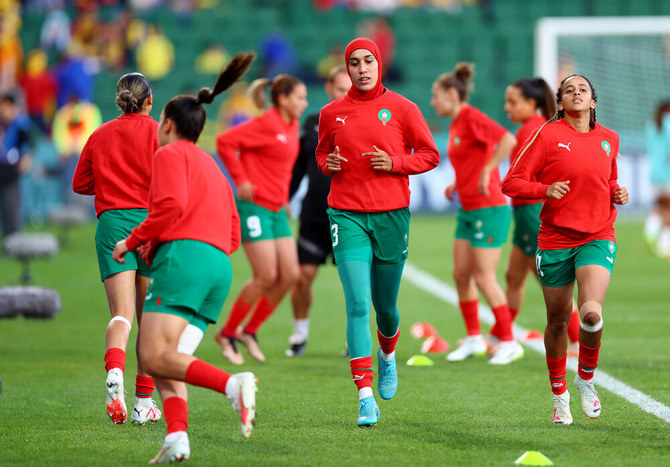
They all went in different directions. Some hugged those nearest, some fell to their knees in prayer and disbelief, and some just ran around not knowing what to do with themselves.
The reaction of the Moroccan players as it all ended was surely matched by fans back home after the stunning 1-0 win over Colombia in Perth, Australia, on Thursday.
Less than eight months after the men reached the semifinals of Qatar 2022, the women’s team, unbelievably, reached the knockout stages of their first ever Women’s World Cup.
This is truly a golden era for Moroccan football.
It could be argued that this latest achievement matches the first, but either way, this is simply stunning.
When the Atlas Lionesses lost their first ever World Cup game 6-0 to Germany on July 24 in Melbourne, the reaction was that the team needed time and experience to compete at this level. After all, this was a game between the two-time world champions, a team ranked second in the world, and a North African debutant, a full 70 places lower.
As the full-time whistle sounded in that game, nobody would have imagined that just a few days later Morocco would be going through to the last 16 and that the mighty Germans would be going home.
Nobody could have conceived that, on Thursday, it would be the Europeans wandering around tearful and shell-shocked in Brisbane at the end of their 1-1 draw with South Korea while the Moroccans would be running around the Perth pitch, thousands of kilometers to the west, celebrating after beating the Group H leaders to take second place and become not just the first Arab team to appear at the competition, but also to progress past the group stage.
Here is what happened in between. After the first game thrashing, Morocco bounced back by beating South Korea 1-0. That gave Reynald Pedros’ team a little hope. Germany lost their second game to Colombia. That meant that the last win over the South Americans was enough to progress, as Germany just could not find the all-important second goal to defeat the Koreans.
For those watching back home in Rabat, Fez, Marrakesh and everywhere else in the Arab world, there was much more to it than that. It was a double agony. First they had to wait for the final whistle to ensure that the three points came against Colombia. The lead had been taken just before the break due to what was a fairly soft penalty as Ibtissam Jraidi was brought down in the area. The legendary Ghizlane Chebbak stepped up only to see her kick saved, before Anissa Lahmani came in to shoot home the rebound.
Of course, there was plenty of Colombian pressure in the second half and while Morocco defended resolutely and Khadija Er-Rmichi made some top-class saves, this was no mere backs-to-the-wall performance full of desperate defending, but one of a team that looked to get forward whenever possible, and it was only in the final few minutes that they started to look tired.
When the whistle came, there were celebrations from the players, but the atmosphere soon went quiet as the realization set it that the group’s other game had yet to finish. Indeed, there were 16 minutes of injury time in Brisbane.
So, then came the second agonizing wait, to see if Korea — by this time aware that they were heading home and out of the competition — could hold on in the face of serious pressure from Germany, the team that reached the final of the European Championships last year. This time, the Moroccan players shared the pain, helplessness but growing excitement with those back home and gathered in a huddle on the pitch, along with coaching staff, to watch the game on their phones. Then the second whistle sounded, the impossible had happened and women’s football in Morocco will never be the same again.
Now they go on to face France in Adelaide on Aug. 8 in a chance to avenge the men’s defeat in the last four last December.
Whatever happens, this has already been a success and it could be argued that it ranks alongside what the men managed in Qatar. Morocco had already appeared at five World Cups before 2022, reaching the knockout stage in 1986 and performing well in a very tough group in 2018. With the likes of Achraf Hakimi and Hakim Ziyech playing at the top levels of European football, they won a tough group, finishing above Croatia and Belgium, and going on to eliminate Spain and then Portugal before coming up against the defending world champions and giving France a tough game.
That was truly heroic, and the side became the darlings of the tournament, but the women have come a long way in such a short period of time. Before 2022, they had only ever appeared at two Women’s Africa Cup of Nations, winning just a single game in total. It could have in no way been said that this side was a powerhouse of the continental football scene. Reaching the continental final on home soil last year electrified the nation, but it was the first taste of international success that the team had ever managed.
Coming into the World Cup, they were ranked 31 out of the 32 participants with only Zambia placed lower. Then came that 6-0 loss. After that, it would have been easy to just focus on not losing face and avoiding embarrassment, but the players picked themselves up and conjured up two very famous wins against teams with more pedigree.
Now, just as when players went off in every direction when the big moment came on Thursday, nobody knows where or how far this Moroccan team can go.


![]()

Atlas Lionesses secure their legacy in Moroccan football’s golden era
Short Url
https://arab.news/r3emq
Atlas Lionesses secure their legacy in Moroccan football’s golden era
- Qualification to knockout stages of Women’s World Cup compares with men’s semifinal appearance at Qatar 2022
- Morocco’s 1-0 win over Colombia on Thursday means they now face France in Round of 16

Latest updates


© 2026 SAUDI RESEARCH & PUBLISHING COMPANY, All Rights Reserved And subject to Terms of Use Agreement.