

Diaz scores again as hosts Morocco beat Cameroon to reach AFCON semis

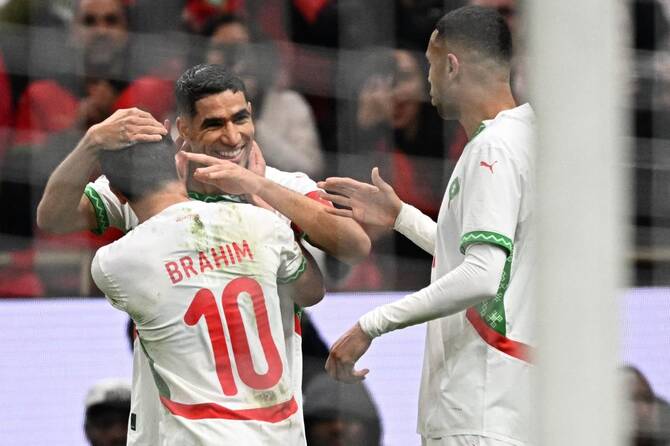
Morocco’s defender Achraf Hakimi and forward Brahim Diaz celebrate their team second goal during the Africa Cup of Nations quarter-final match against Cameroon at the Prince Moulay Abdallah stadium in Rabat on Jan. 9, 2026. (AFP)
Short Url
Updated 10 January 2026
Follow

Diaz scores again as hosts Morocco beat Cameroon to reach AFCON semis

  • Diaz’s fifth goal in five matches at the tournament was followed by Saibari’s strike in the second half
  • Morocco are under enormous pressure to win the Cup of Nations in front of their own fans

RABAT: Brahim Diaz kept up his remarkable Africa Cup of Nations scoring record and Ismael Saibari was also on target as hosts Morocco beat Cameroon 2-0 in their quarter-final showdown on Friday to keep their title dreams alive.
Real Madrid winger Diaz got the decisive touch to Ayoub El Kaabi’s 26th-minute header in front of more than 64,000 fans at the Prince Moulay Abdellah Stadium in capital Rabat.
Diaz’s fifth goal in five matches at the tournament was followed by Saibari’s strike in the second half, with Morocco well worth their victory as they progress to a semifinal against the winner of Saturday’s clash between Algeria and Nigeria.

That promises to be a stiffer test for Walid Regragui’s team than that posed by Cameroon, who were hoping to spring an upset having already exceeded expectations in coming this far after a troubled build-up to the tournament.
The Indomitable Lions, five-time African champions, created little with Manchester United forward Bryan Mbeumo struggling to make an impact.
Morocco, Africa’s top-ranked team and World Cup semifinalists in 2022, are under enormous pressure to win the Cup of Nations in front of their own fans, half a century after their last continental title.
There have been doubts as to whether they can handle the weight of expectation, but they remain on course to achieve their objective — it is the first time Morocco have reached the AFCON semifinals since they lost the 2004 final to Tunisia.

The hosts were unchanged from their 1-0 last-16 win over Tanzania as they looked to continue an unbeaten record going back to their defeat by South Africa at the 2024 AFCON.
Fresh from knocking out South Africa in the last round here, Cameroon were clearly banking on frustrating Morocco as much as possible in an attempt to turn the crowd against the home side.

- Saibari seals it -

Morocco were beaten by the Cameroonians in the semifinals the last time they hosted AFCON in 1988, but a repeat outcome never really looked likely.
David Pagou’s team were not helped by the early loss of right wing-back Jackson Tchamadeu, who tried to carry on after Noussair Mazraoui landed heavily on his knee before eventually being stretchered off.

Moments after that, Morocco scored. Achraf Hakimi sent in a corner from the right which was headed toward goal by El Kaabi at the near post, and the ball struck Diaz in the groin before going in.
That calmed a frenetic home support, who cheered their team off at the break after seeing Abde Ezzalzouli and El Kaabi come close to adding further goals.
Morocco were on top, and Cameroon’s response was to change formation after the break, from a back three to a 4-2-3-1, in an attempt to create more danger.
Ezzalzouli headed just over from a Hakimi corner, and then a cross by the Paris Saint-Germain star caused havoc in the Cameroon box as Samuel Kotto hooked the ball away from the line.
Mbeumo had appeals for a penalty dismissed by the Mauritanian referee before PSV Eindhoven’s Saibari fired in the killer second goal on 74 minutes after controlling Ezzalzouli’s dead-ball delivery, as Morocco march on to Wednesday’s semis.


MESIF 2026 wraps up in Riyadh with spotlight on legacy, fans and sustainable sports growth

Updated 28 January 2026
Follow

MESIF 2026 wraps up in Riyadh with spotlight on legacy, fans and sustainable sports growth

  • A recurring theme in panel discussions was the importance of moving beyond siloed planning toward connected strategies
  • Abdullah Aldrees: I believe Saudi is a sleeping giant within the football ecosystem because of the high demand that exists

RIYADH: The sixth edition of the Middle East Sports Investment Forum concluded on Jan. 28 in Riyadh, reinforcing the need for long-term legacy planning, integrated infrastructure development and fan-centric strategies as the region’s sports ecosystem continues to mature.

Held over two days — Jan. 27-28 — at the ministry of investment headquarters and the Kingdom Arena, the forum brought together senior government officials, global sports executives, investors and technology leaders to assess how the Middle East — and Saudi Arabia in particular — can translate major event hosting and increased investment into sustainable impact.

A recurring theme in panel discussions was the importance of moving beyond siloed planning toward connected strategies that link infrastructure, finance, fan engagement and legacy from the earliest stages of project development.

Dr. Sakis Batsilas, deputy CEO of FIFA World Cup Qatar 2022, stressed that while international expertise has played a key role in the region’s rapid progress, long-term success depends on knowledge transfer and talent development.

“Yes, we do need experts and consultants and expatriates to help,” he said. “But the main, I would say, focus, is how we ensure that we transfer this knowledge and we build talent … to make sure we have the right talent.”

Drawing on his experience delivering major global events, Batsilas highlighted the need to embed legacy considerations during the bidding phase.

“Talking now from an operational point of view … I think everything starts with a bidding phase,” he said, adding that stronger legacy metrics would encourage greater long-term planning from host nations and rights holders alike.

Fan experience and commercialization also featured prominently, particularly as Saudi Arabia continues to expand its domestic leagues and host major international competitions. David Davies, chief experience officer of Catapult, said the Kingdom’s challenge lies in converting strong digital fandom into sustained in-stadium engagement.

“Saudi Arabia is … ranked consistently in the highest in the world” in terms of football fandom, Davies said. “However, attendance in-stadium is still developing.” He noted that younger, digitally native audiences require tailored engagement strategies. “The days of being able to ask them to come to you have gone,” he said.

From a government and delivery perspective, Abdullah Aldrees, chief of staff at the vice minister’s executive office at the ministry of sport, said MESIF highlighted the scale of opportunity ahead — and the importance of a joined-up approach.

“I believe Saudi is a sleeping giant within the football ecosystem because of the high demand that exists, the government support and the anchor IPs that we’re hosting,” Aldrees said. “So all of this can create a lot of opportunities for football to grow in Saudi.”

He said the Kingdom has entered a critical preparation phase as it gears up for a packed calendar of major events. “We are now living in the preparation phase. We’re preparing for all these IPs, we’re preparing for all these big events coming up,” Aldrees said. “So how do you make sure that you really reap the right benefit from them and have the right legacy?”

Pointing to upcoming milestones such as the AFC Asian Cup Saudi Arabia 2027 and the FIFA World Cup 2034, Aldrees emphasized the need to think beyond hosting.

“Yes, we’re hosting World Cup. We’re hosting Asia 2027, but how do you make sure that they have a long, lasting impact on the ecosystem?” he said.

Echoing a key message from the forum, Aldrees concluded: “The effective strategy is to be looking at these things together. We no longer can be looking at them as silos and test cycles.”

The transformation of Saudi football was also highlighted as a reflection of broader cultural and structural change. Juan Esteban Gomez, a football expert specializing in digitalization and artificial intelligence, said the shift has been tangible in recent years. “The people here are breathing football,” he said, describing the Saudi league as “one of the most enjoyable competitions in the world.”

As MESIF 2026 drew to a close, participants agreed that the next phase of sports investment in the Middle East will be defined by execution — ensuring that capital, policy and innovation align to deliver measurable legacy, deeper fan engagement and resilient ecosystems capable of sustaining growth well beyond headline events.