

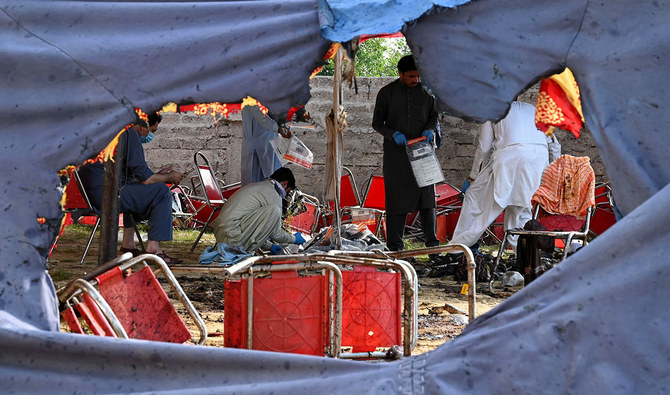

PESHAWAR: Representatives of various political parties in Pakistan’s northwestern Khyber Pakhtunkhwa (KP) province on Thursday rejected a new ‘code of conduct’ for political gatherings days after a suicide bombing at an election rally, saying it would dampen campaigning efforts ahead of general elections due by November.
Over 60 people were killed in the attack at a gathering of the Jamiat Ulema Islam-Fazl (JUI-F) party last Sunday, the deadliest assault on a political party since campaigning for the last election in 2018. The bombing has raised security concerns ahead of general elections and fears of a chaotic and violent polling season. The attack also comes amid a general rise in attacks since November last year when the Pakistani Taliban group unilaterally called off a cease-fire with the government and vowed increased attacks.
Thursday’s attack also came after months of political tension and an economic crisis and Prime Minister Shehbaz Sharif denounced the blast as an attack on the democratic process.
On Thursday, the provincial government in KP announced a code of conduct for gatherings, saying political parties would have to apply for a no objection certificate (NOC) from the district administration before holding political gatherings and would be responsible for the security of their own political leaders. The notification also called upon political parties and their candidates to inform the district administration of plans for gatherings, enabling police to make necessary arrangements.
“Permission shall be granted subject to clearance from law enforcement agencies,” the notification said.
Jalil Jan, a provincial leader of the JUI-F, rejected the restrictions.
“These sorts of limitations are not acceptable,” Jan told Arab News. “Even today, we held a gathering in Peshawar. Political parties will continue their campaigns to convince voters to vote for their choice … Security and protection of citizens is the responsibility of the government but we will not support these restrictions.”
Samiullah Burki, a senior leader of the Pakistan Muslim League-Nawaz (PML-N), also said the party opposed the new instructions.
“I conveyed to the district administration that these restrictions aren’t acceptable to politicians because it is a direct attack on their as well as workers’ democratic rights,” Burki told Arab News.
The Pakistan Peoples Party also rejected the code.
“We reject these limitations at a time when general elections are drawing closer,” PPP leader Faisal Karim Kundi said. “We will go for canvassing at any cost and it is the state’s responsibility to provide security to politicians and political workers.”
The PPP leader called on the government to adopt measures to improve KP’s security situation to ensure a smooth ballot, adding that authorities should question those who negotiated with militants in the past.
Arab News reached out to several leaders of the Pakistan Tehreek-e-Insaf (PTI), arguably the most popular party in KP, but none were available for comment.
Shamim Shahid, a senior analyst, described the new restrictions as an “attempt to keep politicians away” from political campaigns.
“These restrictions would affect the ballot process. At this critical time amid a surge in terrorism, this decision of the government is not a welcome move,” he said.
“This province is already devastated and once again it will experience further destruction. It is the responsibility of the state institutions to restore peace and put a full stop to terror acts. State institutions aren’t fulfilling their responsibilities, putting political forces under pressure.”


