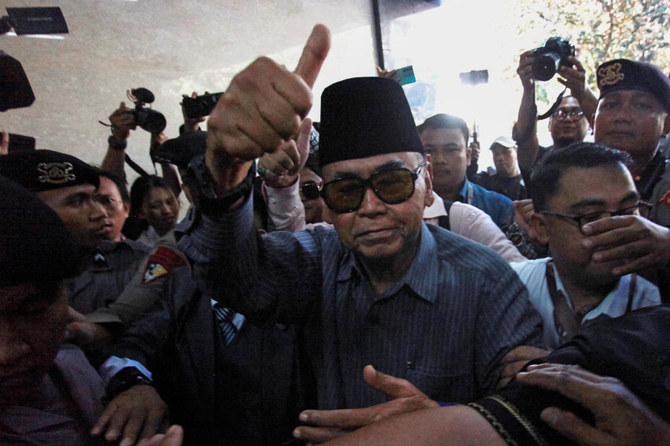
JAKARTA: A Muslim preacher has been arrested on charges including blasphemy and hate speech after his Islamic boarding school provoked protests for allowing women to preach and pray beside men, police said Wednesday.
The Al-Zaytun boarding school in West Java, Muslim-majority Indonesia’s most populous province, has faced backlash from conservative groups that have accused it of following a version of Islam incompatible with the Qur’an.
School head Panji Gumilang, 77, was detained early on Wednesday after questioning, national police spokesman Ahmad Ramadhan told reporters.
“Investigators took legal action... and he is detained in the criminal investigation agency’s detention facility for 20 days,” he said.
Gumilang faces five years in prison for blasphemy, six for spreading hate speech and 10 on the charge of spreading fake news and intentionally causing chaos in public, according to the charges.
The school sparked uproar in conservative circles and protests outside its compound when social media footage in late April showed women praying in the same row as men.
Women are typically expected to pray behind men in traditional Islamic prayer.
Another practice of the school that sparked controversy was allowing women to give a sermon in Friday prayers, a task usually reserved for men in traditional Islamic teaching.
The school opened in 1999 and holds around 5,000 students.
It is also accused of ties to Darul Islam, a group that fought for an Islamic state in Indonesia in the 1950s and 1960s and survived a military defeat.
Thousands have gathered outside the school several times since late June to call for its closure.
Indonesia’s blasphemy legislation has been on the statute books since 1965 but was rarely used before the end of authoritarian rule under dictator Suharto in 1998.
Conservative forms of Islam have since become more popular in Indonesia, which supports a tolerant version of the religion.
However, rights activists say the blasphemy law curbs free speech and puts religious freedom under increased pressure.
Indonesia recognizes six official religions but the growing use of the blasphemy law is fueling fears that its moderate brand of Islam was coming under threat from increasingly influential radicals.
Jakarta’s former governor, the capital’s first Christian leader of Chinese descent, was sentenced in 2017 to two years in jail for blasphemy.

Indonesia arrests Muslim preacher for blasphemy, hate speech
https://arab.news/zydsu
Indonesia arrests Muslim preacher for blasphemy, hate speech
- Al-Zaytun boarding school in West Java, Muslim-majority Indonesia’s most populous province, has faced backlash from conservative groups
- School head Panji Gumilang, 77, was detained early on Wednesday after questioning
US hotels seek World Cup boost after tourism dip under Trump
- At the US hotels that Meade Atkeson manages, a drop in tourism weighs heavily on business — but hoteliers like him hope that World Cup enthusiasm will soon eclipse wariness over President
WASHINGTON: At the US hotels that Meade Atkeson manages, a drop in tourism weighs heavily on business — but hoteliers like him hope that World Cup enthusiasm will soon eclipse wariness over President Donald Trump’s policies.
The US hospitality sector has been reeling from a tourism slump in the world’s biggest economy, which became the only major destination to see a drop in foreign visitors last year.
“Just financially, it’s difficult when international travel is down,” Atkeson told AFP, noting that such visitors tend to stay longer and spend more.
Foreign travelers account for nearly a quarter of business at the three hotels under Sonesta group that he manages — two in Washington and a third in Miami Beach.
Yet, in the first eleven months of 2025, US official data showed that inbound travel dropped by 5.4 percent.
Canadians were noticeably absent, with travel plunging by 21.7 percent from 2024, translating to about four million fewer people. The decline was nearly seven percent for French visitors.
Industry professionals see this as a consequence of Trump’s policies, even if they may not openly say so.
Visitors have chafed at the Republican president’s sweeping tariffs on foreign goods, broadsides against other countries, tightening immigration rules and portrayal of certain Democrat-led cities as ridden with crime.
Canadians “were asked to be the 51st state, right?” Atkeson said.
“If you talk to Canadians, many of them have chosen not to travel out of conscience” or on principle, he added.
Brazilian tourists meanwhile “can go anywhere they want,” he said. “And so they may have gone to Europe, they may have gone to the islands.”
‘Fear’
Thousands of kilometers away, the major resort city of Las Vegas in Nevada — boasting 150,000 hotel rooms — has also had a bad year.
Elsa Rodan, a chambermaid at the Bellagio resort and casino, says her establishment is “blessed” compared with others.
But even so, it has had to lower prices to attract guests, added Rodan, a representative of the Unite Here union who spoke at a Washington press conference.
Unite Here President Gwen Mills urges for a renewed effort to lobby the Trump administration over policies and rhetoric that she believes are jeopardizing the sector employing more than two million people.
According to her, hoteliers are not pushing the government enough.
Employers express “fear, the fear of picking your head up,” she said.
Hopefully ‘better’
Fewer visitors and overnight stays, alongside a drop in revenue, have triggered a $6.7 billion shortfall for Nevada hotels in 2025, according to the American Hotel and Lodging Association (AHLA).
But the organization hopes that 2026 will be a turning point — it is counting on the World Cup, from June 11 to July 19, to attract visitors.
Eleven US cities will be hosting matches.
“It’s being equated to having nearly 80 Super Bowls in just over a month,” AHLA spokesman Ralph Posner told AFP.
“The economic lift won’t be limited to host cities,” he added. “Destinations across the country are hoping to benefit as international visitors extend their trips and travel between markets.”
Las Vegas, for example, hopes to draw fans who might stop there before or after a game in Los Angeles or Kansas City.
Organizers say that besides the seven million spectators in stadiums, the World Cup is set to attract 20-30 million tourists.
The whole event, they believe, can generate $30 billion for the US economy.
“I hope that things will look better,” Atkeson said.
His Miami hotel is under renovations and cannot host much World Cup-related activity.
But his Washington establishments are highlighting their proximity to Philadelphia, where several matches will be held.
Another complication is war in the Middle East following US-Israeli strikes on Iran, which could snarl travel.
“It’s a little too soon to tell how we’re going to do with that, but we’ll see,” he said.


