

UN: Nearly one third of oil on Red Sea FSO Safer tanker transferred

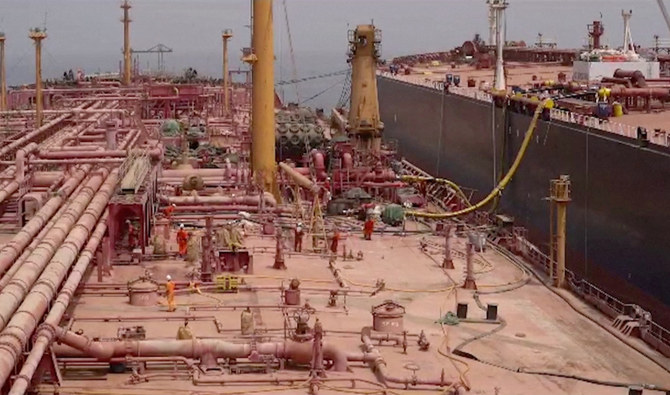
A view of a pipe laid between the decaying supertanker FSO Safer and its replacement oil tanker The Nautica off the coast of Ras Issa, Yemen. (Reuters)
Short Url
Updated 31 July 2023
Follow

UN: Nearly one third of oil on Red Sea FSO Safer tanker transferred

  • Administrator says 360,000 barrels of oil pumped from aging ship to new replacement vessel

AL-MUKALLA, Yemen: The UN has said that nearly one third of the oil on Yemen’s deteriorating Safer tanker has been transferred to a new tanker, as Yemenis expressed optimism about the operation to salvage the vessel.

The UNDP administrator, Achim Steiner, said on Sunday that 360.000 barrels of oil were pumped from the aging tanker to the replacement tanker.

“The #FSOSafer carried 1.15 m barrels of oil. To date 360,000 barrels or 1/3 have been transferred to the replacement tanker, the Yemen. Unwavering determination and great work by our teams continue to drive the #StopRedSeaSpill operation,” Steiner said on X. 

Last week, the UN announced the start of the long-awaited process of transferring more than 1 million barrels of oil from the FSO Safer tanker to a new tanker.

Moored off the coast of Yemen’s western city of Hodeidah, the 47-year-old tanker has been in danger of collapsing or exploding since rust began eating away at the tanker’s wall, allowing water to enter. 

Experts have long warned of a massive environmental disaster if the tanker’s oil poured into the water, threatening the natural ecosystem and the livelihoods of thousands of Yemenis.

People in Yemen have expressed hope that the actions will end the threat posed by the Safer tanker. 

Nabil bin Aifan, maritime safety researcher from Yemen’s Mukalla and a Ph.D. candidate at the Arab Academy for Science Technology and Maritime Transport in Egypt, told Arab News that the operation would benefit Yemen by removing the threat posed by the Safer tanker and providing the country with a new tanker to store oil for the future once the war ends.

“This is fantastic news that oil transfer from one tanker to another has begun,” the researcher said.

“Despite its late arrival, this phase is critical. The delay is being blamed on the Houthis and United Nations organizations due to their lack of effective pressure on the Houthis,” he said.

Basem Al-Ruzaigi, director of the government-controlled Mocha on the Red Sea, told Arab News that warnings about the tanker exploding or sinking had caused great concern among the Yemeni people, particularly those living along the country’s Red Sea coastline, and the UN should take care of the replacement tanker.

“The (new) ship must be routinely maintained so that the tragedy and problem do not reoccur.” 

Other Yemenis, including the director of the port of Mocha, Abdul Malik Al-Shaibani, have said that the UN was defusing a time bomb, but that if oil was stored in the new tanker and not maintained permanently, it would generate a second time bomb.

“Safer is a ticking time bomb, and the alternative is likewise a ticking time bomb,“ Al-Shaibani told Arab News.

“The oil must be sold, and the new tanker must undergo thorough and continual maintenance, not just for six months, as the United Nations says,” he said.


UN rights chief Shocked by ‘unbearable’ Darfur atrocities

Updated 18 January 2026
Follow

UN rights chief Shocked by ‘unbearable’ Darfur atrocities

  • Mediation efforts have failed to produce a ceasefire, even after international outrage intensified last year with reports of mass killings, rape, and abductions during the RSF’s takeover of El-Fasher in Darfur

PORT SUDAN: Nearly three years of war have put the Sudanese people through “hell,” the UN’s rights chief said on Sunday, blasting the vast sums spent on advanced weaponry at the expense of humanitarian aid and the recruitment of child soldiers.
Since April 2023, Sudan has been gripped by a conflict between the army and the paramilitary Rapid Support Forces that has left tens of thousands of people dead and around 11 million displaced.
Speaking in Port Sudan during his first wartime visit, UN Human Rights commissioner Volker Turk said the population had endured “horror and hell,” calling it “despicable” that funds that “should be used to alleviate the suffering of the population” are instead spent on advanced weapons, particularly drones.
More than 21 million people are facing acute food insecurity, and two-thirds of Sudan’s population is in urgent need of humanitarian aid, according to the UN.
In addition to the world’s largest hunger and displacement crisis, Sudan is also facing “the increasing militarization of society by all parties to the conflict, including through the arming of civilians and recruitment and use of children,” Turk added.
He said he had heard testimony of “unbearable” atrocities from survivors of attacks in Darfur, and warned of similar crimes unfolding in the Kordofan region — the current epicenter of the fighting.
Testimony of these atrocities must be heard by “the commanders of this conflict and those who are arming, funding and profiting from this war,” he said.
Mediation efforts have failed to produce a ceasefire, even after international outrage intensified last year with reports of mass killings, rape, and abductions during the RSF’s takeover of El-Fasher in Darfur.
“We must ensure that the perpetrators of these horrific violations face justice regardless of the affiliation,” Turk said on Sunday, adding that repeated attacks on civilian infrastructure could constitute “war crimes.”
He called on both sides to “cease intolerable attacks against civilian objects that are indispensable to the civilian population, including markets, health facilities, schools and shelters.”
Turk again warned on Sunday that crimes similar to those seen in El-Fasher could recur in volatile Kordofan, where the RSF has advanced, besieging and attacking several key cities.
Hundreds of thousands face starvation across the region, where more than 65,000 people have been displaced since October, according to the latest UN figures.