



PESHAWAR: The death toll from Sunday’s suicide blast in the northwestern Pakistani district of Bajaur has risen to 54, while 90 people were wounded in its wake, officials told Arab News on Monday.
Hundreds of supporters of the Jamiat Ulema Islam-Fazl (JUI-F) were meeting in Bajaur in a hall close to a market outside the district headquarters, where organizers added tents as many supporters showed up, and party volunteers with batons were helping control the crowd. Officials were announcing the arrival of Abdul Rasheed, a leader of the JUI-F party, when the bomb went off in one of Pakistan’s bloodiest attacks in recent years.
Provincial police said in a statement that the attack was carried out by a suicide bomber who detonated his explosives vest close to the stage where several senior leaders of the party were sitting. It said initial investigations suggested the Islamic State (Daesh) group — which operates in Afghanistan and is an enemy of the Afghan Taliban — could be behind the attack, and officers were still investigating.
“Fifty-four were killed in the suicide blast in Bajaur,” Shaukat Abbas, additional inspector-general of the Counter-Terrorism Department (CTD) told media in Bajaur. He added that only 46 bodies have been identified so far.
“Approximately 10-12 kg of explosives were used in the suicide bomb blast,” Abbas said, adding that the police force was working on identifying the bomber, which he said would be “soon” revealed through forensic data analysis.
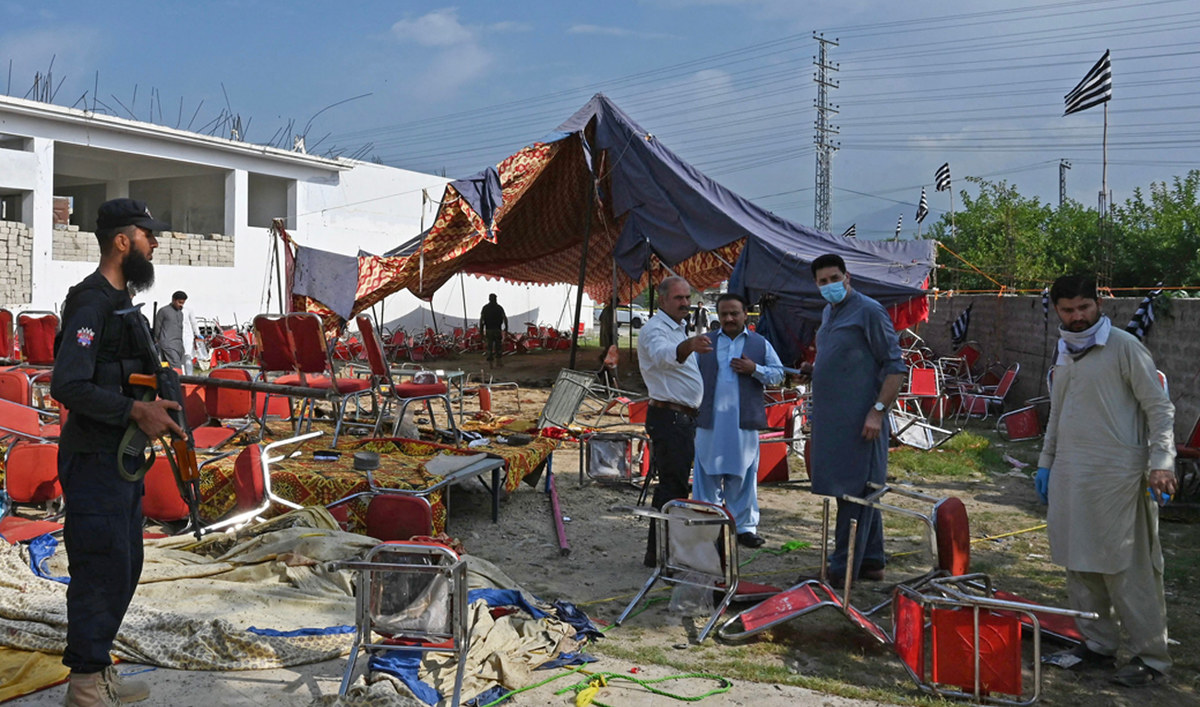
Security personnel examine the site of a bomb blast in Bajaur district of Khyber-Pakhtunkhwa province on July 31, 2023. (AFP)
“It is premature to confirm who carried out the attack but we have got an idea of the organization and those who operated the attack,” he said.
Meanwhile, Bajaur Police spokesperson Muhammad Israr told Arab News 90 people had been injured in the blast.
A police report of the incident was registered at the Malakand counter-terrorism department (CTD) police station as Bajaur doesn’t have a CTD police station where such cases are registered, according to Israr.
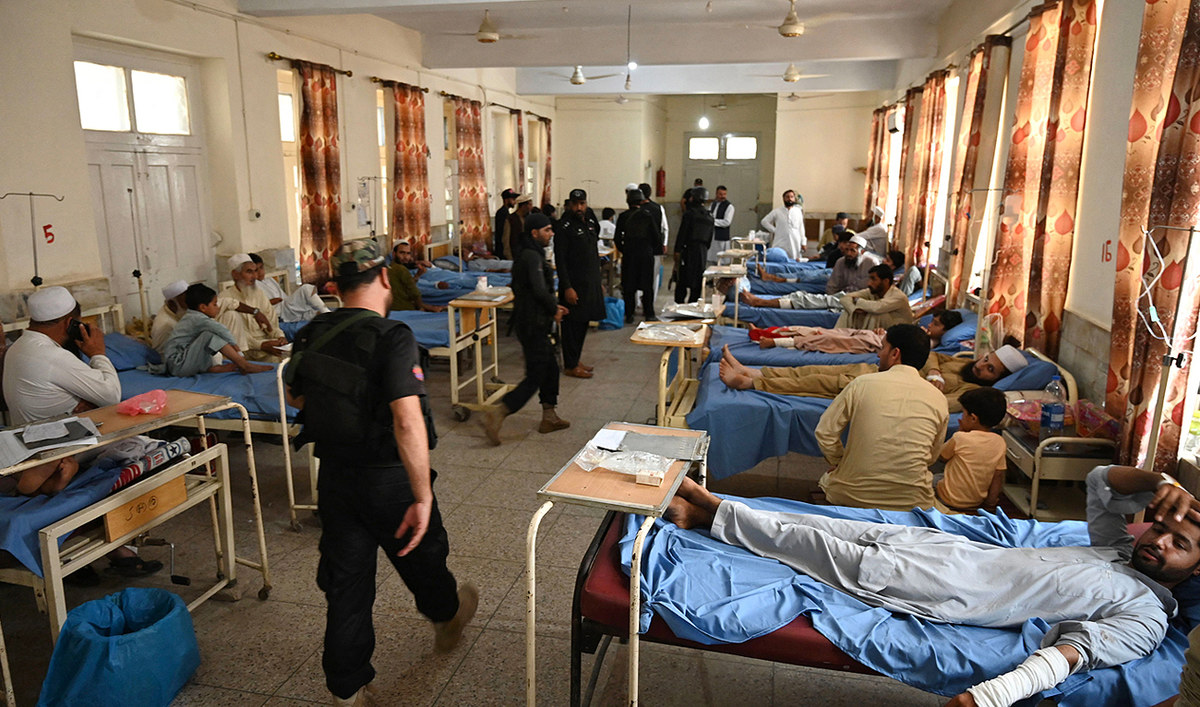
Security personnel walk past bomb blast victims at a hospital in Bajaur district of Khyber-Pakhtunkhwa province on July 31, 2023. (AFP)
The Bajur district near the Afghan border was once a stronghold of the Pakistani Taliban — a close ally of Afghanistan’s Taliban government — before the Pakistani army drove the militants out of the tribal districts in successive operations that began in late 2000s.
The Pakistani Taliban condemned the attack, while the Afghan Taliban spokesman, Zabiullah Mujahid, said on Twitter that “such crimes cannot be justified in any way.”
The bombing came hours before the arrival of Chinese Vice Premier He Lifeng in Islamabad, where he was to participate in an event to mark a decade of the China-Pakistan Economic Corridor, or CPEC, a sprawling package under which Beijing has invested billions of dollars in Pakistan.
In recent months, China has helped Pakistan avoid a default on sovereign payments. However, some Chinese nationals have also been targeted by militants in northwestern Pakistan and elsewhere.
Prime Minister Shehbaz Sharif and President Arif Alvi condemned the attack and asked officials to provide all possible assistance to the wounded and the bereaved families. PM Sharif later telephoned JUI-F chief Maulana Fazlur Rehman and conveyed his condolences to him, assuring that those who orchestrated the attack would be punished.


