Pakistan, China ink multiple agreement as Chinese vice-PM in Islamabad

Pakistan Prime Minister Shehbaz Sharif and Chinese Vice-Premier He Lifeng witness signing of multiple agreement between Pakistan and China in Islamabad, Pakistan, on July 31, 2023. (Government of Pakistan)
Short Url
Updated 31 July 2023
Follow

Pakistan, China ink multiple agreement as Chinese vice-PM in Islamabad

  • The high-level Chinese delegation is on a three-day visit to Islamabad to attend 10-year CPEC celebrations, meet Pakistani leaders 
  • President Alvi bestows Vice-Premier He Lifeng with ‘Hilal-e-Pakistan’ award in recognition of his contributions to the corridor project 

ISLAMABAD: Pakistan and China on Monday signed six agreements to enhance bilateral cooperation, with Prime Minister Shehbaz Sharif saying these would play a significant role in further promoting strong economic ties between the two brotherly countries.

The agreements were signed at a ceremony at PM Sharif’s office in the Pakistani capital after a meeting between Sharif and Chinese Vice-Premier He Lifeng, who is on a three-day visit to the Pakistani capital of Islamabad to mark 10 years of the multi-billion-dollar China-Pakistan Economic Corridor (CPEC). 

CPEC, a major segment of Beijing’s Belt and Road infrastructure initiative, is a $65 billion network of roads, railways, pipelines and ports in Pakistan that will connect China to the Arabian Sea and help Islamabad expand and modernize its economy, with the Gwadar port city in Balochistan as the epicenter of it. 

“I have no doubts that we are entering into the second phase of CPEC and today we have signed certain important documents which will further enhance our economic cooperation where we will undertake a second phase of CPEC under a new model,” Sharif said after the ceremony. 

“It will be B2B (business-to-business), it will be investments in agriculture, in information technology so that Pakistan, through Chinese cooperation and support, is able to export its items according to the requirement and standards of the Chinese government.” 
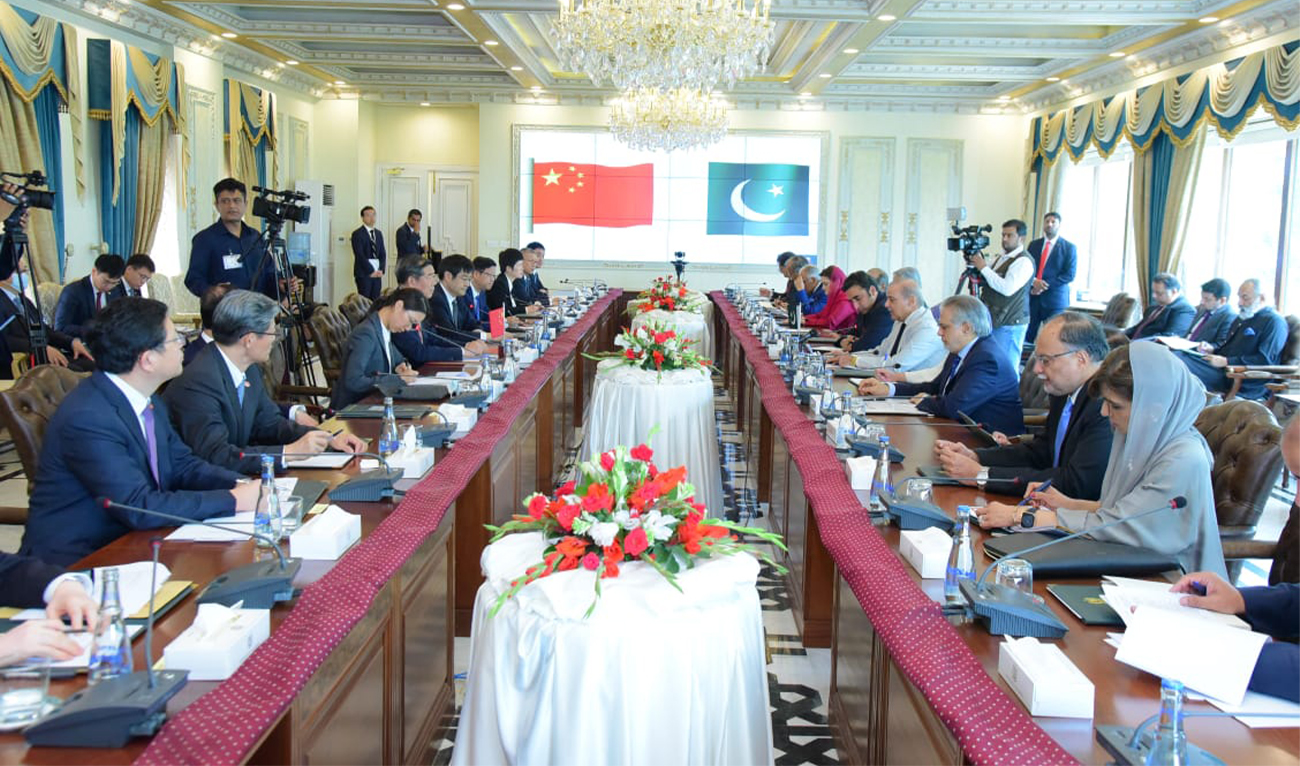


Pakistani and Chinese officials hold delegation level talks in Islamabad, Pakistan, on July 31, 2023. (PID)

Pakistan’s Planning Minister Ahsan Iqbal and Cong Liang, vice-chairman of China’s National Development and Reforms Commission, signed two vital agreements pertaining to the joint cooperation committee of CPEC and the establishment of an experts exchange mechanism within the CPEC framework. 

On the occasion, a protocol was signed for the export of dried chillies from Pakistan to China, while a document concerning realignment of the Karakoram Highway Phase II project feasibility study was signed by Pakistan’s National Highway Authority (NHA) planning member Asim Amin and the Chinese charge d’affaires, Pang Chunxue. Both sides signed two memorandums of understanding (MoUs) for the Industrial Workers’ Exchange Program and to promote the strategic Main Line-1, or ML-1, railway track upgradation project. 

Under CPEC, Sharif said, more than $25 billion worth of investment had taken place in Pakistan’s power sector, infrastructure and transport sectors. Pakistan was absolutely ready to contribute toward Chinese President Xi Jinping’s vision of shared destiny of progress and prosperity, he added. 

“The ML-1 and Karachi Circular railway system are very important projects and I have no doubts that together in time to come, we will successfully achieve these projects and many others,” he said, adding it would make Pakistan stand on its own feet through sacrifice, hard work and undying efforts. 

Separately, Pakistani President Arif Alvi bestowed the Chinese vice-premier with the ‘Hilal-e-Pakistan’ award during a ceremony at the presidency in recognition of his significant contributions to CPEC. 

In the afternoon, the Chinese delegation would attend a ceremony, themed as the ‘Decade of CPEC,’ with the Chinese vice-premier as the chief guest. 

Imran Khan not a ‘national security threat,’ ex-PM’s party responds to Pakistan military

Updated 06 December 2025
Follow

Imran Khan not a ‘national security threat,’ ex-PM’s party responds to Pakistan military

  • Pakistan’s military spokesperson on Friday described Khan’s anti-army narrative as a “national security threat”
  • PTI Chairman Gohar Ali Khan says words used by military spokesperson for Khan were “not appropriate”

ISLAMABAD: Former prime minister Imran Khan’s Pakistan Tehreek-e-Insaf (PTI) party on Saturday responded to allegations by Pakistan military spokesperson Lt. Gen. Ahmed Sharif Chaudhry from a day earlier, saying that he was not a “national security threat.”

Chaudhry, who heads the military’s media wing as director general of the Inter-Services Public Relations (ISPR), spoke to journalists on Friday, in which he referred to Khan as a “mentally ill” person several times during the press interaction. Chaudhry described Khan’s anti-army narrative as a “national security threat.”

The military spokesperson was responding to Khan’s social media post this week in which he accused Chief of Defense Forces Field Marshal Asim Munir of being responsible for “the complete collapse of the constitution and rule of law in Pakistan.” 

“The people of Pakistan stand with Imran Khan, they stand with PTI,” the party’s secretary-general, Salman Akram Raja, told reporters during a news conference. 

“Imran Khan is not a national security threat. Imran Khan has kept the people of this country united.”

Raja said there were several narratives in the country, including those that created tensions along ethnic and sectarian lines, but Khan had rejected all of them and stood with one that the people of Pakistan supported. 

PTI Chairman Gohar Ali Khan, flanked by Raja, criticized the military spokesperson as well, saying his press talk on Thursday had “severely disappointed” him. 

“The words that were used [by the military spokesperson] were not appropriate,” Gohar said. “Those words were wrong.”

NATURAL OUTCOME’

Speaking to reporters earlier on Saturday, Pakistan’s Defense Minister Khawaja Asif defended the military spokesperson’s remarks against Khan.

“When this kind of language is used for individuals as well as for institutions, then a reaction is a natural outcome,” he said. 

“The same thing is happening on the Twitter accounts being run in his [Khan’s] name. If the DG ISPR has given any reaction to it, then I believe it was a very measured reaction.”

Khan, who was ousted after a parliamentary vote of confidence in April 2022, blames the country’s powerful military for removing him from power by colluding with his political opponents. Both deny the allegations. 

The former prime minister, who has been in prison since August 2023 on a slew of charges he says are politically motivated, also alleges his party was denied victory by the army and his political rivals in the 2024 general election through rigging. 

The army and the government both deny his allegations.