BRUSSELS: The EU watchdog on Wednesday announced a probe into the bloc’s border patrol agency Frontex over its actions after a boat packed with migrants off Greece sank last month, killing hundreds.
The investigation is “aimed at clarifying Frontex’s role in search and rescue operations in the Mediterranean sea following the drowning of hundreds of people off the coast of Greece on 14 June,” ombudsman Emily O’Reilly said in a statement.
The independent probe by the European Union watchdog — which looks into suspected cases of poor administration by EU bodies — was launched on O’Reilly’s own initiative.
It adds to two investigations Greece says it has started: a criminal one into alleged smugglers it blames for the tragedy, and another into the actions of its coast guard.
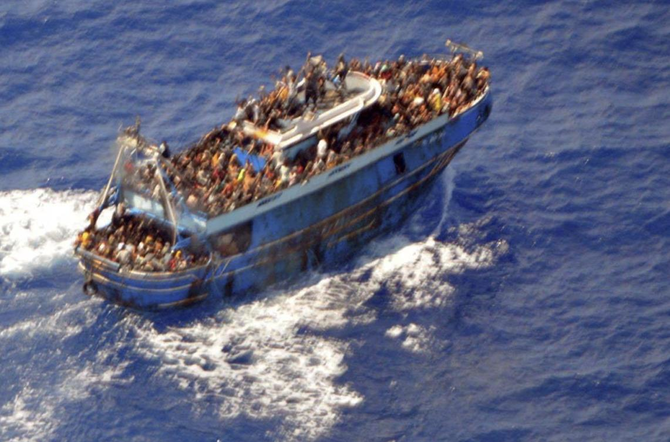
The boat that sank, an overcrowded fishing trawler, was carrying up to 750 people picked up in Libya who sought to cross the Mediterranean to irregularly enter Europe.
Around 100 of them were saved, but it is thought that some 600 drowned, according to Greek figures relayed by EU commissioner Ylva Johansson to the European Parliament in early July.
O’Reilly spoke of “the deaths of at least 500 people.”
EU lawmakers in that hearing expressed skepticism that the Greek probes into the sinking would be adequately carried out. They called for an independent and transparent investigation.
Athens has already rejected survivors’ accounts that the Greek coast guard tied a rope to the drifting vessel and then powered off, causing it to capsize.
O’Reilly said her office’s investigation would be carried out in coordination with the Greek ombudsman’s office.
It will request a “wide range” of Frontex documents on the sinking, including an internal Serious Incident Report, as well as those related to other incidents in the Mediterranean.
One aspect will focus on rules about the use of cameras on boats during joint operations.
That could yield information as to why state-of-the-art cameras on a Greek coast guard vessel near the migrant boat were switched off at the time of its sinking.
The probe would also examine how Frontex and national authorities in EU member states share search and rescue information, and what role they give to ships run by charities that carry out rescue operations.
Frontex chief Hans Leijtens, in the same July 6 European Parliament hearing as Johansson, said that, on the night of the sinking, “we offered to help, but there was no response from Greek authorities.”
On Wednesday, Leijtens posted a social media message welcoming the EU investigation and saying he “will cooperate in full transparency.”
O’Reilly said: “A tragedy of this magnitude requires all those involved to reflect on their responsibilities and to be clear to the public who is accountable for these deaths.”
She said her office’s probe will “try to piece together the events that led to the capsizing of the boat.”
The investigation will also weigh how the EU lives up to its commitments on maintaining fundamental rights when it comes to migration “and does not lose sight of the human suffering that compels people to seek a better life beyond their home countries,” she said.
O’Reilly said she planned future investigations into the EU’s migration and border policies, including one into a deal struck with Tunisia to curb migrant departures from its shores.


![]()

EU watchdog probes Frontex’s action in Greece boat tragedy
Short Url
https://arab.news/msf8m
EU watchdog probes Frontex’s action in Greece boat tragedy
- It adds to two investigations Greece says it has started: a criminal one into alleged smugglers it blames for the tragedy, and another into the actions of its coast guard


Latest updates


Recommended


© 2026 SAUDI RESEARCH & PUBLISHING COMPANY, All Rights Reserved And subject to Terms of Use Agreement.