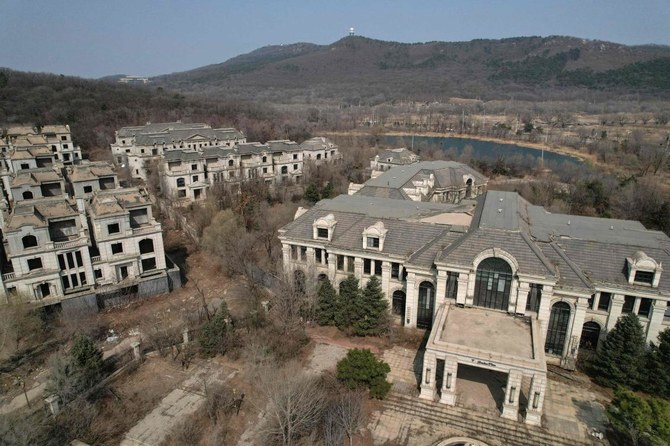
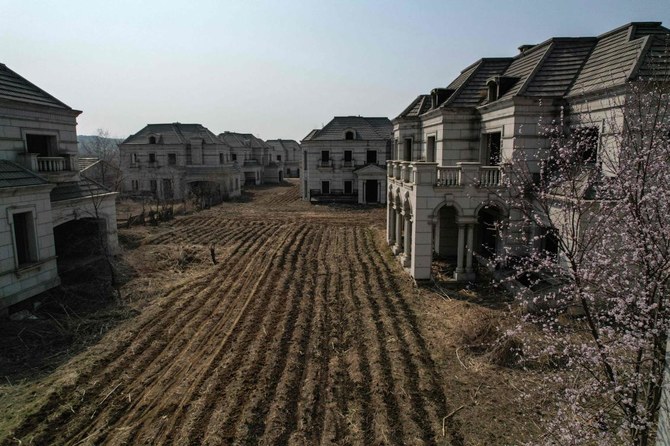
SHENYANG, China: Cattle wander between the concrete shells of half-finished mansions in northeastern China, some of the only occupants of a luxury complex whose crumbling verandas and overgrown arches are stark symbols of a housing market crippled by its own excess.
Property giant Greenland Group broke ground on the development nestled in the hills around Shenyang, an industrial city of 9 million, in 2010 — when the real estate sector’s lightning growth was in full swing.
But around two years later, the State Guest Mansions project — lavishly planned as 260 European-style villas complete with swanky facilities for visitors of the provincial government — was abandoned.
Local farmers now plow land that was envisaged as manicured gardens for the wealthy and politically connected, while feral dogs patrol crudely built poultry pens and double garages crammed with hay bales and farm equipment.
The reasons for the project’s failure remain unclear, though locals have their suspicions.
“Frankly, it was because of official corruption,” a farmer named Guo told AFP as he dug for edible weeds beneath a creaking 10-meter-high metal fence screening the development from a nearby highway.
“They cut off the funding and cracked down on uncontrolled developments, so it was left half-finished,” the swarthy 45-year-old said, as other people carried off buckets of water from the complex’s artificial lake.
A person who answered the phone at a regional Greenland Group office said they would pass a request for comment to a superior, but the company did not engage any further.
Since coming to power in 2012, Chinese President Xi Jinping has waged a sweeping crackdown on corruption in the ruling Communist Party and fostered a social aversion to conspicuous wealth.
“These (homes) would have sold for millions — but the rich haven’t even bought one of them,” said Guo.
“They weren’t built for ordinary people.”
The wider Chinese property sector continued to boom until the end of the decade.
But the government clamped down on excessive borrowing and rampant speculation in 2020, leaving several developers grappling with massive debt and flagging demand.
As a result, ghost towns like the one in Shenyang — known as “rotten-tail” homes in Chinese — now pockmark urban landscapes across the country.
Central government data on their number is not publicly available, but a report by a research group affiliated with an official association in Shanghai said just under four percent of housing projects nationwide had been left half-built as of June 2022.
This is equivalent to 231 million square meters of real estate.
Inside the former sales center at State Guest Mansions, graffiti on the flaking walls suggests farmers are not the only visitors.
Interest in the ghost towns is thriving as intrepid urban explorers visit derelict districts and post their findings online.
“This place is great for exploring, so I like to hang around here... and film a few clips,” said a black-clad drone flier as he rested on the marble floor beneath a vast, tarnished chandelier.
Around him, gloomy alcoves stored haphazard stacks of dust-caked furniture in styles that evoked France’s Palace of Versailles.
“Everything here has been left abandoned,” the man said, declining to give his name.
“It all feels quite creepy.”


![]()
![]()
![]()

Chinese ghost town of mansions reclaimed by farmers

Short Url
https://arab.news/mp4ak
Chinese ghost town of mansions reclaimed by farmers
- Local farmers now plow land that was envisaged as manicured gardens for the wealthy and politically connected
- Interest in the ghost towns is thriving as intrepid urban explorers visit derelict districts and post their findings online


Latest updates


© 2026 SAUDI RESEARCH & PUBLISHING COMPANY, All Rights Reserved And subject to Terms of Use Agreement.