CHEONGJU, South Korea: The bodies of eight people trapped in a tunnel submerged by heavy rain in central South Korea were retrieved on Sunday, authorities and local media said, taking the death toll from days of torrential downpours that have pounded the country to 35.
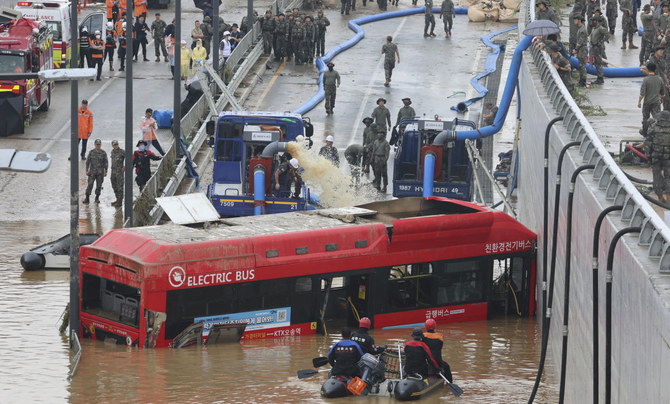
Seo Jeong-il, head of the west Cheongju fire station, said some 15 vehicles, including a bus, were estimated to have been submerged in the underpass in the city shortly after a levee of a nearby river was destroyed by the downpours on Saturday.
CCTV footage aired on local broadcaster MBC showed muddy water rushing into the tunnel as vehicles drove past with their wheels submerged.
“We are focusing on the search operation as there’s likely more people there,” Seo told reporters. “We are doing our best to wrap it up today.”
The death toll in the tunnel stands at nine, including one body retrieved on Saturday, South Korea’s Yonhap news agency reported.
The Ministry of Interior and Safety said 10 people were missing across the country as of 11 a.m. (0200 GMT) as heavy downpours caused landslides and floods, with evacuation orders covering 7,866 people.
The ministry data does not include those in the flooded tunnel because it was not immediately clear how many people were trapped underwater.
The latest disaster took place despite South Korea’s vow to step up preparedness against torrential rains after Seoul was hit last year with floods caused by the heaviest downpours in 115 years, inundating basement flats in low-lying neighborhoods, including in the largely affluent Gangnam district.
One survivor from the submerged tunnel said the government should have restricted access to the underpass when flooding was expected, Yonhap reported.
A North Chungcheong province official said the levee unexpectedly collapsed before the precipitation reached the level required for restricting access to the tunnel.
President Yoon Suk Yeol, now on an overseas trip, convened a video-linked response meeting and said some regions had failed to take preemptive measures against the extreme weather.
Yoon ordered Prime Minister Han Duck-soo to mobilize all available resources to minimize casualties and urged the weather agency to quickly release forecasts because more heavy rain was expected in the coming days, his office said.
The Korea Meteorological Administration said the central and southern parts of the country could receive as much as 300 millimeters (12 inches) of additional rain by Tuesday.
While South Korea often experiences heavy rains in summer, it has witnessed a sharp increase in torrential rains in recent years.
Korea Railroad Corp. has halted all slow trains and some bullet trains since Saturday due to safety concerns over landslides, track flooding and falling rocks.


![]()


Rescuers retrieve eight bodies from flooded South Korea underpass
Short Url
https://arab.news/caa82
Rescuers retrieve eight bodies from flooded South Korea underpass
- Some 15 vehicles, including a bus, were estimated to have been submerged in the underpass in the city
- CCTV footage showed muddy water rushing into the tunnel as vehicles drove past with their wheels submerged


Cuba to protect essential services as US moves to cut off oil supply
HAVANA: Cuba detailed a wide-ranging plan on Friday to protect essential services and ration fuel as the communist-run government dug in its heels in defiance of a US effort to cut off oil supply to the Caribbean island.
The rationing measures are the first to be announced since President Donald Trump threatened to slap tariffs on the US-bound products of any country exporting fuel to Cuba and suggested hard times ahead for Cubans already suffering severe shortages of food, fuel and medicine.
Government ministers said the measures would guarantee fuel supply for key sectors, including agricultural production, education, water supply, health care and defense.
Commerce Minister Oscar Perez-Oliva struck a defiant tone as he laid out details of the government plan.
“This is an opportunity and a challenge that we have no doubt we will overcome,” Perez-Oliva told a television news program. “We are not going to collapse.”
The government will supply fuel to the tourism and export sectors, including for the production of Cuba’s world-famous cigars, to ensure the foreign exchange necessary to fund other basic programs, Perez-Oliva said, adding, “If we don’t have income, then we will not overcome this situation.”
Domestic and international air travel will not be immediately affected by the fuel rationing, although drivers will see cutbacks at the pump until supply normalizes, he said.
The government said it would protect ports and ensure fuel for domestic transportation in a bid to protect the island nation’s import and export sectors.
Perez-Oliva also announced an ambitious plan to plant 200,000 hectares (500,000 acres) of rice to guarantee “an important part of our demand,” but acknowledged fuel shortfalls would push the country to depend more on renewable energy for irrigation needs and animal-power for tilling fields.
Education Minister Naima Ariatne, appearing on the same program, said infant-care centers and primary schools would remain open and in person, but secondary schools and higher education would implement a hybrid system that would require more “flexibility” and vary by institution and region.
“As a priority, we want to leave (open) our primary schools,” Ariatne said.
Top officials said health care would also be prioritized, with special emphasis on emergency services, maternity wards and cancer programs.
The rationing measures are the first to be announced since President Donald Trump threatened to slap tariffs on the US-bound products of any country exporting fuel to Cuba and suggested hard times ahead for Cubans already suffering severe shortages of food, fuel and medicine.
Government ministers said the measures would guarantee fuel supply for key sectors, including agricultural production, education, water supply, health care and defense.
Commerce Minister Oscar Perez-Oliva struck a defiant tone as he laid out details of the government plan.
“This is an opportunity and a challenge that we have no doubt we will overcome,” Perez-Oliva told a television news program. “We are not going to collapse.”
The government will supply fuel to the tourism and export sectors, including for the production of Cuba’s world-famous cigars, to ensure the foreign exchange necessary to fund other basic programs, Perez-Oliva said, adding, “If we don’t have income, then we will not overcome this situation.”
Domestic and international air travel will not be immediately affected by the fuel rationing, although drivers will see cutbacks at the pump until supply normalizes, he said.
The government said it would protect ports and ensure fuel for domestic transportation in a bid to protect the island nation’s import and export sectors.
Perez-Oliva also announced an ambitious plan to plant 200,000 hectares (500,000 acres) of rice to guarantee “an important part of our demand,” but acknowledged fuel shortfalls would push the country to depend more on renewable energy for irrigation needs and animal-power for tilling fields.
Education Minister Naima Ariatne, appearing on the same program, said infant-care centers and primary schools would remain open and in person, but secondary schools and higher education would implement a hybrid system that would require more “flexibility” and vary by institution and region.
“As a priority, we want to leave (open) our primary schools,” Ariatne said.
Top officials said health care would also be prioritized, with special emphasis on emergency services, maternity wards and cancer programs.
Latest updates


© 2026 SAUDI RESEARCH & PUBLISHING COMPANY, All Rights Reserved And subject to Terms of Use Agreement.