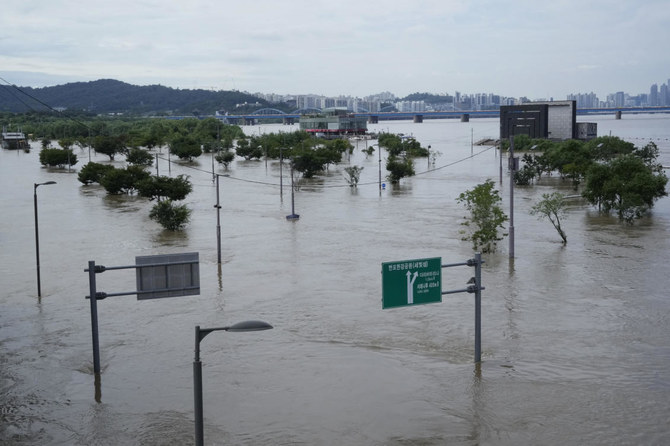
SEOUL: Cleanup and recovery efforts gained pace in South Korea’s greater capital region Wednesday as skies cleared after two days of record-breaking rainfall that unleashed flash floods, damaged thousands of buildings and roads and killed at least nine people.
While lifting heavy rain warnings for Seoul and the neighboring metropolitan areas, South Korea’s weather agency forecasted 10 to 30 centimeters (4 to 12 inches) of rain in the country’s southern regions through Thursday.
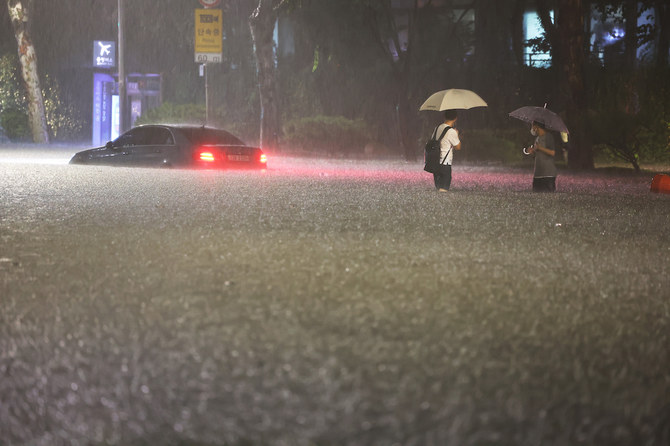
Seven people remain missing in Seoul and nearby Gyeonggi Province following the heavy rains that swamped the region Monday and Tuesday, turning streets into car-clogged rivers, sending floods cascading into subway stations, triggering landslides that crashed into roads and buildings, and displacing more than 1,800 people from their homes. The nine people who died included four who drowned in their homes in Seoul.
South Korean President Yoon Suk Yeol during a disaster response meeting Wednesday apologized on behalf of the government over the deaths and disruption caused by the heavy rains. He urged the central government to provide more financial help and personnel assistance to cities and regional governments to speed up recovery efforts.
He also called for significant improvements to the country’s flood management systems, including building more rain tanks and tunnels and improving flood-prediction technologies, citing the growing challenges posed by extreme weather events.
“It’s certainly true that (the rainfall) was abnormal weather, but we have come to a point where we can no longer call abnormal weather abnormal,” Yoon said. “We could see new record levels (of rain) at any time. We need to build our response so that we are ready for a situation that’s worse than we had imagined.”
The Ministry of the Interior and Safety said workers through Wednesday afternoon had finished restoring more than 90 percent of some 2,800 buildings, homes, roads and other facilities in the capital area that had been prioritized in emergency recovery plans.
Nearly 3,000 government workers, including police and fire department personnel, and dozens of excavators and dump trucks have been deployed in the recovery efforts. The military has separately deployed around 1,300 troops, some of whom were seen cleaning debris and salvaging furniture at flooded neighborhoods in southern Seoul.
There were no immediate reports of major damage or casualties in regions south of the capital area, where the weather agency issued heavy rain warnings. Landslide warnings were issued in more than 30 cities and towns across the country,
More than 52 centimeters (20 inches) of rain was measured in Seoul’s hardest-hit Dongjak district from Monday to Wednesday at noon. Precipitation in the area exceeded 14 centimeters (5.5 inches) per hour at one point Monday night — the highest hourly downpour measured in Seoul since 1942.


![]()
![]()
![]()
![]()

South Korea’s rain-hit capital region reeling from flood damages


Short Url
https://arab.news/jg5wv
South Korea’s rain-hit capital region reeling from flood damages
- Two days of record-breaking rainfall unleashed flash floods, damaged thousands of buildings and roads and killed at least nine people


Latest updates


Recommended


© 2026 SAUDI RESEARCH & PUBLISHING COMPANY, All Rights Reserved And subject to Terms of Use Agreement.