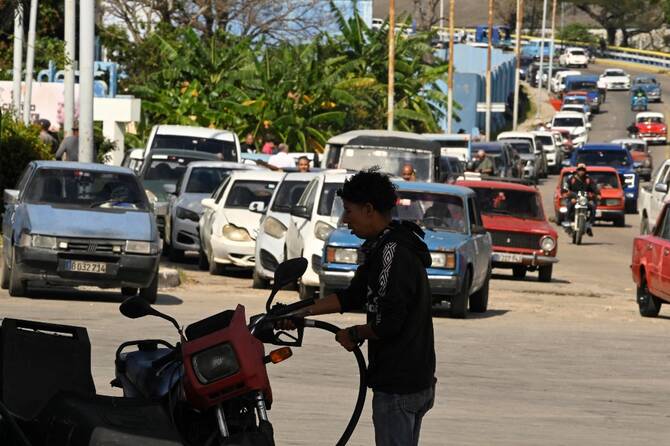
HAVANA: Cuba detailed a wide-ranging plan on Friday to protect essential services and ration fuel as the communist-run government dug in its heels in defiance of a US effort to cut off oil supply to the Caribbean island.
The rationing measures are the first to be announced since President Donald Trump threatened to slap tariffs on the US-bound products of any country exporting fuel to Cuba and suggested hard times ahead for Cubans already suffering severe shortages of food, fuel and medicine.
Government ministers said the measures would guarantee fuel supply for key sectors, including agricultural production, education, water supply, health care and defense.
Commerce Minister Oscar Perez-Oliva struck a defiant tone as he laid out details of the government plan.
“This is an opportunity and a challenge that we have no doubt we will overcome,” Perez-Oliva told a television news program. “We are not going to collapse.”
The government will supply fuel to the tourism and export sectors, including for the production of Cuba’s world-famous cigars, to ensure the foreign exchange necessary to fund other basic programs, Perez-Oliva said, adding, “If we don’t have income, then we will not overcome this situation.”
Domestic and international air travel will not be immediately affected by the fuel rationing, although drivers will see cutbacks at the pump until supply normalizes, he said.
The government said it would protect ports and ensure fuel for domestic transportation in a bid to protect the island nation’s import and export sectors.
Perez-Oliva also announced an ambitious plan to plant 200,000 hectares (500,000 acres) of rice to guarantee “an important part of our demand,” but acknowledged fuel shortfalls would push the country to depend more on renewable energy for irrigation needs and animal-power for tilling fields.
Education Minister Naima Ariatne, appearing on the same program, said infant-care centers and primary schools would remain open and in person, but secondary schools and higher education would implement a hybrid system that would require more “flexibility” and vary by institution and region.
“As a priority, we want to leave (open) our primary schools,” Ariatne said.
Top officials said health care would also be prioritized, with special emphasis on emergency services, maternity wards and cancer programs.

Cuba to protect essential services as US moves to cut off oil supply
https://arab.news/pqyx5
Cuba to protect essential services as US moves to cut off oil supply
- The rationing measures are the first to be announced since Trump threatened to slap tariffs on the US-bound products of any country exporting fuel to Cuba and suggested hard times ahead for Cubans
Canada PM Carney says can’t rule out military participation in Iran war
- Carney had said the US-Israeli strikes on Iran were “inconsistent with international law”
- However, he supports the efforts to stop Iran from obtaining a nuclear weapon
CANBERRA, Australia: Canadian Prime Minister Mark Carney said Thursday that he couldn’t rule out his country’s military participation in the escalating war in the Middle East.
Carney’s visit to Australia this week has been overshadowed by expanding war in the Middle East, sparked by a massive US-Israeli strike on Iran that killed its supreme leader, Ayatollah Ali Khamenei.
Speaking alongside local counterpart Anthony Albanese in Canberra, Carney was asked whether there was a situation in which Canada would get involved.
“One can never categorically rule out participation,” he said, while stressing the question was a “hypothetical” one.
“We will stand by our allies,” said Carney, adding that “we will always defend Canadians.”
Carney had said the US-Israeli strikes on Iran were “inconsistent with international law.”
However, he supports the efforts to stop Iran from obtaining a nuclear weapon — a position that Canada takes “with regret” as it represented “another example of the failure of the international order.”
The Canadian leader reiterated on Thursday his call for a “de-escalation” of the conflict.
Carney’s trip is part of a multi-country tour of the Asia-Pacific aimed at reducing reliance on the United States — a hedge against what he has described as a fading US-led global order.
The Australia leg of the tour is aimed at bringing in investment and deepening ties with a like-minded “middle power” partner.
‘Middle power’ rallying cry
On Thursday morning he issued a rallying cry in Australia’s parliament to “middle powers,” urging them to work together in an increasingly hegemonic world order.
Nations like Australia and Canada faced a stark choice — work together to help write the “new rules” of the global order or have great powers do it for them, he said.
“In this brave new world, middle powers cannot simply build higher walls and retreat behind them. We must work together,” he said.
“Great powers can compel, but compulsion comes with costs, both reputational and financial,” the former central banker added.
“Middle powers like Australia and Canada hold this rare convening power because others know we mean what we say and we will match our values with our actions.”
The Canadian leader also said the two countries would together as “strategic collaborators” to pool their vast combined rare earth mineral resources.
And he detailed renewed cooperation in areas from defense to artificial intelligence.
“We know we must work with others who share our values to build solid capabilities,” he told parliament.
Otherwise, he warned, they risked being “caught between the hyperscalers and the hegemons.”
The Canadian leader has frequently clashed with US President Donald Trump, who has repeatedly threatened to annex Canada and slapped swingeing tariffs on the country.
In a speech to political and financial elites at the World Economic Forum in January, Carney warned the US?led global system of governance was enduring “a rupture.”


