MOSCOW: Belarus said Friday that instructors from the Russian mercenary force Wagner were training its troops, following weeks of uncertainty about the future of the group after its failed mutiny in Russia.
The short-lived rebellion was ended by a deal under which some Wagner fighters and their outspoken leader Yevgeny Prigozhin were supposed to move to Belarus.
But Belarusian President Alexander Lukashenko had cast doubt on the deal when he said earlier this month that no Wagner fighters had moved to the country yet.
The Belarusian defense ministry appeared to confirm Friday that at least some Wagner fighters had arrived.
“Near Asipovichy, units of territorial defense troops are undergoing training,” the defense ministry said in a statement.
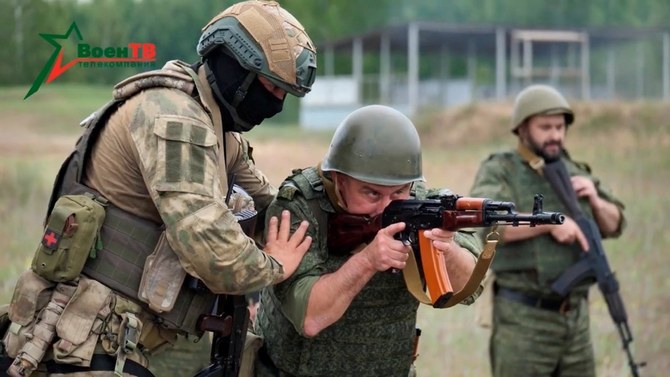
“Fighters of the Wagner private military company are acting as instructors in a number of military disciplines,” it said.
The ministry later added that it and Wagner had worked out “a road map for the near term on training and sharing experience” between various units.
The Wagner group, which recruited extensively from Russian prisons, played a key role in the Ukraine offensive.
A video released by the Belarusian defense ministry showed masked fighters as instructors in the drills for soldiers living in a nearby tent camp.
A group of foreign reporters earlier this month was shown a camp near Asipovichy where Belarusian officials said the mercenaries could be based.
Ukrainian President Volodymyr Zelensky said in his evening address Friday that Kyiv was “closely monitoring what is happening there in terms of security.”
The latest development came as the clock ran down on a UN and Turkiye-mediated deal with Russia to allow Ukrainian grain exports through the Black Sea — a vital supply route for the developing world.
The deal, first signed in July 2022, five months after Moscow’s all-out assault on Ukraine, is set to expire on Monday.
Russian President Vladimir Putin has repeatedly threatened not to renew it because of what he says have been obstacles to Russian exports.
Turkish President Recep Tayyip Erdogan appeared confident on Friday on the prospects of an extension to the deal.
“We are preparing to welcome Putin in August and we agree on the extension of the Black Sea grain corridor,” Erdogan told reporters.
But Kremlin spokesman Dmitry Peskov told state news agency RIA Novosti: “There were no statements on this subject from the Russian side.”
In Ukraine, Kyiv’s much-hyped counteroffensive, which began last month, ground on with only very gradual advances.
Ukraine has blamed the slow delivery of promised arms, calling on allies to send long-range weapons and fighter jets.
Ukraine said on Friday its forces had moved forward 1,700 meters (just over a mile) on the front line in the south over the past seven days.
Ukrainian troops are advancing despite “dense” minefields and shelling, Mykola Urshalovych, a senior representative of the National Guard, told reporters.
There have also been some advances to the north and south of Bakhmut, a city captured by Russian troops in May after a battle lasting nearly a year.
The aim of Ukrainian forces is to surround the eastern city in a pincer movement.
The head of Ukraine’s presidential office, Andriy Yermak, admitted that Kyiv’s troops were advancing “not so quickly.”
“If we are going to see that something is going wrong, we’ll say so. No one is going to embellish,” he told reporters.
Yermak also said that Ukraine would not consider talks with Moscow until Russian troops had left.
“Even thinking about these talks is only possible after Russian troops leave our territory,” he said.
Zelensky addressed the challenges facing the frontline troops in his evening address.
“We must all understand very clearly — as clearly as possible — that the Russian forces in our southern and eastern lands are investing everything they can to stop our soldiers.
“And every thousand meters of advance, every success of each of our combat brigades deserves gratitude,” he added.
Ukraine’s air force said on Friday it had downed 16 Iranian-made drones launched by Russian forces overnight, in the fourth consecutive night of aerial attacks by Moscow.


![]()

Wagner troops training Belarus forces
Short Url
https://arab.news/c9zsg
Wagner troops training Belarus forces
- The Belarusian defense ministry appeared to confirm Friday that at least some Wagner fighters had arrived
- The Wagner group, which recruited extensively from Russian prisons, played a key role in the Ukraine offensive
Latest updates


© 2026 SAUDI RESEARCH & PUBLISHING COMPANY, All Rights Reserved And subject to Terms of Use Agreement.