



PARIS: From subtly shifting the position of Ramses II’s sceptre, to touch-ups on a necklace or headdress, ancient Egyptian artists were more creative than previously thought, according to a study published Wednesday.
Using new portable imaging and chemical analysis techniques, an international team of scientists took a fresh look at paintings in the Valley of the Kings — a royal burial ground for pharaohs and other ancient Egyptian elites.
Egyptologists have until now considered art in these tombs to be very conventional, adhering to certain rules and using predefined patterns which were transferred onto walls.
However, a small robot moving in front of the painted walls used X-ray, ultraviolet, and infrared vision to “scrutinize” the art in-depth, much like a medical scanner, said Philippe Walter of the French center for scientific research, CNRS, a co-author of the study published in the PLOS One journal.
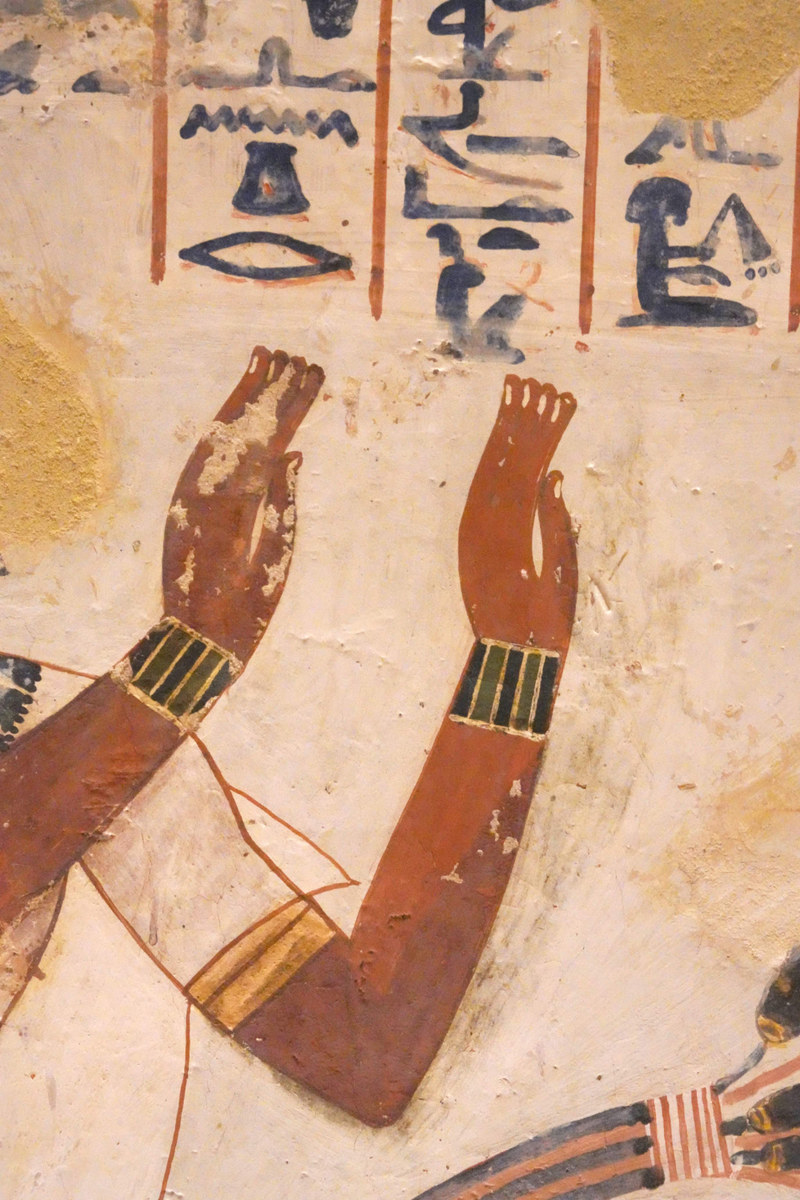
The arms of Menna in front of Osiris, in the tomb of Menna, in Sheikh Abd el Qurnah, near Luxor, in Egypt. (AFP/CEA ULIEGE)
On an image of Ramses II, decorating the tomb of the priest Nakhtamon, painted some 1,200 years BCE, the pharaoh is depicted in profile, wearing a necklace and headdress and holding a royal sceptre.
However image analysis revealed a different composition, hinting at efforts to touch up the original work.
“We didn’t expect to see such modifications of a supposedly very formal representation of a pharaoh,” meant to be frozen in time, said Walter.
Similar alterations were found on the tomb of the nobleman Menna, depicted with his arms stretched out toward Osiris.
Analysis showed the position of one of the arms had been moved, while changes were made in the pigments used for skin color.
It is unclear how many years passed between the alterations, or why they were carried out, but the scientists said it showed evidence of “freedom of creation.”
Walter compared this “personal touch” to that seen from “the great painters of the Renaissance,” who were shown to make adjustments to their work.
Philippe Martinez, the other co-author of the study with the CNRS, said that if this practice was shown to be commonplace, it would bring pharaonic art closer to our “modern aesthetic standards, nourished by Greco-Roman art.”


