BEIRUT: Israeli fire wounded three members of Lebanon’s Iran-backed Hezbollah movement on Wednesday near the border with Israel, a security source in southern Lebanon said.
The incident comes amid tensions along the Israel-Lebanon border area, a stronghold of the Shiite movement and the site of sporadic skirmishes.
“Three Hezbollah members were wounded by Israeli fire near the border,” the source told AFP, requesting anonymity as they were not authorized to speak to the media.
Three other sources with knowledge of the incident also said Hezbollah members had been wounded. One said a sound grenade was fired and that three members were “lightly” hurt.
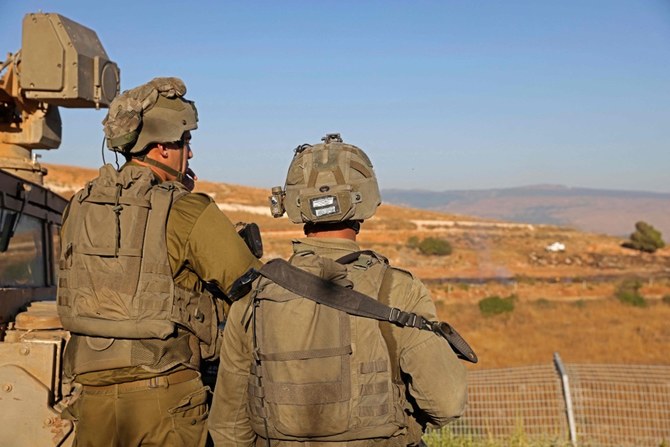
The Israeli army said in a statement that “a number of suspects approached the northern security fence with Lebanon and attempted to sabotage the security fence in the area.”
“Soldiers immediately spotted the suspects and used means to distance them,” the army said, adding that “the identity of the suspects is unknown.”
An AFP correspondent said the incident took place near the village of Al-Bustan, where Lebanese army and peacekeepers were deployed.
The Israeli military released footage it said was of the incident showing several people approaching the fence before an apparent blast caused them to run away.
The United Nations Interim Force in Lebanon (UNIFIL), which acts as a buffer between Lebanon and Israel, said it was “aware of disturbing reports about an incident along the Blue Line.”
“The situation is extremely sensitive. We urge everyone to cease any action that may lead to escalation of any kind,” it said in a statement.
Israel and Hezbollah fought a devastating war in 2006 after the group captured two Israeli soldiers.
The conflict killed 1,200 people in Lebanon, mostly civilians, and 160 Israelis, mostly soldiers.
Hezbollah chief Hassan Nasrallah said in a televised speech to mark the anniversary of the 2006 war that Wednesday’s incident was “under investigation.”
UNIFIL was set up in 1978 to monitor the withdrawal of Israeli forces after they invaded Lebanon in reprisal for a Palestinian attack. The UN mission was beefed up in response to the 2006 conflict, and operates in the south near the border.
Lebanon and Israel are technically at war.
Wednesday’s incident comes less than a week after the Israeli army struck southern Lebanon following an anti-tank missile launch from its northern neighbor. The missile exploded in the border area between the two foes.
That same day, Hezbollah had denounced Israel for building a concrete wall around the town of GHajjar.
The Blue Line cuts through GHajjar, formally placing its northern part in Lebanon and its southern part in the Israeli-occupied and annexed Golan Heights.
“This land will not be left to Israelis,” Nasrallah said Wednesday.
“Through cooperation” between Hezbollah, the state and the Lebanese people, “we can get back our occupied land in GHajjar,” he added.
The foreign ministry on Tuesday said Lebanon would file a complaint with the United Nations Security Council over Israel’s “annexation” of the north of GHajjar.
Considered a “terrorist” organization by many Western governments, Hezbollah is the only side not to have disarmed following Lebanon’s 1975-1990 civil war, and it is also a powerful player in Lebanese politics.
Nasrallah also said Hezbollah had set up two tents recently in the Shebaa Farms — one erected in a disputed area — but that the Israelis had “not dared to take any steps on the ground” in response.
In June, Hezbollah said it shot down an Israeli drone that had flown into Lebanon’s southern airspace.
In April, Israel’s military said soldiers had shot down a drone that entered its airspace from Lebanon, a day after a barrage of rockets was fired into Israel.


![]()

Israeli fire wounds Hezbollah members near Lebanon-Israel border
Short Url
https://arab.news/zzb54
Israeli fire wounds Hezbollah members near Lebanon-Israel border
Latest updates


© 2026 SAUDI RESEARCH & PUBLISHING COMPANY, All Rights Reserved And subject to Terms of Use Agreement.