

Environmentalists question sustainability as Karachi gets first ‘plastic road’

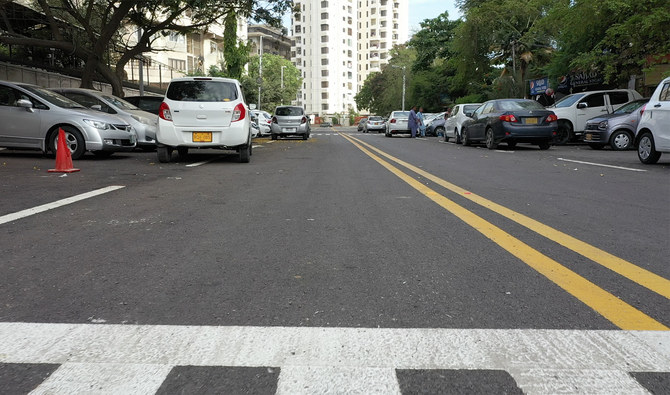
The still image taken on July 10, 2023, shows a road in Pakistan's Karachi city carpeted with recycled plastic waste. (Shell Pakistan)
Short Url
Updated 10 July 2023
Follow

Environmentalists question sustainability as Karachi gets first ‘plastic road’

  • Around 2.5 tons of plastic waste used to construct 730-foot-long and 60-foot-wide patch of road in Karachi’s Frere Town 
  • Environmentalists call plastic roads ‘marketing gimmick,’ call for transitioning away from plastic products, fossil fuels 

KARACHI: A road carpeted with recycled plastic waste and inaugurated in Karachi this week was built keeping in mind ‘sustainability and eco-friendliness,’ the company behind the project said, while environmentalists questioned the impact of such initiatives in helping Pakistan deal with the growing problem of how to dispose off its waste. 

According to a UNDP report in 2021, Pakistan has one of the highest percentages of mismanaged plastic in South Asia. More than 3.3 million tons of plastic is wasted each year in Pakistan and most of it ends up in landfills, unmanaged dumps or strewn about land and water bodies across the country, damaging the environment and people’s health. If this waste is dumped collectively together, it would reach as high as 16500 meters, the height of two K2 mountains, the world’s second highest mountain in the world. 

Utilizing a solution that is gaining traction around the world, Shell Pakistan teamed up with Karachi’s District Municipal Corporation (DMC) South and a startup called BRR Enterprises, using around 2.5 tons of plastic waste to construct a 730-foot-long and 60-foot-wide patch of road in Karachi’s Frere Town. In December 2021, Coca-Cola Pakistan and Afghanistan also partnered with technology hub Teamup and the Capital Development Authority to use plastic waste to re-carpet roads, recycling almost 10 tons of plastic waste to pave a kilometer-long patch of Ataturk Avenue in Islamabad at a cost of Rs21 million. 

“This [Karachi] road was in dire need of repair work. There was an idea of sustainability and eco-friendliness that we should use our lubricant plastic bottles to construct this road, which is right outside our facility,” Zunair Bin Hassan Siddiqui, the project lead of Shell Pakistan’s Plastic Road Project, told Arab News this week. 

Plastic roads are either made entirely of plastic or of composites of plastic along with other materials. The recently launched road in Karachi was constructed using a dry method process that uses plastic as a substitute for aggregate and bitumen. 

“It’s cheaper than a normal road,” said Mohsin Munir, Shell Pakistan’s procurement lead, declining to disclose the cost of the project. 

“The main idea was to show what the industry can do collectively to put plastic waste to productive use,” he added. 

However, environmentalists question the sustainability of building plastic roads, saying they do not provide a solution to divert plastic bottles from ending up in landfills, and the real solution was to reduce plastics rather than finding ways to get rid of or recycle them. 

Ahmad Shabbar, the founder of the sustainable waste management company, GarbageCAN, said recycling plastics on roads was a “marketing gimmick” and not an “environmentally friendly solution.” 

“In the long run, I can see roads being built with plastic, which means the industry will grow. But as far as environmental sustainability is concerned, I don’t see that happening. I don’t think this is a very environmentally friendly project or industry,” Shabbar, who also spearheads the Pakistan Maholiati Tahaffuz Movement to save the environment, said. 

“In the [grand] scheme of things, the more significant thing to do would be to transition away from plastic products, and for that to happen, there needs to be a transition away from fossil fuels and oil and gas as well.” 


Imran Khan’s party shutdown draws mixed response; government calls it ‘ineffective’

Updated 08 February 2026
Follow

Imran Khan’s party shutdown draws mixed response; government calls it ‘ineffective’

  • Ex-PM Khan’s PTI party had called for a ‘shutter-down strike’ to protest Feb. 8, 2024 general election results
  • While businesses reportedly remained closed in Khyber Pakhtunkhwa, they continued as normal elsewhere

ISLAMABAD: A nationwide “shutter-down strike” called by former prime minister Imran Khan’s party drew a mixed response in Pakistan on Sunday, underscoring political polarization in the country two years after a controversial general election.

Khan’s Pakistan Tehreek-e-Insaf (PIT) opposition party had urged the masses to shut businesses across the country to protest alleged rigging on the second anniversary of the Feb. 8, 2024 general election.

Local media reported a majority of businesses remained closed in the Khyber Pakhtunkhwa (KP) province, governed by the PTI, while business continued as normal in other provinces as several trade associations distanced themselves from the strike call.

Arab News visited major markets in Islamabad’s G-6, G-9, I-8 and F-6 sectors, as well as commercial hubs in Rawalpindi, which largely remained operational on Sunday, a public holiday when shops, restaurants and malls typically remain open in Pakistan.

“Pakistan’s constitution says people will elect their representatives. But on 8th February 2024, people were barred from exercising their voting right freely,” Allama Raja Nasir Abbas Jafri, the PTI opposition leader in the Senate, said at a protest march near Islamabad’s iconic Faisal Mosque.

Millions of Pakistanis voted for national and provincial candidates during the Feb. 8, 2024 election, which was marred by a nationwide shutdown of cellphone networks and delayed results, leading to widespread allegations of election manipulation by the PTI and other opposition parties. The caretaker government at the time and the Election Commission of Pakistan (ECP) both rejected the allegations.

Khan’s PTI candidates contested the Feb. 8 elections as independents after the party was barred from the polls. They won the most seats but fell short of the majority needed to form a government, which was made by a smattering of rival political parties led by Prime Minister Shehbaz Sharif. The government insists the polling was conducted transparently and that Khan’s party was not denied a fair chance.

Authorities in the Pakistani capital deployed a heavy police contingent on the main road leading to the Faisal Mosque on Sunday. Despite police presence and the reported arrest of some PTI workers, Jafri led local PTI members and dozens of supporters who chanted slogans against the government at the march.

“We promise we will never forget 8th February,” Jafri said.

The PTI said its strike call was “successful” and shared videos on official social media accounts showing closed shops and markets in various parts of the country.

The government, however, dismissed the protest as “ineffective.”

“The public is fed up with protest politics and has strongly rejected PTI’s call,” Pakistan’s Information Minister Attaullah Tarar said on X.

“It’s Sunday, yet there is still hustle and bustle.”

Ajmal Baloch, All Pakistan Traders Association president, said they neither support such protest calls, nor prevent individuals from closing shops based on personal political affiliation.

“It’s a call from a political party and we do not close businesses on calls of any political party,” Baloch told Arab News.

“We only give calls of strike on issues related to traders.”

Khan was ousted from power in April 2022 after what is widely believed to be a falling out with the country’s powerful generals. The army denies it interferes in politics. Khan has been in prison since August 2023 and faces a slew of legal challenges that ruled him out of the Feb. 8 general elections and which he says are politically motivated to keep him and his party away from power.

In Jan. 2025, an accountability court convicted Khan and his wife in the £190 million Al-Qadir Trust land corruption case, sentencing him to 14 years and her to seven years after finding that the trust was used to acquire land and funds in exchange for alleged favors. The couple denies any wrongdoing.