On World Environment Day, Pakistan PM stresses need to combat plastic pollution

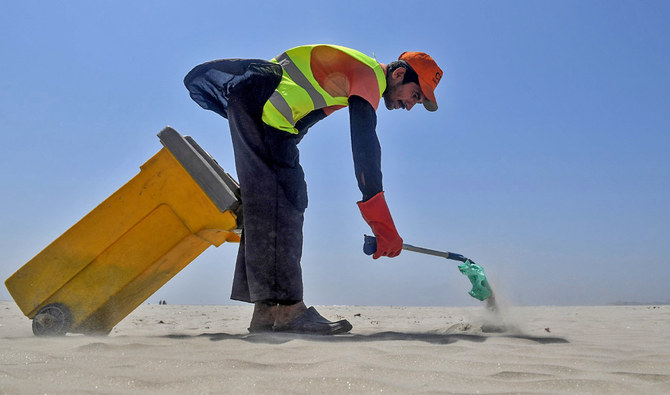
A worker of Cantonment Board Clifton (CBC) collects plastic and other waste from the Clifton beach in Karachi on September 19, 2019. (AFP/File)
Short Url
Updated 05 June 2023
Follow

On World Environment Day, Pakistan PM stresses need to combat plastic pollution

  • With 70% of plastic waste being improperly disposed of, Sharif says Pakistan recognizes the need for urgent action 
  • Climate Change Minister Sherry Rehman says plastic pollution was projected to triple by 2060, if no action was taken

ISLAMABAD: Prime Minister Shehbaz Sharif on Monday expressed Pakistan’s unwavering commitment to combat plastic pollution on the occasion of World Environment Day, amid global efforts to sustain a liveable planet. 

The World Environment Day, which is annually observed on June 5, encourages awareness and action for the protection of environment. Supported by government entities, non-governmental organizations and businesses, it represents the primary United Nations outreach day supporting the environment. This year, the day is being celebrated under the theme #BeatPlasticPollution. 

Pakistan, a nation of more than 220 million, ranks among countries most vulnerable to climate change. The South Asian country last year witnessed disastrous floods that killed more than 1,700 people, affected 33 million Pakistanis and caused more than $30 billion losses. 

In his message on the occasion, PM Sharif said his government recognized the urgent need to reduce plastics and had taken several steps to put Pakistan on a path to sustainable use of resources. 

“With an estimated 70 percent of plastic waste being improperly disposed of, Pakistan recognizes the urgent need for action. The government has prioritized the adoption of environment-friendly alternatives and is actively working on the Plastics Prohibition Regulation 2023 for ICT (Islamabad Capital Territory),” Sharif said in a statement. 

“This regulation will establish a comprehensive framework and timeline for phasing out single-use plastics, while also leading by example on a plan to reduce and then ban the use of single-use plastics by the entire federal government.” 

The prime minister urged citizens, businesses, civil society organizations and the media to renew their commitment in fight against plastic pollution and preserving the planet’s biodiversity for future generations. He emphasized the importance of empowering local communities, supporting recycling initiatives, and promoting a circular economy that minimizes such waste. 

Pakistan’s Minister for Climate Change Senator Sherry Rehman said the consequences of plastic pollution were intense and long-term as it irreversibly damaged the environment and threatened the very fabric of life on earth. 

She urged for immediate action against plastic pollution that was projected to triple by 2060, sharing a 7Rs action agenda that stood for reduce, redesign, reuse, recycle, responsibility, research and resource. 

Sherry Rehman highlighted Pakistan’s commitment to promoting a sustainable circular economy for plastics by reducing waste, consumption, and encouraging reuse, recycling, and material recovery. 

The Minister stressed the need for an incentive-driven approach to encourage consumers to change their plastic consumption habits. 


Pakistan urges diplomacy on Iran nuclear issue, warns sanctions would hurt civilians

Updated 10 sec ago
Follow

Pakistan urges diplomacy on Iran nuclear issue, warns sanctions would hurt civilians

  • Pakistan warns the situation has become more complex since Israel’s attack on Iran and US bombing of nuclear sites
  • It cautions against invoking the snapback mechanism, saying sanctions will further deepen mistrust, derail diplomacy

ISLAMABAD: Pakistan demanded on Tuesday that diplomacy be given a chance in addressing all issues related to Iran’s nuclear program, warning the United Nations Security Council that sanctions would hurt ordinary Iranians, as tensions remain heightened following this year’s war between Israel and Iran.

Pakistan’s comments came amid renewed debate at the Security Council over Iran’s nuclear program and the future of the Joint Comprehensive Plan of Action (JCPOA), which sought to limit Tehran’s nuclear activities in exchange for sanctions relief.

The conflict in June was dubbed the Twelve-Day War and erupted after Israel carried out a surprise attack on Iranian military and nuclear facilities while international diplomacy was still underway. The strikes derailed negotiations, with the United States later bombing Iranian nuclear sites and declaring that the attacks had substantially degraded Iran’s nuclear capabilities.

Addressing the Security Council, Pakistan’s Acting Permanent Representative Ambassador Usman Jadoon said Islamabad believed that “diplomacy and dialogue should be the guiding principles for the resolution of all outstanding issues concerning Iran’s nuclear program in accordance with the rights, obligations and responsibilities of the parties concerned.”

“Coercive measures would not help in bringing the parties closer and only exacerbate the trust deficit,” he said. “Sanctions directly hurt ordinary people the most, impact trade, affect economic development and diminish the prospects of regional connectivity.”

Jadoon said the council last met on the issue in September following developments related to the JCPOA’s “snapback” mechanism — a provision that allows the automatic re-imposition of UN sanctions on Iran in cases of alleged non-compliance — adding that Pakistan opposed what it viewed as a rushed move and cautioned against hasty action.

He said Pakistan’s stance was grounded in the belief that disputes over Iran’s nuclear program should be resolved through dialogue, with more time allowed for diplomacy to succeed, while preserving the JCPOA framework until a successor arrangement is reached.

The ambassador said divisions within the council had widened in recent months, further complicating efforts to resolve the issue.

While acknowledging that the JCPOA was not implemented as intended, Jadoon said the agreement had nonetheless provided an essential framework rooted in international law and mutual respect, and could still prove useful if there was a shared willingness to move forward in a spirit of compromise.

He stressed the need to revive the agreement’s underlying principles and restore trust in diplomatic engagement that had been damaged in recent months, urging all parties to avoid confrontation and work toward a solution-oriented approach.