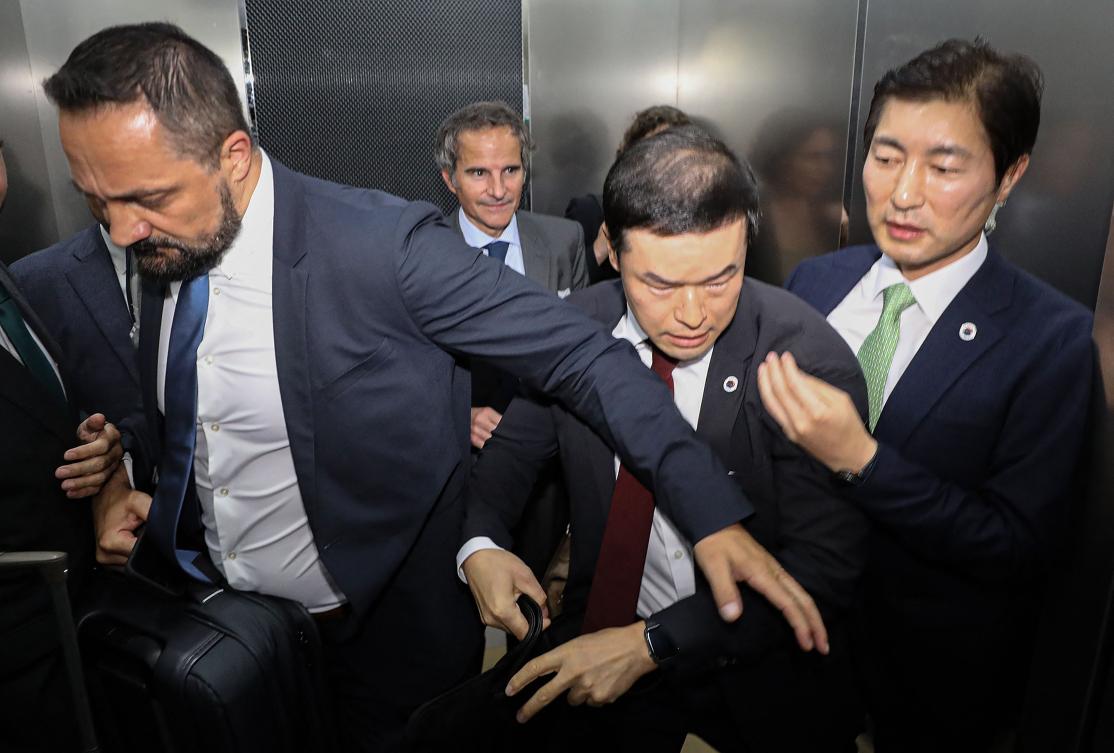
SEOUL: The head of the United Nations’ nuclear watchdog will meet South Korea’s foreign minister and a top nuclear safety official on Saturday as part of a bid to calm fears over Japan’s plan to discharge treated radioactive water from its tsunami-hit Fukushima plant.
Rafael Grossi, director general of the International Atomic Energy Agency (IAEA), arrived in South Korea on Friday after wrapping up a trip to Japan, during which the watchdog approved the plan to release wastewater from the Fukushima nuclear facility into the ocean.
His arrival was met with protesters at Seoul’s Gimpo Airport, local media reported.
No expert behind the IAEA’s Fukushima report disagreed with the content, Grossi told news agency Yonhap on Saturday, hinting at his comment during an interview with Reuters one day earlier.
Prior to that, Grossi said during a Friday press conference in Japan that he wanted to also meet with the opposition party in South Korea which has been critical of the discharge plan.
South Korea’s government said on Friday it respected the IAEA’s report and that its own analysis had found the release will not have “any meaningful impact” on its waters.
The administration of President Yoo Suk Yeol has walked a fine line in its stance to Japan’s discharge proposal, as it tries to improve ties with Tokyo. But the plan has stirred anger and concern among South Koreans, prompting some shoppers to buy up sea salt.
Despite South Korea’s assent for the plan, a ban on food and seafood products from the Fukushima region would remain in place.
Opposition Democratic Party leader Lee Jae-myung has also said the government should try to halt the plan and take the case to the International Tribunal for the Law of the Sea.
IAEA chief in South Korea to allay Fukushima water dump concerns
https://arab.news/7m38k
IAEA chief in South Korea to allay Fukushima water dump concerns
- Nuclear watchdog approved plan to release wastewater from the Fukushima nuclear facility into the ocean
- But the plan has stirred anger and concern among South Koreans, prompting some shoppers to buy up sea salt
Two high-speed trains derail in Spain, broadcaster reports seven people killed
- The accident happened near Adamuz, which is near Cordoba
MADRID: Two high-speed trains derailed on Sunday in southern Spain, the rail network operator said, and state-run television channel RTVE said seven people had died, citing police sources.
The accident happened near Adamuz, in Cordoba province. Seven people have been confirmed dead by police, RTVE said, adding that 100 people have been injured, 25 seriously.
Spanish police did not immediately respond to request for comment from Reuters.
“The Iryo 6189 Malaga — (to Madrid) train has derailed from the track at Adamuz, crashing onto the adjacent track. The (Madrid) to Huelva train which was traveling on the adjacent track has also derailed,” said Adif, which runs the rail network, in a social media post.
Adif said the accident happened at 6:40 p.m. (1740 GMT), about ten minutes after the Iryo train left Cordoba heading toward Madrid.
Iryo is a private rail operator, majority-owned by Italian state-controlled railway group Ferrovie dello Stato. The train involved was a Freccia 1000 train which was traveling between Malaga and Madrid, a spokesperson for Ferrovie dello Stato said.
Iryo did not immediately respond to a request for comment.
Adif has suspended all rail services between Madrid and Andalusia.
Andalusia emergency services said on social media that all rail traffic had been halted and emergency services were on their way, including at least nine ambulances and emergency support vehicles.
CALLS FOR MEDICS
A woman named Carmen posted on X that she had been on board the Iryo to Madrid. “Ten minutes after departing (from Cordoba) the train started to shake a lot, and it derailed from coach 6 behind us. The lights went out.”
Footage posted by another Iryo train passenger, also on X, showed an Iryo staffer in a fluorescent jacket instructing passengers to remain in their seats in the darkened carriages, and those with first aid training to keep watch over fellow passengers.
The staffer told passengers they would be evacuated when it was safe to leave, but at that moment the safest place was on the train. He also urged people to maintain mobile phone batteries to be able to use their torches when they disembarked.
The passenger wrote: “In our carriage we’re well but we don’t know about the other carriages. There’s smoke and they’re calling for a doctor.”
The regional government has activated emergency protocols to mobilize more resources to the accident site. Locals posted on social media that a building would be set up in the village nearest the crash for evacuated passengers to be taken to.
Salvador Jimenez, a journalist for RTVE who was on board the Iryo train, shared images showing the nose of the rear carriage of the train lying on its side, with evacuated passengers sitting on the side of the carriage facing upwards.
Jimenez told TVE by phone from beside the stricken trains that passengers had used emergency hammers to smash the windows and climb out, and they had seen two people taken out of the overturned carriages on stretchers.
“There’s a certain uncertainty about when we’ll get to Madrid, where we’ll spend the night, we’ve had no message from the train company yet,” he said. “It’s very cold but here we are.”