

Etidal, Telegram remove 7m extremist posts online

Etidal and Telegram have together removed 28,233,979 extremist online items and closed 10,218 channels since February 2022. (Supplied)
Short Url
Updated 04 July 2023
Follow

Etidal, Telegram remove 7m extremist posts online

  • April 18 witnessed the highest activity of extremist content on Telegram

DUBAI: The Global Center for Combating Extremist Ideology, Etidal, and messaging platform Telegram, together removed more than 7 million online items of extremist content and shut down 1,554 extremist channels between April and June.

Etidal’s team monitored digital content broadcast in Arabic by three terrorist organizations: Al-Qaeda, Hayat Tahrir Al-Sham and Daesh.
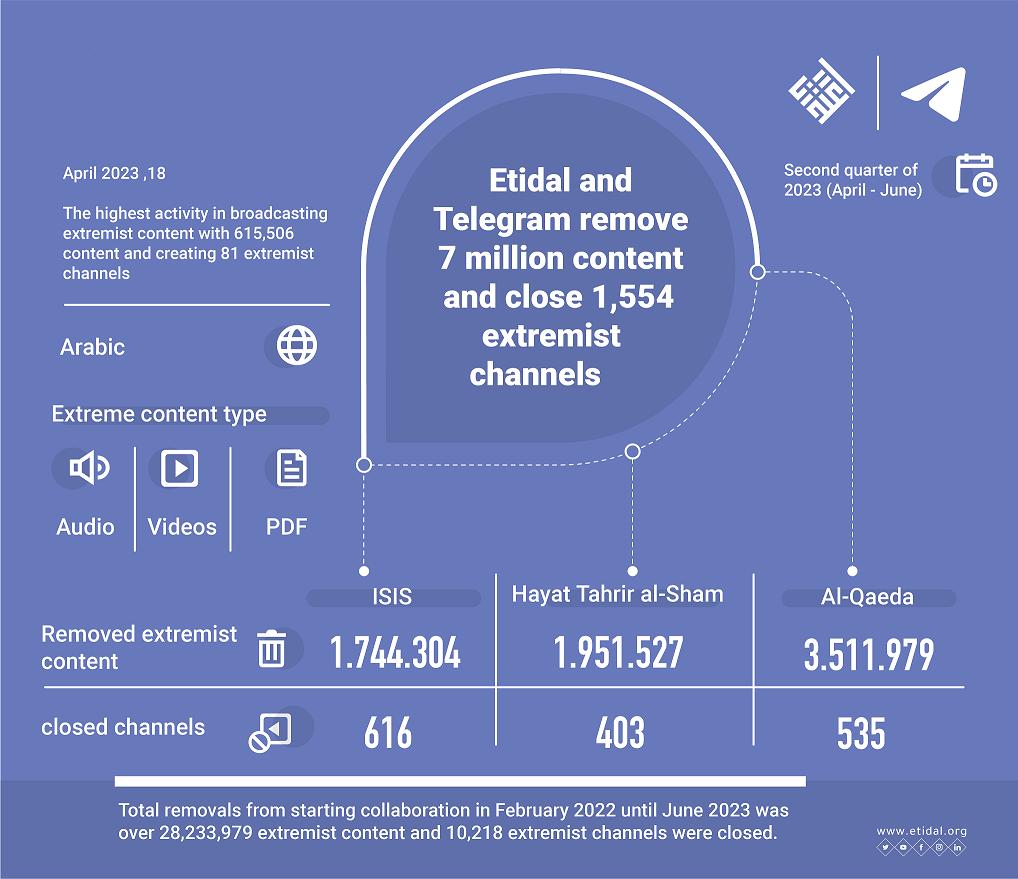
The majority of the removed content was posted by Al-Qaeda (3,511,979 pieces of content across 535 extremist channels), followed by Hayat Tahrir Al-Sham (1,951,527 pieces of content across 403 extremist channels) and Daesh (1,744,304 pieces of content across 616 channels).

This quarter marked a period of intense activity in terms of broadcasting extremist content for Al-Qaeda for the first time since February 2022.

April 18 witnessed the highest activity with 615,506 extremist items posted and 81 extremist channels established.

Etidal has been collaborating with Telegram since February 2022 to prevent and counter terrorism and violent extremism by reviewing online content posted in Arabic. During this time, the two organizations have together removed 28,233,979 extremist online items and closed 10,218 channels.


WhatsApp says Russia ‘attempted to fully block’ app

Updated 12 February 2026
Follow

WhatsApp says Russia ‘attempted to fully block’ app

  • Moscow has been trying to nudge Russians to use a more tightly controlled domestic online service

SAN FRANCISCO, United States: WhatsApp said Wednesday that Russia “attempted to fully block” the messaging app in the country to push users to a competing state-controlled service, potentially affecting 100 million people.
Moscow has been trying to nudge Russians to use a more tightly controlled domestic online service.
It has threatened a host of Internet platforms with forced slowdowns or outright bans if they do not comply with Russian laws, including those requiring data on Russian users to be stored inside the country.
“Today the Russian government attempted to fully block WhatsApp in an effort to drive people to a state-owned surveillance app,” WhatsApp posted on X.
“Trying to isolate over 100 million users from private and secure communication is a backwards step and can only lead to less safety for people in Russia,” WhatsApp added.
“We continue to do everything we can to keep users connected.”
Critics and rights campaigners say the Russian restrictions are a transparent attempt by the Kremlin to ramp up control and surveillance over Internet use in Russia, amid a sweeping crackdown on dissent during the Ukraine offensive.
That latest developments came after Russia’s Internet watchdog said Tuesday it would slap “phased restrictions” on the Telegram messaging platform, which it said had not complied with the laws.