

UN to hold ‘urgent’ debate on incidents of Qur’an burning after Pakistan’s request

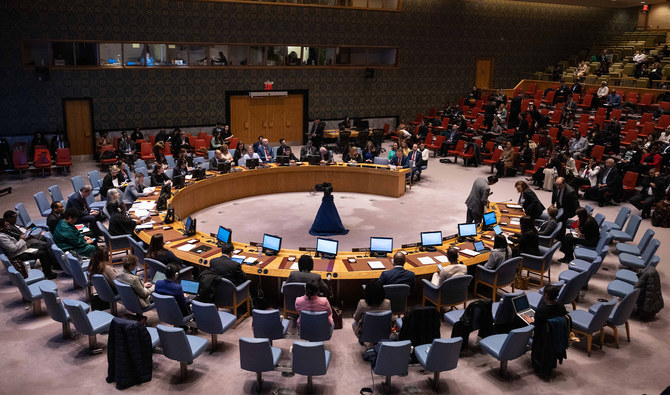
The UN Security Council holds a meeting at UN Headquarters in New York, US, on March 7, 2023. (AFP/File)
Short Url
Updated 04 July 2023
Follow

UN to hold ‘urgent’ debate on incidents of Qur’an burning after Pakistan’s request

  • Pakistan, on behalf of some members of the Organization of Islamic Cooperation, made the request to hold the debate  
  • UN Human Rights Council will hold the debate to discuss an alarming rise in ‘premeditated, public acts of religious hatred’ 

ISLAMABAD: The United Nations Human Rights Council (UNHRC) has decided to hold an “urgent” session to discuss desecration of the Holy Qur’an, a UN spokesperson said Tuesday, days after a copy of the holy book was burnt in the Swedish capital of Stockholm. 

Salwan Momika, 37, a refugee from Iraq, last week desecrated the Qur’an and set fire to its pages in front of Stockholm’s largest mosque. The act, coming during the major Muslim holiday of Eid Al-Adha, drew widespread condemnation in the Muslim world.  

Countries throughout the Middle East and beyond denounced the burning, some recalled their ambassadors, and foreign ministries summoned the Swedish ambassadors to their countries to hear official protests.  

Following the incident, the European Union also condemned the incident, terming it “offensive,” “disrespectful” and an “act of provocation.” 

“Following a request received by Pakistan yesterday evening, the United Nations Human Rights Council will hold an urgent debate to ‘discuss the alarming rise in premeditated and public acts of religious hatred, as manifested by the current desecration of the holy Qur’an in some European and other countries’,” UNHRC spokesperson Pascal Sim said at a press briefing. 

“The urgent debate will most likely be convened this week at a date and time to be determined by the bureau of the Human Rights Council that is meeting today.” 

Pakistan had requested for the debate on behalf of several member countries of the Organization for Islamic Cooperation (OIC), including countries that were current members of the Human Rights Council, he added.  

In an extraordinary meeting in Saudi Arabia over the weekend, the 57-state OIC also called for collective measures to prevent acts of desecration of the Holy Qur’an, saying international law should be used to stop religious hatred.  

On Monday, Pakistani Prime Minister Shehbaz Sharif said the Pakistani nation fully condemned the “disgusting” incident that took place in Sweden. 

“It is our demand [from the Swedish government] to initiate action against those involved in the crime,” he said, addressing a federal cabinet meeting in Islamabad.  

“Unfortunately, this is not the first incident, such heart-wrenching incidents took place in the past as well. The Pakistani government endorses the OIC decision and hopes that the recurrence of such incident is avoided.” 


Pakistan PM calls for faster CPEC implementation, pledges security for Chinese workers

Updated 27 February 2026
Follow

Pakistan PM calls for faster CPEC implementation, pledges security for Chinese workers

  • Shehbaz Sharif pushes expanded cooperation in agriculture, IT and mining under CPEC phase two
  • Chinese envoy reaffirms Beijing’s support for Pakistan’s sovereignty and economic development

ISLAMABAD: Prime Minister Shehbaz Sharif on Friday called for speeding up projects under the China-Pakistan Economic Corridor (CPEC) and pledged stronger security guarantees for Chinese workers and investments, during a meeting with China’s ambassador in Islamabad.

Sharif made the remarks as the two countries strive to launch the second phase of CPEC, a multibillion-dollar infrastructure and energy initiative launched in 2015 as part of China’s Belt and Road Initiative (BRI).

CPEC’s first phase focused largely on power generation and transport infrastructure aimed at easing Pakistan’s chronic energy shortages and improving connectivity. The second phase seeks to expand cooperation into industrial development, with an emphasis on special economic zones and export-oriented growth.

“While highlighting the importance of accelerating ongoing CPEC projects, the Prime Minister stressed on the need to enhance cooperation in agriculture and IT and mining & minerals,” said a statement circulated by the PM Office after the meeting.

“He also underscored Pakistan’s resolve to provide a secure and conducive environment for Chinese personnel, investments, and institutions in Pakistan,” it added.

Chinese nationals and projects in Pakistan have faced security threats in the past, including attacks by militant groups targeting infrastructure sites and convoys. Islamabad has repeatedly vowed to tighten security and has deployed special protection units for Chinese workers.

China is Pakistan’s closest ally in the region and a key economic partner, with CPEC widely regarded by Islamabad as central to long-term economic growth.

During the meeting, the prime minister conveyed greetings to Chinese President Xi Jinping and Premier Li Qiang, particularly on the occasion of the Chinese New Year.

China’s Ambassador to Pakistan, Jiang Zaidong, reiterated Beijing’s support for Pakistan’s sovereignty and socioeconomic development, according to the statement. Both sides also exchanged views on regional and international issues and agreed to maintain close coordination.