

EU rejects Qur’an burning in Sweden

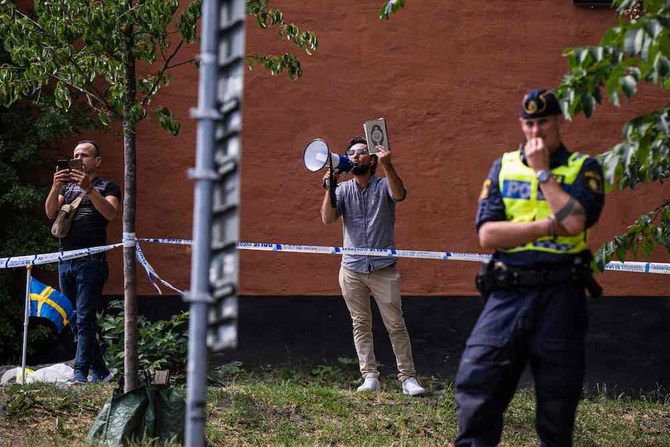
Salwan Momika, who fled from Iraq to Sweden several years ago, earlier this week stomped on the Qur’an before setting several pages alight in front of the mosque in Stockholm. (AFP)
Short Url
Updated 01 July 2023
Follow

EU rejects Qur’an burning in Sweden

  • EU: Manifestations of racism, xenophobia and related intolerance have no place in Europe

DUBAI: The European Union has expressed its “strong rejection” of the Qur’an burning in Sweden, and called the act “offensive, and disrespectful and a clear act of provocation.”

“This act in no way reflects the opinions of the European Union… Manifestations of racism, xenophobia and related intolerance have no place in Europe,” a statement from the bloc said.

The group’s statement added that the Qur’an burning was made even more deplorable at a time when Muslims were celebrating Eid Al-Adha.

“The EU continues to stand up for freedom of religion or belief and freedom of expression, abroad and at home. Now is the time to stand together for mutual understanding and respect and to prevent any further escalation,” the EU said.

The bloc also noted that it was following developments in Iraq closely as thousands of protesters have converged in front of the Swedish embassy in Baghdad on Friday to demand an end to diplomatic ties with Stockholm.

Salwan Momika, who fled from Iraq to Sweden several years ago, earlier this week stomped on the Qur’an before setting several pages alight in front of the mosque in Stockholm.

Police had granted him a permit for the protest in line with free-speech protections, but was charged for “agitation against an ethnic group.”

His action has drawn widespread condemnation from the Muslim and Arab world, with recalling their envoys and foreign ministries summoning Swedish ambassadors demanding explanation as well as airing their objections.

The Organization of Islamic Cooperation has called an emergency meeting of its executive committee to discuss the consequences of the burning of a copy of the Qur’an in Sweden.


Rubio says new governance bodies for Gaza will be in place soon

Updated 20 December 2025
Follow

Rubio says new governance bodies for Gaza will be in place soon

  • Rubio said progress had been made recently in identifying Palestinians to join the technocratic group and that Washington aimed to get the governance bodies in place “very soon,” without offering a specific timeline.

WASHINGTON: US Secretary of State Marco Rubio said that a ​new governance structure for Gaza — made up of an international board and a group of Palestinian technocrats — would be in place soon, followed by the deployment of foreign troops, as the US hopes to cement a fragile ceasefire in Israel’s war in the Palestinian enclave. 
Rubio, speaking at a year-end news conference, said the status quo was not sustainable in Gaza, where Israel has continued to strike Hamas targets while the group has reasserted its control since the October peace agreement ‌brokered by the US.
“That’s why we have a sense of ‌urgency about ​bringing ‌phase one to its full completion, which is the establishment of the Board of Peace, and the establishment of the Palestinian technocratic authority or organization that’s going to be on the ground, and then the stabilization force comes closely thereafter,” Rubio said.
Rubio said progress had been made recently in identifying Palestinians to join the technocratic group and that Washington aimed to get the governance bodies in place “very soon,” without offering a specific timeline. Rubio was speaking after the US Central Command hosted a conference in Doha this week with partner nations to plan ‌the International Stabilization Force for Gaza. 
Two US officials said last week that international troops could be deployed in the strip as early as next month, following the UN Security Council’s November vote to authorize the force.
It remains unclear how Hamas will be disarmed, and countries considering contributing troops to the ISF are wary that Hamas will engage their soldiers in combat.
Rubio did not specify who would be responsible for disarming Hamas and conceded that countries contributing troops want to know the ISF’s specific mandate and how it will be funded. 
“I think ⁠we owe them a few more answers before we can ask anybody to commit firmly, but I feel very confident that we have a number of nation states acceptable to all sides in this who are willing to step forward and be a part of that stabilization force,” Rubio said, noting that Pakistan was among the countries that had expressed interest.
Establishing security and governance was key to securing donor funding for reconstruction in Gaza, Rubio added.
“Who’s going to pledge billions of dollars to build things that are going to get blown up again because a war starts?” Rubio said, discussing the possibility of a donor conference to raise reconstruction funds. 
“They want to know ‌who’s in charge, and they want to know that there’s security so and that there’ll be long term stability.”