

Bangladesh summons Swedish envoy over Qur’an burning in Stockholm 

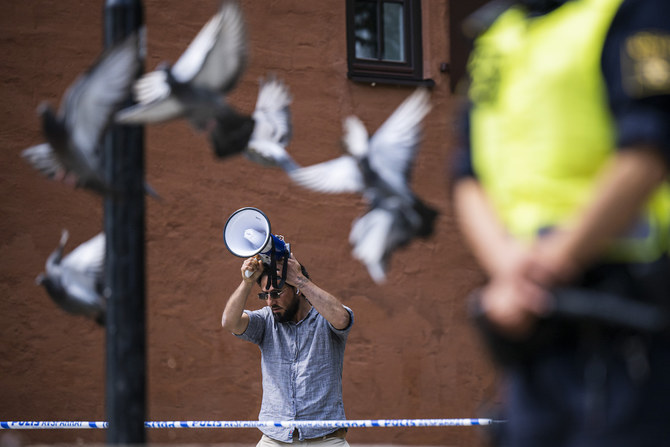
Salwan Momika protests outside a mosque in Stockholm on June 28, 2023, during the Eid Al-Adha holiday. (AFP)
Short Url
Updated 02 July 2023
Follow

Bangladesh summons Swedish envoy over Qur’an burning in Stockholm 

  • Bangladesh is first country in Asia to summon Swedish envoy over Qur’an incident 
  • Ministry of Foreign Affairs earlier said the burning was heinous, despicable act 

DHAKA: Bangladesh summoned the chargé d’affaires of the Swedish Embassy in Dhaka on Sunday to protest against the burning of a copy of the Qur’an in Stockholm amid widespread international condemnation over the incident. 

The burning of the Qur’an outside a mosque in Sweden during Eid Al-Adha sparked outrage in many Muslim countries and condemnations of the Swedish authorities. 

As acts and statements of protest swept the Muslim world, Bangladesh on Sunday became the first country in Asia to summon the Swedish envoy to protest the “despicable act.” 

In a statement issued on Thursday, the Ministry of Foreign Affairs urged an end to “unwarranted provocations for the sake of harmony and peaceful coexistence.” 

The ministry said: “Bangladesh expresses grave concern over such (a) heinous act of insulting the sacred values and religious symbols of … Muslims in the name of ‘freedom of expression.’” 

As Muslims celebrated Eid Al-Adha, one of the most important holidays in the Islamic calendar, a man identified as a refugee from Iraq tore up pages of the Qur’an on Wednesday and set it on fire in front of Stockholm’s largest mosque. 

The recent incident in Stockholm and Dhaka’s subsequent summon of the Swedish envoy is unlikely to impact bilateral relations, experts said. 

“It’s a religious issue that touches all the Muslims of the country. Any sort of disrespect to the holy Qur’an creates emotional sentiment among Muslims around the world. It’s a very emotional and sensitive issue for us,” Humayun Kabir, Bangladesh’s former ambassador to the US, told Arab News. 

“I think summoning the chargé d’affaires was a good approach … I don’t think this summon issue will impact much on the bilateral relations between the two countries since they (Sweden) also understand it’s an emotional issue for us.” 

For Bangladesh, development cooperation has been a “cornerstone” of its relations with Sweden, while the European country has said the South Asian nation is an “important and growing Swedish trade partner,” with steady growth in the sector.

Bangladesh is one of the largest Muslim-majority countries in the world, with over 150 million people professing Islam, making up over 91 percent of its total population. 

Touhid Hossain, former foreign secretary at the Bangladeshi Ministry of Foreign Affairs, highlighted how Bangladesh is not alone in protesting the Qur’an burning in Sweden. 

“We are not alone. Many Muslim countries expressed reactions to this issue. Not all Muslim countries but many,” Hossain told Arab News. 

“The government should work in line with the sentiment of its people. Maybe people don’t come out onto the streets in protest, but everyone is unhappy. There is no doubt about it. So, the government took this initiative as a part of its responsibility,” he said. 

“There is no logic to justify this sort of incident by saying ‘freedom of expression.’ It’s a hate crime. Hate can’t be a freedom of expression.” 


Only 4% women on ballot as Bangladesh prepares for post-Hasina vote

Updated 26 January 2026
Follow

Only 4% women on ballot as Bangladesh prepares for post-Hasina vote

  • Women PMs have ruled Bangladesh for over half of its independent history
  • For 2026 vote, only 20 out of 51 political parties nominated female candidates

DHAKA: As Bangladesh prepares for the first election since the ouster of its long-serving ex-prime minister Sheikh Hasina, only 4 percent of the registered candidates are women, as more than half of the political parties did not field female candidates.

The vote on Feb. 12 will bring in new leadership after an 18-month rule of the caretaker administration that took control following the student-led uprising that ended 15 years in power of Hasina’s Awami League party.

Nearly 128 million Bangladeshis will head to the polls, but while more than 62 million of them are women, the percentage of female candidates in the race is incomparably lower, despite last year’s consensus reached by political parties to have at least 5 percent women on their lists.

According to the Election Commission, among 1,981 candidates only 81 are women, in a country that in its 54 years of independence had for 32 years been led by women prime ministers — Hasina and her late rival Khaleda Zia.

According to Dr. Rasheda Rawnak Khan from the Department of Anthropology at Dhaka University, women’s political participation was neither reflected by the rule of Hasina nor Zia.

“Bangladesh has had women rulers, not women’s rule,” Khan told Arab News. “The structure of party politics in Bangladesh is deeply patriarchal.”

Only 20 out of 51 political parties nominated female candidates for the 2026 vote. Percentage-wise, the Bangladesh Socialist Party was leading with nine women, or 34 percent of its candidates.

The election’s main contender, the Bangladesh Nationalist Party, whose former leader Zia in 1991 became the second woman prime minister of a predominantly Muslim nation — after Pakistan’s Benazir Bhutto — was the party that last year put forward the 5 percent quota for women.

For the upcoming vote, however, it ended up nominating only 10 women, or 3.5 percent of its 288 candidates.

The second-largest party, Jamaat-e-Islami, has not nominated a single woman.

The 4 percent participation is lower than in the previous election in 2024, when it was slightly above 5 percent, but there was no decreasing trend. In 2019, the rate was 5.9 percent, and 4 percent in 2014.

“We have not seen any independent women’s political movement or institutional activities earlier, from where women could now participate in the election independently,” Khan said.

“Real political participation is different and difficult as well in this patriarchal society, where we need to establish internal party democracy, protection from political violence, ensure direct election, and cultural shifts around female leadership.”

While the 2024 student-led uprising featured a prominent presence of women activists, Election Commission data shows that this has not translated into their political participation, with very few women contesting the upcoming polls.

“In the student movement, women were recruited because they were useful, presentable for rallies and protests both on campus and in the field of political legitimacy. Women were kept at the forefront for exhibiting some sort of ‘inclusive’ images to the media and the people,” Khan said.

“To become a candidate in the general election, one needs to have a powerful mentor, money, muscle power, control over party people, activists, and locals. Within the male-dominated networks, it’s very difficult for women to get all these things.”