Cambodia’s Hun Sen kicks off campaign for virtually unopposed election

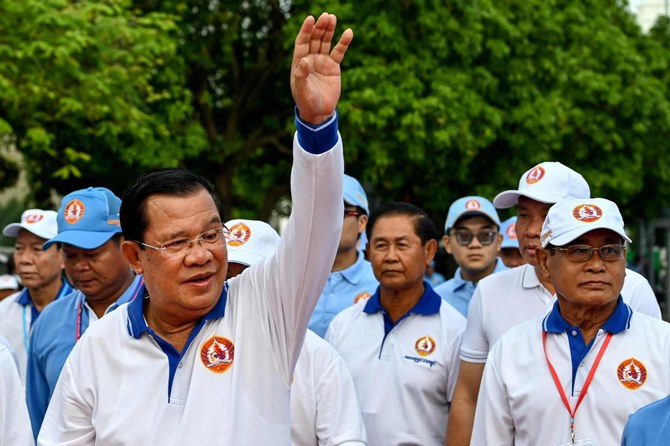
Cambodia’s prime minister Hun Sen, left, is running unopposed after the main opposition party was prevented from running. (AFP)
Short Url
Updated 01 July 2023
Follow

Cambodia’s Hun Sen kicks off campaign for virtually unopposed election

  • Strongman has ruled the Southeast Asian nation of 16 million for four decades
  • The main opposition party was dissolved in 2017 over an alleged coup attempt

PHNOM PENH: Cambodian Prime Minister Hun Sen on Saturday commenced his ruling party’s campaign for an election later this month – a poll that has been criticized as a sham after the main opposition party was prevented from running.
The 70-year-old strongman, who has ruled the Southeast Asian nation of 16 million for four decades, spoke before a crowd in the capital of Phnom Penh. He stood beside his son Hun Manet, who is also a candidate in the polls and widely tipped as his successor.
Hun Sen said his Cambodian People’s Party (CPP) has ensured peace, socio-economic development and the strengthening of democracy, adding that rights and freedoms were being respected.
But he also warned that any attempts to incite “social disorder” or rebellion would be put down.
Other than the CPP, only small parties with little funding or popularity will be standing in the July 23 election.
The main opposition party was dissolved in 2017 over an alleged coup attempt, with scores of its members imprisoned. A party formed from its remnants was barred in May over a paperwork discrepancy.
Hun Sen also recently ordered Cambodia’s parliament to revise the law so that anyone who does not vote will be barred from contesting any future elections.
Prominent opposition figure Sam Rainsy has labelled the election a sham. The US has said it is “deeply troubled” by the “undemocratic actions” ahead of the polls and will not send official observers to attend an electoral process “many independent Cambodian and international experts assess is neither free nor fair.”
This week Hun Sen quit Facebook for Telegram. Meta’s oversight board said on Thursday he should be suspended for six months for a post in which he said people who accused the CPP of buying votes in a previous election could face a beating from CPP supporters.
The Ministry of Post and Telecommunications said late Friday they would deport a Meta representative and Cambodia would cease all cooperation with the company, attributing the move to an abundance of fake accounts, data risks, and lack of transparency.
Hun Sen has made no comment on the Meta case. Government spokesperson Phay Siphan on Thursday denied knowledge of the case and said the switch to Telegram was made because it was easier to use and could reach more people.
A Meta representative declined to comment.
During Hun Sen’s rule – one of the world’s longest premierships – political rivals have been jailed or exiled, critical media outlets shuttered and civil dissent crushed.
In recent months he has hinted that he will hand power to Hun Manet, deputy commander-in-chief of the Royal Cambodian Armed Forces and a graduate of the United States Military Academy at West Point.


EU leaders to reassess US ties despite Trump U-turn on Greenland

Updated 55 min 3 sec ago
Follow

EU leaders to reassess US ties despite Trump U-turn on Greenland

  • Diplomats stressed that, although Thursday’s emergency EU talks in Brussels would now lose some of their urgency, the longer-term issue of how to handle the relationship with the US remained

BRUSSELS: EU leaders will rethink their ties with the US at an emergency summit on Thursday after Donald Trump’s threat of tariffs and even military action to ​acquire Greenland badly shook confidence in the transatlantic relationship, diplomats said.
Trump abruptly stepped back on Wednesday from his threat of tariffs on eight European nations, ruled out using force to take Greenland, a semi-autonomous territory of NATO ally Denmark, and suggested a deal was in sight to end the dispute.
German Chancellor Friedrich Merz, welcoming Trump’s U-turn on Greenland, urged Europeans not to be too quick to write off the transatlantic partnership.
But EU governments remain wary of another change of mind by a mercurial president who is increasingly seen as a bully that Europe will have to stand up to, and they are focused on coming up with a longer-term plan on how to deal with the ‌United States under this ‌administration and possibly its successors too.
“Trump crossed the Rubicon. He might do ‌it ⁠again. ​There is no ‌going back to what it was. And leaders will discuss it,” one EU diplomat said, adding that the bloc needed to move away from its heavy reliance on the US in many areas.
“We need to try to keep him (Trump) close while working on becoming more independent from the US It is a process, probably a long one,” the diplomat said.
EU RELIANCE ON US
After decades of relying on the United States for defense within the NATO alliance, the EU lacks the needed intelligence, transport, missile defense and production capabilities to defend itself against a possible Russian attack. This gives the US substantial leverage.
The US ⁠is also Europe’s biggest trading partner, making the EU vulnerable to Trump’s policies of imposing tariffs to reduce Washington’s trade deficit in goods, and, as in ‌the case of Greenland, to achieve other goals.
“We need to discuss where ‍the red lines are, how we deal with this bully ‍across the Atlantic, where our strengths are,” a second EU diplomat said.
“Trump says no tariffs today, but does ‍that mean also no tariffs tomorrow, or will he again quickly change his mind? We need to discuss what to do then,” the second diplomat said.
The EU had been considering a package of retaliatory tariffs on 93 billion euros ($108.74 billion) on US imports or anti-coercive measures if Trump had gone ahead with his own tariffs, while knowing such a step would harm Europe’s economy as well ​as the United States.
WHAT’S THE GREENLAND DEAL?
Several diplomats noted there were still few details of the new plan for Greenland, agreed between Trump and NATO Secretary General Mark Rutte late on ⁠Wednesday on the sidelines of the World Economic Forum in Davos, Switzerland.
“Nothing much changed. We still need to see details of the Greenland deal. We are a bit fed up with all the bullying. And we need to act on a few things: more resiliency, unity, get our things together on internal market, competitiveness. And no more accepting tariff bullying,” a third diplomat said.
Rutte told Reuters in an interview in Davos on Thursday that under the framework deal he reached with Trump the Western allies would have to step up their presence in the Arctic.
He also said talks would continue between Denmark, Greenland and the US on specific issues.
Diplomats stressed that, although Thursday’s emergency EU talks in Brussels would now lose some of their urgency, the longer-term issue of how to handle the relationship with the US remained.
“The approach of a united front in solidarity with Denmark and Greenland while focusing on de-escalation and finding an off-ramp has worked,” a fourth EU diplomat said.
“At the ‌same time it would be good to reflect on the state of the relationship and how we want to shape this going forward, given the experiences of the past week (and year),” he said.