KARACHI: While many young Pakistanis are attempting to leave the country, some even risking their lives, in search of greener pastures amid the country’s deteriorating economic situation, Afaq Ahmed, a 71-year-old mechanical engineer, has landed a specialized job of a gas turbine operator in Australia, demonstrating that age is merely a number and that skills are what truly matters.
Finding a job abroad while applying from Pakistan is often an uphill task and people rarely get it if they are older in age. Most developed nations across the world hire foreigners to fill up the shortage of skills in certain occupations, with medicine, nursing, engineering, information and technology (IT) and architecture being the most prominent ones, according to a report by the US-based Society of Human Resource Management.
But Ahmed defied the age barrier and successfully secured the job as a gas turbine specialist in Australia.
“One of my friends, who was working in Australia, said that there were no gas turbine specialists there, so [I was invited to Australia by my friend] to help disassemble a turbine,” Ahmed told Arab News last week.
Ahmed, who has more than 45 years of experience in the field, said he disassembled the unit seamlessly, making his friend and the company “very happy” with the results.
The septuagenarian returned to Pakistan after completing the task, but the firm, Siemens Energy, once again invited him to Australia to reassemble the unit after a successful run of the gas turbine this year.
Impressed with his skills, the firm decided to offer Ahmed a permanent job and sent him an employment visa.
“They offered me a job related to the gas turbine and steam turbine and sent me the visa for the operation of a Mitsubishi steam turbine through Siemens Energy,” he said.
Adnan Paracha, a Pakistani overseas employment promotor, called it an “extraordinary case” as there were no overseas employment opportunities for people this age.
The maximum age limit for overseas workers in the Gulf and Europe is 40 years, while it is up to 47 years in Japan, according to Paracha.
“This is an extraordinary case and, in such cases, the companies offer employment mainly for consultancy only when they need highly skilled and specialized professionals,” he told Arab News.
“In this case the company has ignored age factor to meet its requirement otherwise this is the age at which people get retired in other countries.”
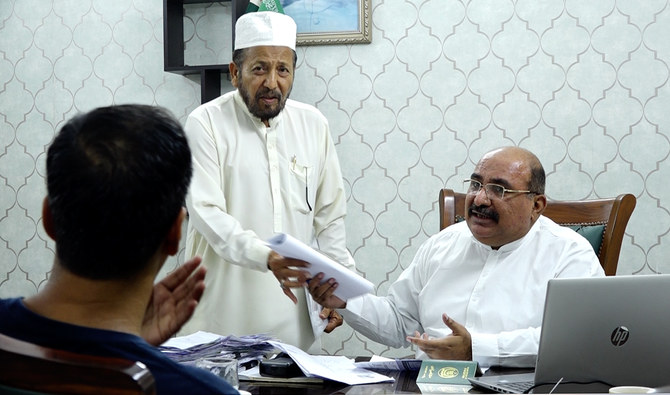
Arab News met Ahmed, who has previously worked with Siemens Westinghouse and spent 25 years working in Saudi Arabia, at the Protectorate of Emigrant Office in Karachi last week, where he had arrived to collect his protector, which the Pakistani government issues to citizens who have been offered employment abroad.
A protector helps a Pakistani open a bank account and ensures compensation by the government in case of death or disability while working abroad.
As many young Pakistanis have been desperate to leave the country and looking for employment abroad, Ahmed said there was no shortcut to success and Pakistanis should work hard and take their jobs “very seriously.”
“Pakistani people are very intelligent, but they don’t take interest [in their work],” he said. “The young generation, if they work hard and take their job very seriously, they can definitely get a job [abroad].”
To a question about employment opportunities in Pakistan, Ahmed said a lot of jobs existed in the power sector that could be availed by young Pakistanis.
“The power companies, the turbine companies, they always have jobs, and they always have problems to be solved. They need the [manpower] as they hardly get employees from Europe, Japan, America, or other countries,” he said.
“So, I think there is always a job. Even though I am very old, they [the Australian company] are calling me for the job.”
Ahmed is going to Australia at a time when Pakistan mourns the loss of hundreds of lives in a shipwreck near the Peloponnese peninsula off the coast of Greece on June 14. According to the government, about 350 Pakistanis were among more than 700 migrants aboard the ship, while only 12 citizens have been identified among the survivors.
These Pakistanis reportedly attempted to flee the adverse economic conditions at home, dreaming of a better life in Europe.


![]()

In rare stroke of luck, Pakistani septuagenarian lands specialized job in Australia
Short Url
https://arab.news/6umcf
In rare stroke of luck, Pakistani septuagenarian lands specialized job in Australia
- Afaq Ahmed, an engineer who specializes in gas and steam turbine operations, was recently hired by a multinational firm
- The 71-year old says job opportunities exist both in Pakistan and abroad, but only condition for young Pakistanis is hard work


Latest updates


Recommended


© 2026 SAUDI RESEARCH & PUBLISHING COMPANY, All Rights Reserved And subject to Terms of Use Agreement.